Why Is My AC Unit Fan Not Spinning? A Diagnostic Guide to Repair Options
August 17, 2026
In our years of providing AC repair and AC installation across the local area, our team has seen firsthand how unrelenting summer in South Florida can be, making options comparisons for homeowners critical the moment you realize your AC unit fan has stopped spinning. The heat index climbs, the indoor vents start blowing lukewarm air, and outside, the condenser unit hums ominously while the fan blades sit completely still. This is an urgent mechanical failure that places maximum thermal stress on your entire cooling system. The longer the system runs in this compromised state, the closer it gets to catastrophic failure.
Evaluating local service options quickly and accurately is the only way to restore your home's comfort before minor component wear cascades into irreversible system damage. When faced with a stalled fan, you need an objective framework to understand the root cause of the failure, weigh your potential repair solutions, and make a value-driven decision for your property. This diagnostic guide strips away the technical jargon to provide a clear, criteria-based look at why your condenser fan has failed and how to navigate the available options comparisons for homeowners.
If your outside AC fan is not spinning but you hear a humming or buzzing noise, our team strongly advises you to turn off your thermostat immediately. Leaving the system running without a functional fan can cause catastrophic, irreversible damage to the compressor.
Understanding the mechanical chain reaction of a stalled fan is the absolute first step in evaluating local service options effectively. The condenser fan plays a vital role in the refrigeration cycle. Its primary job is to pull ambient air across the condenser coils to dissipate the intense heat extracted from the inside of your home. When the fan stops spinning, that heat has nowhere to go. The system rapidly enters a dangerous state of thermal overload.
• Trapped Heat: Without airflow, the high-pressure refrigerant gas cannot condense back into a liquid, causing temperatures inside the outdoor unit to spike dramatically.
• Compressor Strain: The compressor, which acts as the heart of the HVAC system, continues to pump against extreme pressures and temperatures.
• Thermal Overload: Most modern compressors have an internal thermal overload switch that will trip to shut the system down. However, repeated cycling in this state will eventually cause the compressor windings to melt and short out.
• Complete Failure: A burnt-out compressor often requires a full system replacement, turning a manageable repair into a massive unexpected expense.
By shutting the system down at the thermostat the moment you notice the fan is stationary, you protect the compressor and preserve your ability to explore more affordable options comparisons for homeowners.
Once the system is safely powered down, the next step is identifying the specific component failure. Understanding what went wrong mechanically is an essential part of evaluating local service options when your system breaks down. In our daily AC repair service calls, we find there are several distinct reasons why your AC fan motor stops working, ranging from simple electrical faults to complete mechanical seizure.
The dual run capacitor is the most common culprit behind a stalled condenser fan. This cylindrical component acts like a powerful battery, storing energy to send a high-voltage jolt that jump-starts both the fan motor and the compressor. Capacitors are highly susceptible to heat degradation. Over time, the internal chemical composition breaks down, causing the capacitor to swell, leak, or simply lose its ability to hold a charge. If you hear a distinct "humming" or "buzzing" sound coming from the outside unit while the fan remains still, it usually indicates that the motor is receiving power but lacks the initial torque provided by the capacitor to begin rotating.
If the capacitor is functioning correctly but the fan still refuses to spin, the fan motor itself may have burnt out. Continuous strain, lack of lubrication, or operating with a weak capacitor forces the motor to draw higher amperage than it was designed to handle. This excess electrical current generates extreme heat, which eventually melts the protective insulation around the copper motor windings. Unlike a failed capacitor, which produces a humming noise, a completely dead fan motor will often be entirely silent, or it may feel exceptionally hot to the touch. Mechanical seizure can also occur if the motor bearings fail, locking the shaft in place.
Beyond the capacitor and the motor, other common issues include tripped circuit breakers and physical obstructions. A power surge or a locked rotor can cause the system to pull too much electricity, tripping the dedicated breaker at your electrical panel. Additionally, severe weather can blow twigs, dense leaves, or other debris into the condenser cabinet, physically jamming the fan blades and preventing rotation. Identifying these root causes is crucial for navigating options comparisons for homeowners effectively.
The environment in which your HVAC system operates plays a massive role in component longevity. Evaluating local service options requires understanding these unique environmental stressors. In our experience serving the local area and South Florida coastal regions, the combination of extreme heat, relentless humidity, and salt-laden air creates a highly corrosive atmosphere for electrical components.
Standard HVAC parts are tested against national averages, but coastal climates demand continuous, high-capacity cooling. The delta-T—the difference between the outdoor temperature and your desired indoor temperature—remains consistently wide for most of the year. This means your condenser fan runs for far more hours annually than a comparable unit in a milder climate. The continuous run-times place maximum thermal stress on the dual run capacitor and the fan motor bearings.
Furthermore, coastal humidity and salt air accelerate the oxidation of electrical contacts and the degradation of motor housings. According to ASHRAE equipment life expectancy standards, systems operating in high-demand, high-corrosion coastal environments often see a reduction in the average lifespan of standard electrical components. A capacitor that might last eight years in the Midwest may fail in three years under continuous South Florida thermal loads. Recognizing this accelerated wear and tear is vital when analyzing options comparisons for homeowners, as it shifts the math on long-term reliability.
When evaluating local service options, our team typically recommends determining whether a targeted component repair offers better long-term value than a broader system upgrade, such as a new AC installation or heat pump replacement. This objective, criteria-based evaluation framework strips away the marketing jargon to focus on core performance factors. Not every stalled fan requires a new air conditioner, but continually repairing an aging system can quickly become a bad investment.
Targeted repairs make the most financial sense when the system is relatively new and the failure is isolated. If a diagnostic test reveals a swollen dual run capacitor but the fan motor windings are still intact, replacing the capacitor is a highly cost-effective solution. Repair is the optimal path when the overall system efficiency remains high, the unit uses modern refrigerant, and the equipment is still covered by a manufacturer warranty. In these scenarios, restoring the failed component returns the system to peak operational health without unnecessary expenditure.
Conversely, replacing the motor or the entire condensing unit becomes necessary when you face repeated component failures indicating a deeper underlying issue. If a failing fan motor has been pulling excessive amperage for months, it may have already compromised the compressor. Furthermore, if the age of the system exceeds standard life expectancy in high-demand climates—typically beyond 10 to 12 years in coastal zones—investing heavily in a new fan motor yields diminishing returns. Upgrading the system provides a fresh warranty, significantly higher energy efficiency, and reliable performance during peak summer heat.
• Capacitor Replacement — Upfront Investment: Low — Long-Term Reliability: High (if motor is healthy) — Best Use Case: Isolated electrical failure on a relatively new, well-maintained system.
• Fan Motor Replacement — Upfront Investment: Moderate — Long-Term Reliability: Moderate to High — Best Use Case: Motor bearings have seized or windings burnt out, but the compressor and coils remain in excellent condition.
• Full Condenser Replacement — Upfront Investment: Higher — Long-Term Reliability: Maximum (New Warranty) — Best Use Case: System is over 10 years old, uses phased-out refrigerant, or has suffered secondary compressor damage.
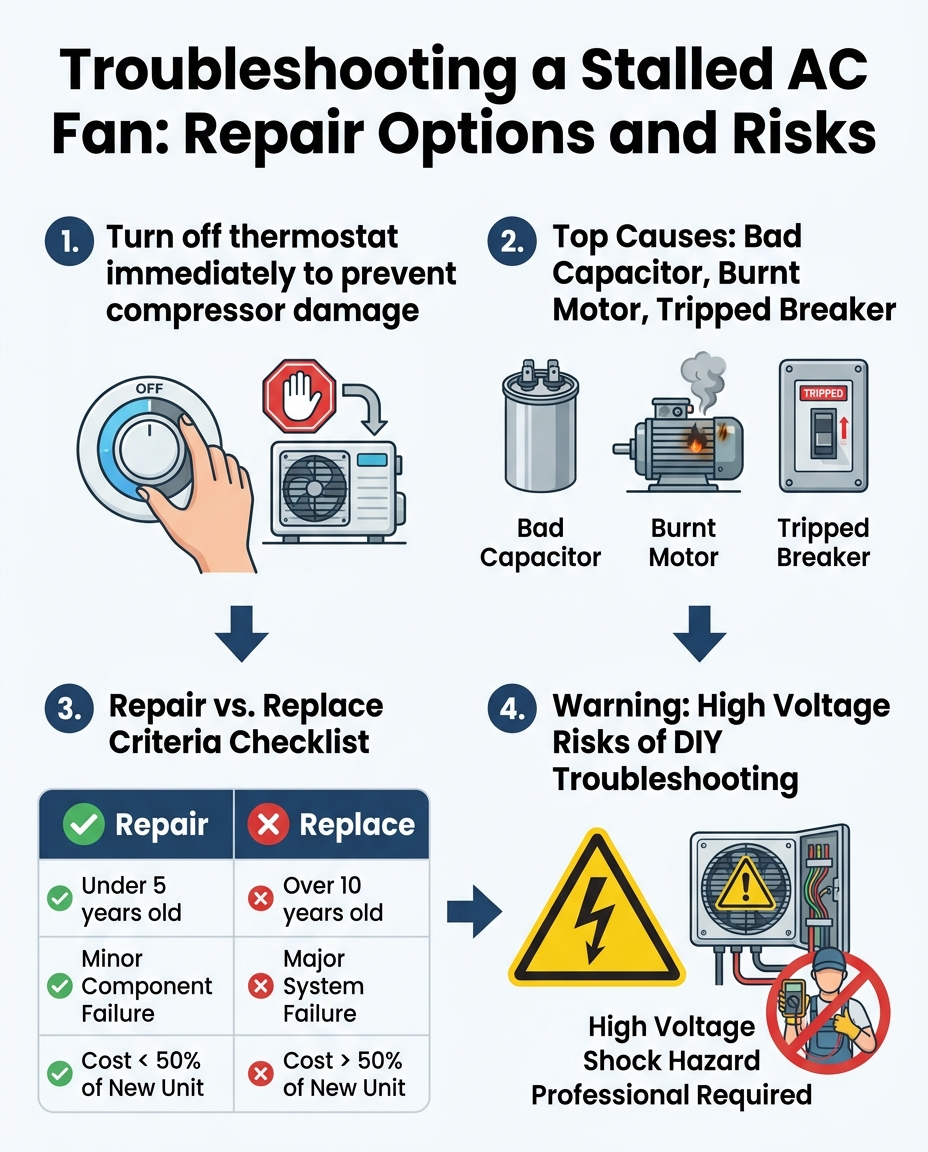
With a wealth of information available online, it can be tempting to attempt a quick fix when the house is heating up. However, evaluating local service options is always safer and more cost-effective than risking severe personal injury or further equipment damage through DIY electrical troubleshooting. HVAC systems operate on high-voltage electricity, and the outdoor condenser unit presents specific, lethal hazards.
One of the most dangerous myths circulating online is the "stick test." This involves using a wooden stick or a screwdriver to manually push the fan blades through the top grate while the system is turned on, attempting to jump-start the motor. Do not attempt this under any circumstances. If the fan starts spinning, it confirms the capacitor is dead, but it forces the motor to run on unbalanced voltage. This rapidly overheats the motor windings, practically guaranteeing that you will have to replace the motor in addition to the capacitor. More importantly, sticking objects into a live, high-voltage appliance can result in severe electrical shock or physical injury from the rapidly spinning metal blades.
Furthermore, HVAC capacitors are designed to store massive amounts of electrical energy. Even after you have turned off the power at the thermostat and pulled the disconnect block at the outdoor electrical panel, the dual run capacitor retains a potentially lethal high-voltage charge. Discharging a capacitor requires specific tools and technical knowledge. No step-by-step DIY electrical instructions should ever be followed without a proper license. Relying on professional options comparisons for homeowners ensures the diagnostic process is handled safely and correctly.
Accurate troubleshooting requires more than just looking at the fan blades; it requires precise electrical measurements. This is where prompt, professional diagnostic expertise becomes the cornerstone of evaluating local service options without relying on guesswork. When our business dispatches a technician, they utilize specialized diagnostic tools to determine exactly where the failure occurred and what secondary damage may have resulted.
During a professional diagnostic visit, technicians use digital multimeters to measure the exact microfarad reading of the dual run capacitor safely. They use megohmmeters to test the fan motor windings for microscopic shorts to ground, which indicate internal insulation failure. They also inspect the electrical contactor for pitting and measure the amperage draw of the compressor to ensure it hasn't been compromised by the heat buildup.
This level of prompt diagnostic expertise is the only safe way to resolve dangerous electrical and mechanical issues before they lead to costly, full-system failures. By accurately diagnosing whether the issue is a simple capacitor, a failing motor, or a complex electrical fault, a professional provides the concrete data you need. This data forms the baseline for accurate options comparisons for homeowners, allowing you to choose a repair path based on facts rather than assumptions.
When the peak summer heat hits and your AC fan stops spinning, the speed and accuracy of your response dictate the outcome. Summarizing the immediate steps: our team always reminds customers to turn off the thermostat first to protect your compressor from catastrophic thermal overload. Once the system is safe, understanding the root causes—from heat-degraded capacitors to burnt-out motors—helps you navigate the situation calmly.
Evaluating local service options objectively leads to better long-term value and reliability for your home cooling system. Whether the data points toward a simple component replacement or indicates that a broader system upgrade is the most financially sound choice, having a clear framework makes the decision straightforward. The most critical step in navigating options comparisons for homeowners is obtaining an accurate, professional assessment of your specific equipment.
Don't let a stalled fan compromise your entire HVAC system. Reach out to our local experts for a comprehensive, professional inspection to get concrete answers about your unit. By prioritizing safe diagnostics and clear options comparisons for homeowners, you can restore your home's comfort reliably and efficiently.
The most common reason is a failed dual run capacitor or a burnt-out fan motor. The condenser unit may still hum because the compressor is receiving power and trying to operate, but the fan lacks the stored electrical energy to start turning. In other cases, a tripped breaker or physical debris blocking the blades can prevent rotation. It is critical to turn the system off immediately to prevent the compressor from overheating while you arrange for diagnostics.
Absolutely not; running the system without the fan will cause severe, irreversible damage to the compressor. The fan's job is to pull air across the coils to remove heat from the system. Without this airflow, the refrigerant cannot cool down, causing temperatures and pressures inside the compressor to spike dangerously high. Always shut the system off at the thermostat the moment you notice the fan has stopped.
Fixing a stalled fan requires replacing the specific electrical or mechanical component that has failed. A licensed professional will use a multimeter to test the capacitor, the motor windings, and the electrical contactor to pinpoint the exact fault. Depending on the diagnosis, the fix usually involves safely discharging and replacing the dual run capacitor, swapping out a seized motor, or clearing internal blockages from the cabinet.
A failing or dead AC capacitor typically produces a distinct humming, buzzing, or clicking sound from the outdoor unit. This noise occurs because electrical current is still flowing to the motor, but the motor cannot start without the high-voltage boost the capacitor normally provides. If you hear this sound while the fan blades are stationary, it is a strong indicator of a capacitor failure and requires immediate attention.
Replacing a dual run capacitor is generally a low-cost repair, whereas a fan motor replacement requires a more moderate investment. The exact difference depends on the specific make and model of your HVAC system, as well as the complexity of the motor (such as single-speed versus variable-speed ECM motors). Because capacitors are standard consumable electrical parts, they are faster and less complex to replace than an entire motor assembly.
No, using a stick to push the fan blades is incredibly dangerous and can cause further damage to your system. While it might temporarily force a motor with a bad capacitor to start spinning, the motor will run on unbalanced voltage and rapidly overheat, likely destroying the windings. Furthermore, inserting objects into a live, high-voltage appliance presents a severe risk of electrical shock and physical injury.