Options Comparisons for Homeowners: Why Is My AC Unit Fan Not Spinning?
August 17, 2026
Summer in South Florida is relentless, and when your system breaks down, finding reliable options comparisons for homeowners is the first step toward restoring comfort. Peak summer temperatures place maximum thermal stress on outdoor cooling components. When the outdoor fan blades suddenly stop moving, the immediate heat and humidity inside the house can cause panic. However, not every silent condenser unit requires a complete system replacement.
Homeowners must quickly determine the most cost-effective and reliable service option to restore cooling without overspending or applying a temporary fix to a dying system. By utilizing a structured local service comparison framework, you can objectively weigh your repair versus replacement paths. This guide breaks down exactly what happens when the fan fails, what a professional will check, and how to evaluate your next steps based on objective equipment data.
The outdoor fan motor serves one primary, highly critical function: exhausting the dense heat removed from your home's interior. In coastal South Florida's extreme heat and humidity, the system works overtime to extract thermal energy from the indoor air. That heat travels through refrigerant lines to the outdoor condenser coil, where the fan blows ambient air over the fins to dissipate it.
When that fan stops spinning, the heat has nowhere to go. Without proper heat exhaust, the compressor—the expensive "heart" of your air conditioning system—suffers thermal overload within minutes. It continues attempting to pump high-pressure, high-temperature refrigerant, but because the heat cannot escape, the internal temperature and pressure spike dangerously high.
Here is exactly how a stopped fan triggers a cascading failure:
1. Loss of Heat Exhaust: The fan stops pulling air through the condenser fins, trapping heat inside the unit.
2. Thermal Overload: The compressor continues pumping refrigerant but rapidly overheats due to the lack of heat dissipation.
3. High-Pressure Trip: If equipped with safety switches, the system shuts down to protect itself; if not, the compressor windings can literally melt and short out.
4. Indoor Coil Freezing: The interrupted heat transfer process causes the indoor evaporator coil temperature to drop below freezing, encasing it in solid ice.
Utilizing a structured local service comparison framework early on is imperative. Acting quickly and understanding the mechanical stakes prevents a relatively straightforward fan repair from destroying the compressor entirely, which often forces a complete system replacement.
When a technician arrives to inspect a silent outdoor unit, they are looking for a few specific points of failure. South Florida's coastal salt air and high humidity significantly accelerate corrosion on outdoor AC components, often shortening the lifespan of electrical connections, contactors, and motors compared to inland regions. Understanding what causes the failure helps you apply options comparisons for homeowners effectively.
Bad capacitors are the most frequent culprit behind a stationary fan. The dual run capacitor acts as a powerful battery that delivers the massive jolt of electricity required to jumpstart the compressor and the fan motor. Listen closely to the outdoor unit: if you hear a distinct buzzing or humming sound coming from the condenser but the fan blades are stationary, the capacitor is likely trying to send voltage to a motor that cannot start. Without this initial electrical push, the motor remains completely stationary, even though the system is calling for cooling.
If the capacitor is functioning properly, the fan motor itself may have failed. Burnt-out fan motors result from age, natural mechanical wear, or excessive thermal stress from running constantly during peak summer months. One of the primary symptoms of a burnt-out motor is the top of the condenser unit feeling excessively hot to the touch. It is important to note that most AC condenser fan motors have a finite operational lifespan of 10 to 12 years under normal conditions. Once the internal copper windings degrade or short out, the motor can no longer generate the magnetic field required to turn the blades.
Beyond the capacitor and motor, electrical failures at the contactor can prevent power from reaching the fan entirely. The contactor is a mechanical relay that clicks shut to allow high voltage into the outdoor unit. In coastal environments, the metal contacts often pit, burn, or corrode, blocking the electrical current. Finally, physical blockages can physically prevent the blades from turning. Severe dirt buildup, invasive vines, fallen branches, or debris wedged into the fan grille can lock the motor in place, causing it to overheat and fail if the system isn't shut down immediately.
While diagnosing the exact electrical failure requires licensed expertise, there are safe, non-electrical troubleshooting steps you can take. These steps help you gather information so you can use the local service comparison framework effectively when speaking with a technician.
• Verify thermostat settings: Ensure the thermostat is set to "Cool" and the temperature is set at least five degrees below the current room temperature. Sometimes, a blank or malfunctioning thermostat is the actual reason the outdoor unit isn't receiving the signal to turn on.
• Check the electrical panel: Locate your home's main electrical panel and check for a tripped breaker dedicated to the outdoor AC unit. If the breaker is tripped, reset it once. If it trips again immediately, leave it off—this indicates a serious electrical short.
• Perform a visual-only inspection: Walk outside and look closely at the condenser unit without touching it or opening any access panels. Look for obvious physical obstructions, such as fallen branches, heavy leaf accumulation, or debris wedged between the fan blades and the metal grille.
The absolute most important rule: Never attempt the dangerous DIY "stick test." Many online forums suggest attempting to jumpstart a humming fan by pushing the blades with a stick. This is incredibly dangerous. Not only do you risk severe physical injury if the high-speed fan suddenly engages, but you also risk catastrophic electrical shock or causing permanent damage to the motor bearings and blades. Always leave internal electrical and mechanical diagnostics to a certified professional.
Once a professional diagnoses the specific cause of the fan failure, you face a critical decision. This is where options comparisons for homeowners become essential. Establishing a neutral, criteria-based breakdown helps confidently rule out the wrong options and removes the pressure often associated with emergency repairs.
The baseline criteria for your decision-making should always include the age of the system, the severity of the component failure, and the overall health of the remaining parts. By referencing objective data like Department of Energy (DOE) and ASHRAE equipment life expectancy charts, you establish an objective baseline. For example, ASHRAE guidelines suggest most outdoor condensing units last roughly 15 years, while the fan motors typically last 10 to 12 years.
Using this local service comparison framework allows you to view the repair as a mathematical equation rather than an emotional emergency. If a system is relatively new and in excellent condition, a localized repair makes perfect sense. If the system is far past its expected lifespan and showing signs of widespread wear, pouring resources into a dying unit is a poor investment. The following sections provide a side-by-side comparison of component repairs versus system upgrades so you can weigh these paths objectively.
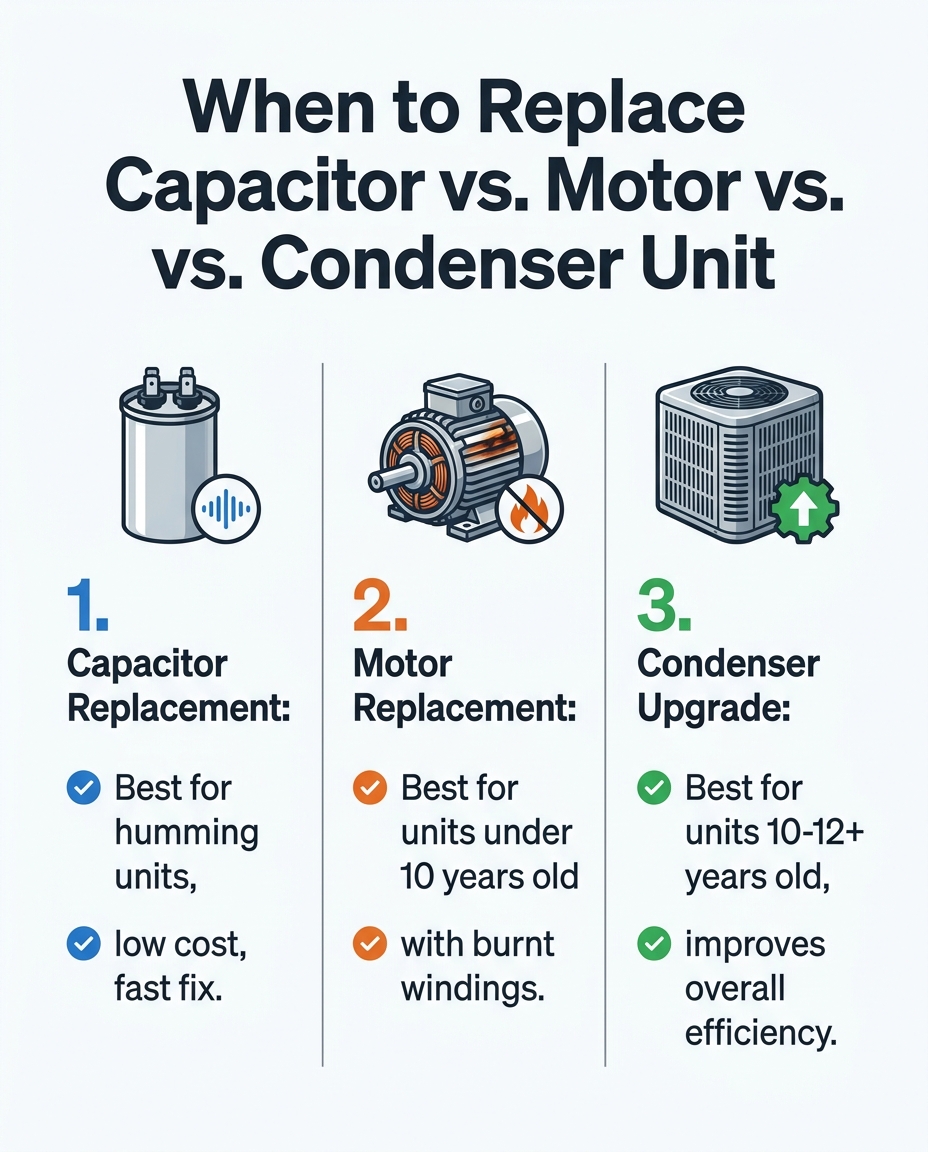
When the failure is isolated to the electrical components that drive the fan, the two most common localized repairs are replacing the capacitor or replacing the motor itself. Understanding the scope of these two professional repairs helps clarify their long-term value when reviewing options comparisons for homeowners.
• Capacitor Replacement — Scope of Work: Swapping the small, cylindrical electrical component that stores voltage. — Expected Lifespan Extension: Restores full function immediately; does not reset motor lifespan. — Best Use Case: System is humming but not spinning; motor is still healthy.
• Fan Motor Replacement — Scope of Work: Removing the fan blades, unmounting the old motor, and hardwiring a new motor. — Expected Lifespan Extension: Provides 10-12 years of reliable fan operation. — Best Use Case: Motor windings are burnt out, but the compressor and condenser coil are under 10 years old.
A capacitor replacement is a swift, highly cost-effective repair that restores function immediately. Because the capacitor is a wear-and-tear item, replacing it does not mean the rest of the motor is failing. A motor replacement, however, is a much more intensive repair required when the internal copper windings have failed or the bearings have seized.
The long-term viability of a motor replacement depends heavily on the age of the equipment. Putting a brand-new capacitor on a 12-year-old motor is logical because the part is inexpensive and quickly swapped. Putting a brand-new, labor-intensive motor into a 12-year-old condenser unit carries significant risk, as the aging compressor could fail shortly after. The local service comparison framework helps you balance these technical realities.
If the fan motor is completely burnt out, you must compare the value of fixing that specific component against replacing the aging outdoor unit entirely. This is the most important decision point in any options comparisons for homeowners.
Apply the 10-to-12-year lifespan rule: if the outdoor unit is older than a decade, investing in a major component like a new motor often yields diminishing returns.
Replacing the Fan Motor Only
• Pros: Addresses the immediate problem without the larger commitment of a full system changeout. Keeps the current system operational for a few more seasons if the compressor is still healthy.
• Cons: Does not reset the clock on the aging compressor or the corroded condenser coil. Offers no improvements in energy efficiency.
Upgrading the Condenser Unit
• Pros: Provides a brand-new warranty on all outdoor components, including the fan motor and compressor. Delivers significant efficiency gains, which lowers monthly energy consumption. Eliminates the risk of a cascading failure in the near future.
• Cons: Requires a larger upfront investment and more extensive installation time.
When making this choice, there is a technical necessity to consider: ensuring the indoor and outdoor components match. If you decide to upgrade the condenser, the new outdoor unit must be compatible with your existing indoor air handler and evaporator coil. If they use different refrigerants or operate at vastly different efficiency ratings, the system will not function properly. If you are wondering whether to replace only the outside unit or the entire system, a professional diagnostic can map out the exact compatibility of your current equipment. Weighing these options objectively based on your system's specific history is the best way to ensure long-term comfort.
Absolutely not. Running the AC without the exhaust fan will cause the compressor to overheat and potentially suffer catastrophic failure. The system relies on that fan to dissipate the thermal energy removed from your home. If you leave the system running while the fan is stationary, you risk turning a minor electrical repair into a complete system replacement due to thermal overload.
This is the classic symptom of a failed dual run capacitor attempting to send voltage to a motor that cannot start. The capacitor acts as a battery, providing the necessary torque to get the heavy fan blades moving. When it fails, the electrical current reaches the motor, creating a distinct humming noise, but the motor lacks the power to overcome inertia and spin.
It depends entirely on the age and overall condition of the system. If the unit is under 10 years old and the compressor is healthy, a motor replacement is usually a worthwhile investment. For older units approaching or exceeding 12 years of age, upgrading the entire condenser is often more cost-effective long-term, as it prevents you from pouring money into a failing system.
Technicians use specialized diagnostic tools like digital multimeters to check for proper voltage reaching the unit. They test the microfarad reading on the capacitor to ensure it is storing and releasing power correctly. Additionally, they measure the electrical resistance (ohms) in the motor windings to determine if the internal copper wires have shorted out or degraded.
Yes, if the indoor air handler and outdoor condenser are on completely separate electrical circuits, which is standard in most homes. In this scenario, the indoor blower fan may continue running and circulating room-temperature air while the outdoor fan and compressor lose power entirely. This is why checking the electrical panel is a highly recommended first step in safe troubleshooting.
Choosing the appropriate service tier relies on objective criteria: system age, failure severity, and overall condition. By applying the local service comparison framework, you can confidently navigate the stress of a sudden breakdown. Remember that shutting off the system immediately at the thermostat is the absolute best way to protect your expensive compressor from permanent heat damage.
When you schedule an expert diagnostic, use these options comparisons for homeowners to discuss the findings with your technician. Local expertise and fast emergency response are key to diagnosing the fan issue before it causes expensive compressor damage. Getting a professional on-site quickly ensures you get the objective data you need to definitively rule out the wrong option and confidently choose the right path to restore your home's cooling before the summer heat takes over.