Dealing with AC Drainage Issues in Cutler Bay's High Water Table Zones
October 3, 2026
Your air conditioner is running nonstop, but the house still feels warm and sticky. Then, the system abruptly shuts off entirely, or worse, you find a growing puddle of water pooling around the indoor air handler. At Air On Demand, when we help homeowners dealing with AC drainage issues in Cutler Bay's high water table zones, we see firsthand how frustrating this cycle can be. Most homeowners immediately assume a standard internal clog—like a buildup of dirt, dust, or algae inside the pipe—is to blame for the backup.
However, the actual culprit is often the environment directly outside your home. When the ground is completely saturated from fall king tides and late-season rains, standard plumbing rules no longer apply. The water your air conditioner extracts from the indoor air has nowhere to go, forcing you to make a decision: keep paying for temporary drain line blowouts that only last a few days, or invest in a permanent solution engineered specifically for saturated ground.
Ready to stop the cycle of overflowing drain pans? Start by exploring professional Air Conditioning Services designed for coastal challenges.
Over our years of servicing Miami and Cutler Bay, the Air On Demand team has found that to understand why your system keeps backing up, it helps to identify whether you are dealing with an internal blockage or an environmental failure. The symptoms often overlap, but the underlying causes require entirely different approaches.
• Timing of Backup — Typical Internal Clog: Happens randomly, often during peak summer usage. — Environmental Saturation Failure: Aligns perfectly with heavy rainstorms or high tide events.
• Post-Clearing Result — Typical Internal Clog: System runs perfectly for months after a blowout. — Environmental Saturation Failure: System backs up again within 24 to 48 hours of clearing.
• Outdoor Pipe Exit — Typical Internal Clog: Dry soil around the exit, but no water dripping out. — Environmental Saturation Failure: Pipe exit is submerged in puddles or standing yard water.
• Water Consistency — Typical Internal Clog: Thick, sludgy water filled with green or black algae. — Environmental Saturation Failure: Relatively clear water that simply cannot drain away.
Recognizing the difference between a simple clog and environmental saturation is the first step toward a permanent fix. When the discharge point is underwater, no amount of pipe cleaning will solve the problem.
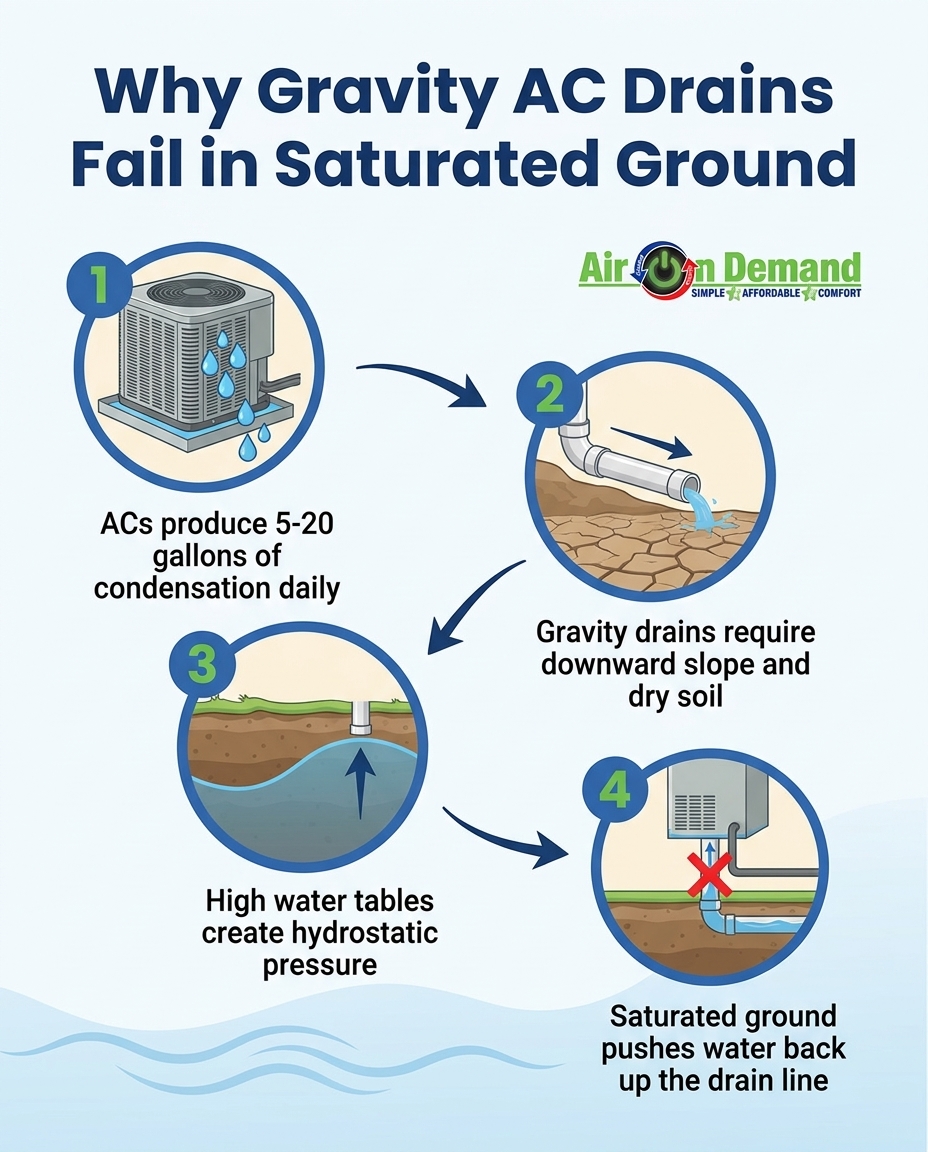
A standard residential central air conditioner works by pulling heat and humidity out of your indoor air. As warm air passes over the freezing cold evaporator coil, the moisture in the air condenses into liquid water. Depending on the size of your home and the indoor humidity levels, a typical system produces anywhere from 5 to 20 gallons of condensation every single day. All of that water collects in a drain pan and must be routed safely outside your home.
Traditional condensate lines rely entirely on gravity to move this water. For gravity drainage to work, the PVC pipe must maintain a consistent downward slope (usually a minimum of one-quarter inch per foot of run) from the indoor unit to the outdoor exit. Just as importantly, the soil at the discharge point must be dry and permeable enough to absorb the water as it exits.
Living in Cutler Bay coastal zones completely changes this equation. The local geography features a naturally high water table sitting just below the surface of highly porous limestone. When heavy rains hit, the ground cannot absorb any more moisture. The standing water in your yard creates hydrostatic pressure—a physical force where the saturated ground actually pushes water back up into the open drain pipe. Instead of flowing out, the condensation hits a wall of groundwater and has nowhere to go but backward.
Miami's intense humidity creates maximum condensation precisely when the ground is least capable of absorbing it. Your air conditioner is working overtime to dehumidify the house, generating gallons of water, while the saturated yard actively prevents that water from escaping.
The wet/dry vac illusion: Many homeowners try to fix a backed-up drain by attaching a wet/dry vacuum to the outdoor exit pipe. While this might suck out the standing water inside the PVC line, it does absolutely nothing to fix the saturated yard.
The temporary fix: Blowing out the line with compressed air yields the same frustrating result. You might clear the pipe momentarily, allowing the air conditioner to turn back on. However, because the yard itself is the actual blockage, the pipe simply refills with condensation over the next few hours. The illusion of a "fixed" drain quickly shatters when the system shuts down again the very next day.
In our experience at Air On Demand, the timing of persistent AC drainage failures is rarely a coincidence. According to NOAA data, South Florida experiences its highest astronomical tides—known as king tides—during the month of October. Our technicians frequently respond to emergency calls during these predictable tidal events, which push ocean water higher than normal, creeping into drainage canals, storm sewers, and residential neighborhoods.
During fall king tides and late-season rains, coastal flooding temporarily raises the water table even further inland. You do not have to live directly on the water to feel the effects; the rising groundwater pushes up through the porous limestone foundation beneath the entire region. This completely submerges outdoor AC drain exits that might function perfectly fine during the drier spring months.
When the outdoor line is blocked by groundwater, the risk of severe indoor property damage skyrockets. The condensation continues to drip off the indoor coil, filling the primary drain pan. If the water cannot exit the house, it eventually overflows the pan, soaking into your drywall, ruining baseboards, and warping expensive flooring. In attic installations, an overflowing pan can cause ceiling collapses and massive structural damage.
Signs your home is vulnerable to seasonal backups:
• Low-lying discharge points: Your AC drain pipe exits directly into a garden bed that frequently puddles.
• Slow draining sinks: You notice other gravity-fed drains in the home running slowly during heavy rain weeks.
• Constant dripping sounds: You hear water splashing or dripping near the indoor air handler when the AC turns off.
• Musty indoor odors: A damp, mildew-like smell develops around the indoor unit, indicating standing water in the pan.
Because these environmental factors are entirely predictable, proactive system checks are highly recommended as part of your fall pre-winter inspection before peak tidal events. Identifying vulnerable discharge locations early allows you to implement solutions before the water breaches your home. Scheduling professional Cutler Bay AC maintenance with our team ensures your drain pans and safety switches are tested and ready for the wettest weeks of the year.
If your air conditioner suddenly stops cooling during a heavy rainstorm, it might feel like a major mechanical failure. In reality, the shutdown is usually triggered by a tiny, inexpensive component doing exactly what it was designed to do: the AC float switch.
The float switch is a critical safety mechanism wired directly into your air conditioner's low-voltage control circuit. It is typically installed on the edge of the primary drain pan or spliced into the main condensate line. The switch contains a small plastic or cork buoy. Under normal conditions, the drain pan remains relatively empty, and the buoy rests at the bottom of the switch housing. However, if the drain line backs up due to ground saturation, water begins to fill the pan.
As the water level rises, it lifts the buoy. Once the buoy reaches a certain height, it trips the internal sensor, instantly breaking the electrical connection to the thermostat. This immediately shuts off the outdoor compressor and the indoor blower motor, stopping the system from producing any more condensation.
Our repair crews frequently find that a tripped switch during a heavy rainstorm is almost always a symptom of ground saturation, not an electrical failure. The switch is actively protecting your home from thousands of dollars in water damage.
Important Safety Warning: Never attempt to bypass a tripped float switch to force your air conditioner to run. Bypassing this safety control removes the only defense your home has against an overflowing drain pan.
Some homeowners, desperate for cool air during a humid storm, will twist the float switch wires together to complete the circuit manually. Doing this during a high-water event guarantees an indoor flood. The system will resume pulling gallons of moisture from the air, and with the drain pipe blocked by groundwater, that water will spill directly into your home. Understanding the dangers of bypassing a tripped AC float switch is critical for protecting your property.
When the current discharge zone is consistently prone to flooding, the most effective permanent solution is physically changing where the water exits the home. Standard line blowouts will never solve a high water table issue; the line must be professionally rerouted to an area that remains dry year-round.
This is a structural fix rather than a temporary patch. Our local expertise at Air On Demand allows our technicians to engineer custom rerouting specific to Cutler Bay's coastal geography, rather than offering generic blowouts that fail the next day. The rerouting process requires careful planning and precise execution to ensure the new line functions flawlessly.
The professional rerouting process involves:
1. Elevation Assessment: Technicians survey the exterior of the property to identify higher elevation points around the foundation that do not collect standing water during heavy rain.
2. Code Compliance Check: The team determines if the condensate line can be legally tied into appropriate alternative drainage systems, such as a dedicated French drain or a specific utility runoff, depending on strict local municipal codes.
3. Pitch Calculation: The most critical step is calculating the required downward slope over the new, often longer, distance. The line must drop at least one-quarter inch for every foot it travels to maintain gravity flow.
4. Secure Installation: The new PVC routing is securely strapped and insulated where necessary to prevent sagging, which can create internal water traps over time.
Because maintaining the precise pitch over a long distance is incredibly difficult, rerouting a condensate line is never a do-it-yourself project. A slight miscalculation in the slope will cause water to pool inside the pipe, leading to rapid algae growth and secondary backups. Relying on an experienced AC repair service in Cutler Bay like Air On Demand ensures the new drainage path is mathematically sound and fully compliant with local building standards.
In some coastal properties, gravity rerouting is simply impossible. The home may sit too low, the yard may be entirely flat, or the required downward pitch cannot be achieved without tearing through structural concrete. When gravity fails, the second professional solution is installing an active condensate pump.
A condensate pump is a specialized device that actively pushes water upward and outward, completely overcoming gravity and high water table limitations. Instead of relying on a downward slope, the pump uses mechanical force to move the condensation wherever it needs to go, even if that means pumping it vertically into an attic space before routing it to a safe exterior drain.
How an active condensate pump works:
• The Reservoir: Condensation drips from the indoor coil into a small, built-in holding tank on the pump rather than flowing directly into a PVC pipe.
• The Internal Float: As the tank fills, an internal float rises. Once the water hits a specific level, it triggers the pump's motor.
• The Impeller: A motorized impeller spins rapidly, forcing the collected water out of the tank under high pressure.
• The Check Valve: The water travels through a specialized, flexible discharge tube. A one-way check valve prevents the water from flowing backward into the tank once the motor turns off.
Proper sizing and installation are absolutely critical for these devices. A standard, off-the-shelf pump may lack the horsepower required to handle Miami's high-humidity condensation volume, leading to premature motor burnout. Furthermore, condensate pumps require dedicated, high-voltage electrical connections tied directly into the air handler's power supply.
Because of the electrical requirements and the need for precise integration with the AC's safety switches, a pump should only be installed by a licensed professional. Upgrading your drainage system with a heavy-duty pump is often best handled during major repairs or a complete AC installation in Cutler Bay, ensuring the entire system is calibrated to handle coastal moisture loads. Our installation team strongly recommends this approach for properties where gravity drainage simply isn't an option.
Persistent AC drainage issues in coastal zones are a complex environmental challenge, not just a routine maintenance nuisance. When the ground beneath your home is completely saturated, the physical laws of hydrostatic pressure will always defeat standard plumbing.
Reiterating a simple truth saves homeowners significant time and money: relying on standard gravity drains in saturated soil will only lead to repeated system shutdowns, warm indoor temperatures, and the looming threat of severe water damage. You cannot vacuum away a high water table, and blowing out a clear pipe will not stop the ocean from rising.
If you are tired of resetting your system after every heavy rain, it is time to address the root cause. Schedule a professional fall evaluation with Air On Demand to determine whether a permanent line reroute or an active condensate pump is the right solution for your property's specific elevation.
Heavy rain saturates the ground around your home, preventing water from absorbing into the soil. When the outdoor drain pipe exit is submerged in puddles or a high water table, hydrostatic pressure physically pushes the water back up the pipe. Because the condensation has nowhere to exit, it backs up into the indoor drain pan, eventually triggering the safety switch and shutting down the system.
First, turn off your air conditioner at the thermostat to stop the system from producing any more condensation. Do not attempt to use a wet/dry vacuum on the line, as you cannot drain a flooded yard through a small PVC pipe. You will need to contact a licensed HVAC professional to evaluate the property and either reroute the discharge line to higher ground or install an active condensate pump.
Yes, flooded ground directly impacts the system's ability to manage moisture. If the ground is flooded, the gravity-fed drain line cannot empty the condensation produced by the indoor evaporator coil. This leads to persistent shutdowns, elevated indoor humidity, and a total loss of cooling performance until the water recedes or the drainage is mechanically rerouted.
Fixing an environmentally blocked drain requires changing how or where the water exits the home. A professional technician will either reroute the PVC line to a higher elevation point with proper downward pitch, or they will install an active condensate pump. The pump uses a motor to push the water upward and away from the saturated zone, bypassing the need for gravity drainage entirely.
No, it is never safe to bypass the AC float switch under any circumstances. The float switch is the only safety mechanism preventing your air conditioner from continuously pumping water into an overflowing drain pan. Bypassing it during a storm guarantees that gallons of condensation will spill over the pan, causing severe water damage to your ceilings, walls, and flooring.
A standard residential central air conditioner can produce between 5 and 20 gallons of condensation per day, depending on the system's size and the indoor humidity levels. In high-humidity coastal environments, the system extracts moisture almost continuously while running. This massive volume of water requires a reliable, unobstructed drainage path to safely exit the home.