Post-Hurricane Power Surges and Your AC Compressor
September 23, 2026
At Air On Demand, our team has spent years helping Miami homeowners navigate the height of the September hurricane season, which brings a familiar routine: tracking the forecast, securing the property, and eventually breathing a sigh of relief when the worst of the weather moves on. But while the physical winds may have died down, understanding the hidden danger of post-hurricane power surges and your AC compressor is critical before the next storm hits. Most homeowners assume that once the sky clears and the utility trucks begin their work, their home appliances are safe. Unfortunately, this is exactly when your cooling equipment is at its most vulnerable.
If you need help evaluating your air conditioning systems or require emergency AC repair in Miami, our team is ready to assist.
In our experience servicing local HVAC equipment, the true danger to your home comfort system rarely comes from a direct lightning strike. Instead, the threat lies in the chaotic, repetitive grid fluctuations that occur as power is restored to neighborhoods across the region. When utility companies work to bring sections of the grid back online, the supply of electricity is rarely smooth. Power flickers, drops, and surges repeatedly. During these moments, homeowners face a critical decision: simply hoping that their standard electrical breakers will hold up against the erratic voltage, or taking proactive steps to install dedicated HVAC surge protection.
Miami's severe tropical weather creates unique challenges for utility infrastructure. After a major weather event, tree branches, flooded substations, and wind-damaged lines cause localized grid instability. This instability means the electricity flowing into your home is highly inconsistent. For low-draw devices like LED lights or phone chargers, these fluctuations are mostly a nuisance. However, for a high-draw appliance like a central air conditioner or heat pump, this erratic power delivery is incredibly stressful. The sudden starts and stops force the system's motors to pull massive amounts of current, creating immense heat and electrical strain on the internal components.
The Problem: When most people think of power surges, they picture a massive, direct lightning strike hitting a utility pole and frying every television on the block. Because direct strikes are relatively rare, many homeowners believe their cooling equipment is safe as long as the storm didn't score a direct hit on their property. However, this misconception leaves expensive equipment completely exposed during the days following a major weather event.
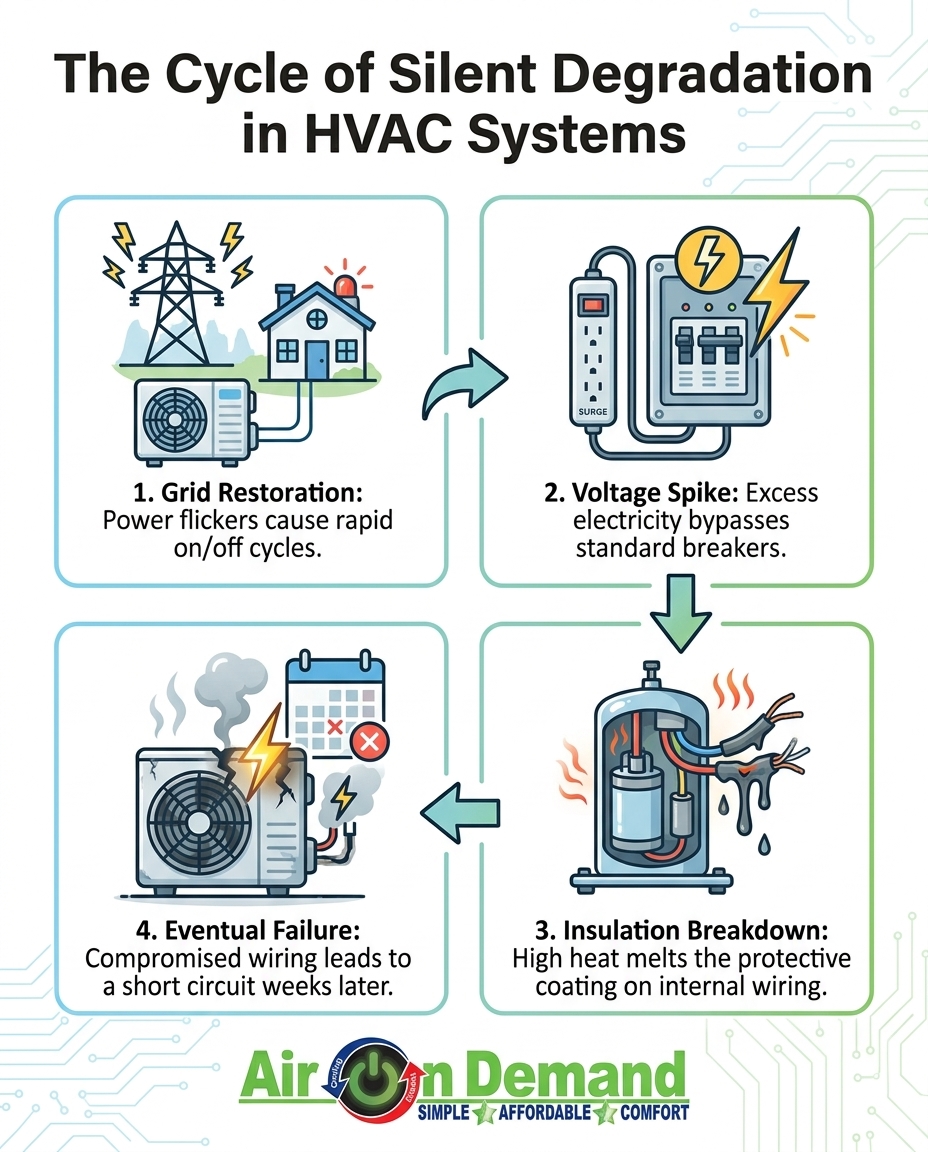
The Cause: The actual threat comes from the standard process of utility grid restoration. As power is routed back into a neighborhood, it frequently flickers. This creates two distinct electrical hazards: brownouts and voltage spikes. A brownout occurs when the voltage drops significantly below normal levels. Because an air conditioner still needs a specific amount of power to run, a drop in voltage forces the system to pull more amperage to compensate, which generates dangerous amounts of heat. Conversely, a voltage spike sends a sudden, massive wave of electricity into the home, far exceeding what the equipment was designed to handle.
The Solution: Understanding that these repetitive micro-fluctuations send erratic electrical loads directly to major household appliances is the first step in protecting your home. High-draw equipment is particularly vulnerable to these rapid on-and-off cycles. The aftermath of a Miami storm often involves localized grid instability that can last for days, meaning your system might be subjected to dozens of minor surges and brownouts before the power supply fully stabilizes. Recognizing that the September hurricane season brings prolonged periods of grid instability helps homeowners shift their focus from worrying about lightning to preparing for the realities of power restoration, especially as we transition into the early fall season.
To understand why these grid fluctuations are so destructive, it helps to look at the heart of your cooling system: the compressor. The compressor is responsible for pumping refrigerant throughout the system, and it requires a massive, stable draw of electricity to function properly. When erratic power hits the unit, it attacks the AC compressor windings—the tightly coiled copper wires inside the motor that generate the magnetic field required to turn the compressor.
This leads to a phenomenon known as silent degradation. When voltage spikes exceed the system's operating limits, they do not always cause an immediate, catastrophic failure. Instead, they slowly compromise the electrical components over time. You might turn your thermostat down after a storm, hear the unit hum to life, and assume everything is fine. This creates a false sense of security while the internal damage actually worsens with every cooling cycle. Over the following weeks, the system works harder, runs hotter, and eventually fails completely long after the storm has passed.
The AC compressor windings are coated in a thin layer of protective lacquer insulation. This coating is designed to keep the tightly packed copper wires from touching each other and shorting out. However, this insulation is highly sensitive to extreme heat and excess voltage. When a power surge or brownout forces the motor to run hot, that protective coating begins to bubble, melt, and break down.
Once this coating degrades, the risk of a catastrophic short circuit increases exponentially. Bare wires touch, electrical current arcs where it shouldn't, and the motor eventually burns out. Because these failures can be incredibly complex to trace back to a specific weather event, it requires a trained eye to spot the damage. A pattern we see often at Air On Demand is systems failing weeks after a storm, right as homeowners are starting to schedule their early fall tune-ups. Our expertise lies in diagnosing these specific, complex post-storm electrical failures that other contractors often miss. If you suspect your system has been compromised, reaching out for professional Miami AC repair services is the safest way to assess the health of your compressor.
A common misconception among homeowners is that the standard electrical panel in their garage provides sufficient protection for all their appliances. While the breakers in your panel are a critical safety feature, they are designed with a very specific, limited purpose. They exist to protect the house's wiring from overloading and catching fire, not to protect sensitive electronic appliances from external voltage spikes.
Furthermore, the standard plug-in power strips you might use for a television or computer are entirely irrelevant for hardwired, high-voltage cooling systems. A central air conditioner is wired directly into the home's electrical system, meaning it requires a specialized, dedicated line of defense to intercept voltage anomalies before they reach the AC compressor windings.
• Primary Purpose — Standard Whole-Home Breaker: Protects the home's internal wiring from overloading and overheating. — Dedicated HVAC Surge Protector: Protects the specific HVAC equipment from external voltage spikes and surges.
• Trigger Mechanism — Standard Whole-Home Breaker: Trips when the equipment pulls too much amperage from the panel. — Dedicated HVAC Surge Protector: Clamps down when too much voltage attempts to enter the equipment from the grid.
• Reaction Time — Standard Whole-Home Breaker: Relatively slow; designed to tolerate brief spikes before tripping. — Dedicated HVAC Surge Protector: Instantaneous clamping speed to redirect excess voltage into the ground.
• Protection Level for AC — Standard Whole-Home Breaker: Minimal; allows micro-fluctuations to pass through to the motor. — Dedicated HVAC Surge Protector: Maximum; acts as a sacrificial barrier for sensitive electrical components.
As the comparison shows, the massive electrical draw of a cooling system requires a completely different approach to electrical safety. The reaction time of a standard breaker is simply too slow to stop a micro-fluctuation from reaching the equipment. By the time a standard breaker physically trips and breaks the circuit, the excess voltage has already traveled down the line and struck the motor.
If your neighborhood has recently experienced the rolling blackouts and flickering lights typical of the September hurricane season, our technicians recommend monitoring your cooling equipment closely as we move into early fall. Because silent degradation takes time to present as a total failure, catching the early warning signs can sometimes save the system from catastrophic burnout. Here is what you should be looking and listening for in the days following a major weather event:
• Repeatedly tripping the circuit breaker: If the unit trips the breaker immediately upon startup, it usually means the AC compressor windings have already suffered a short circuit and are pulling dangerous amounts of amperage.
• Unusual electrical noises: Loud humming, heavy buzzing, or a distinct hissing sound coming from the outdoor cabinet often indicates severe electrical strain, a locked rotor, or internal shorting. (For more details on what these sounds mean, diagnosing unusual AC noises is a great next step).
• Failure to turn on: If the thermostat indicates a call for cooling, the screen is active, but the outdoor unit remains completely silent and still, the internal capacitors or contactors may have been fried by a surge.
• Inconsistent cooling performance: If the air coming from the vents is lukewarm, or if the system is short-cycling (turning on and off rapidly without completing a full cooling cycle), the electrical components are likely struggling to maintain a consistent magnetic field in the motor.
• Acrid burning smells: A faint smell of burning plastic or ozone near the outdoor cabinet or the indoor air handler is a massive red flag that wire insulation has melted.
If you notice any of these symptoms, turn the thermostat to the "off" position immediately. Continuing to force a compromised system to run will only accelerate the damage and guarantee a more expensive repair.
In our years of protecting Miami's cooling systems, we've found that the most effective way to break the cycle of silent degradation is to stop the erratic voltage before it ever reaches the equipment. This is where a dedicated HVAC surge protector becomes a vital addition to your home's electrical defense. Unlike standard power strips, an HVAC surge protector is a heavy-duty device wired directly into the disconnect box located near your outdoor compressor unit.
How It Works: The protector acts as a highly sensitive, high-speed gatekeeper. When normal voltage flows from the grid, the protector allows it to pass through to the air conditioner seamlessly. However, the moment a voltage spike hits the line, the internal components of the surge protector instantly clamp down. It absorbs the excess electrical energy and redirects it safely into the earth through the system's ground wire, keeping it far away from the AC compressor windings.
A Sacrificial Layer: In the event of a massive surge, the protector acts as a sacrificial layer. It is designed to take the fatal electrical blow so that your expensive cooling equipment does not have to. If the protector is destroyed while stopping a surge, replacing it is a minor, cost-effective insurance policy compared to the massive expense of a full AC replacement. (Note that if you do require a replacement, federal tax credits may apply to qualifying high-efficiency heat pump installations, though you should always verify current programs with your utility or a tax professional).
Professional Installation is Mandatory: It is critical to stress that installing these devices involves handling high-voltage components and interacting directly with the main electrical supply. This work MUST be performed by a licensed professional. Attempting to wire a surge protector yourself is incredibly dangerous and can easily void your equipment's manufacturer warranty.
Yes, a power surge can severely damage an AC compressor. When excess voltage enters the system, it generates extreme heat that melts the thin lacquer insulation coating the internal windings. Once that insulation is compromised, the wires can touch, creating a short circuit that permanently destroys the motor.
The most common signs of surge damage include a system that repeatedly trips the circuit breaker the moment it tries to turn on, loud humming or buzzing noises from the outdoor unit, or a complete failure to power up despite a working thermostat. If you smell burning plastic near the unit after a storm, that is also a strong indicator of fried electrical components.
Yes, but only if they are dedicated, hardwired HVAC surge protectors. Standard plug-in power strips cannot handle the massive electrical draw of a central air conditioner, nor can they be connected to hardwired equipment. A professionally installed HVAC surge protector is specifically designed to clamp down on high-voltage spikes and redirect them safely to the ground.
It is highly recommended to turn off your AC at the thermostat during a severe thunderstorm or hurricane. By keeping the system off during the height of the storm and during the initial, chaotic stages of grid restoration, you prevent the unit from trying to operate on unstable, fluctuating power, thereby reducing the risk of electrical damage.
Silent degradation is unpredictable and can take anywhere from a few days to several weeks to cause a total failure. The initial surge weakens the wire insulation, but the system may continue to run normally for a short time. With each subsequent cooling cycle, the compromised wires generate more heat until they finally short out completely.
Surviving the high winds and heavy rains of a major weather event is only half the battle; surviving the unpredictable grid restoration process is the other. The erratic power that flows through your neighborhood in the days following a storm is the true threat to your home comfort system. Understanding the hidden danger of post-hurricane power surges and your AC compressor allows you to take control of the situation before the damage is done.
There is immense peace of mind that comes with knowing your most expensive home appliance is shielded from unpredictable voltage spikes. Don't wait until the AC compressor windings are already compromised by a failing grid. Schedule a professional early fall assessment with our team and have a dedicated HVAC surge protector installed before the next major weather event hits our coast.