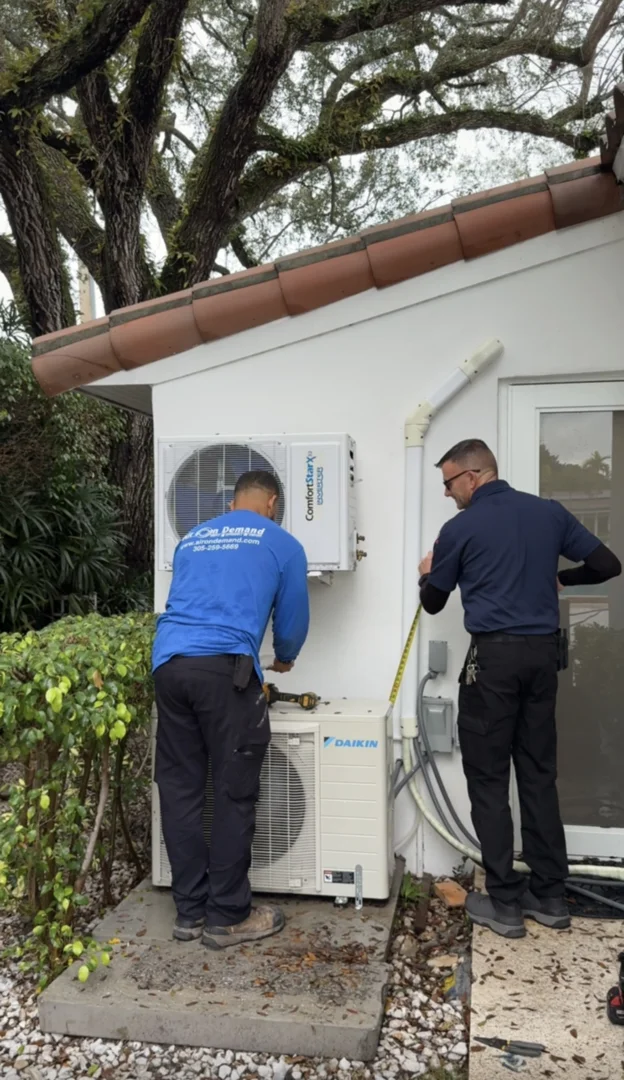
The Great Debate of Ducted vs Ductless Cooling
August 17, 2026
The central ac vs ductless mini split comparison is one of the most important decisions you'll make as a homeowner — especially in South Florida, where your AC runs hard for most of the year.
Here's a quick breakdown to help you decide:
• Requires ductwork — Central AC: Yes — Ductless Mini Split: No
• Best for — Central AC: Homes with existing ducts, large open layouts — Ductless Mini Split: Additions, older homes, zoned cooling needs
• Energy efficiency (SEER2) — Central AC: Up to 21+ SEER2 — Ductless Mini Split: Up to 38+ SEER2
• Installation disruption — Central AC: Higher — Ductless Mini Split: Minimal (3-inch wall opening)
• Zone control — Central AC: Limited (costly to add) — Ductless Mini Split: Built-in per room
• Lifespan — Central AC: ~15 years — Ductless Mini Split: 20–30 years
• Noise level — Central AC: Moderate — Ductless Mini Split: 19–26 dB (whisper-quiet)
• Heating capability — Central AC: Cooling only (needs separate furnace) — Ductless Mini Split: Yes, built-in heat pump
In short: if your home already has solid, well-sealed ductwork, central AC is a proven, cost-effective choice. If your home lacks ducts, has a problem room, or you want room-by-room control, a ductless mini split is hard to beat.
But that quick answer only scratches the surface. In South Florida's heat and humidity, the wrong system doesn't just cost you comfort — it costs you money every single month. Homes in Kendall, Coral Gables, and Cutler Bay face unique challenges: high humidity, older construction, and layouts that aren't always built with modern cooling in mind.
This guide walks you through every major factor — efficiency, installation, maintenance, air quality, and more — so you can make a confident, informed choice.

When we talk about cooling a home in Palmetto Bay or Pinecrest, we are essentially looking at two different philosophies of air distribution. Both systems use the same basic refrigeration cycle—refrigerant absorbs heat from inside and releases it outside—but how they deliver that comfort to your living room is where they diverge.
Air Conditioners of the central variety have been the standard in American homes for decades. However, Ductless Mini Split Systems have surged in popularity recently because they offer a level of precision that traditional systems often struggle to match.
A central air conditioning system relies on a network of hidden ducts. Think of your ductwork as the "arteries" of your home. A large indoor air handler pushes cooled air through these channels, which then exits through vents in every room.
This method is designed for uniformity. It aims to keep the entire house at a single temperature set by one thermostat. While this is great for large, open-concept homes in areas like Kendale Lakes, it can be a struggle if you have a two-story home where the upstairs is always five degrees warmer than the downstairs. For many of our neighbors, Air Conditioning means cooling the whole house just to enjoy the master bedroom.
Ductless systems, as the name implies, skip the "arteries" entirely. Instead of one large central unit, we install individual air handlers directly on the walls or ceilings of the rooms you want to cool. These units are connected to an outdoor compressor by a small conduit containing refrigerant lines and power cables.
This setup offers incredible flexibility. Because there are no ducts, there is no major construction required to tear open your drywall. A simple three-inch hole in the exterior wall is all it takes to connect the indoor and outdoor components. There are at least 3 Benefits of Ductless Mini Split Air Conditioner systems that homeowners love: they are easier to install in older homes, they offer room-by-room control, and they are remarkably efficient.
In April 2026, energy efficiency standards are more rigorous than ever. The industry now uses SEER2 (Seasonal Energy Efficiency Ratio 2) to measure how much cooling a system provides for every watt of electricity it uses.
• Older Central AC (Pre-2015) — Typical SEER2 Range: 8 – 12 SEER2 — Energy Loss Potential: High (Duct leaks + Age)
• Modern Central AC (2026) — Typical SEER2 Range: 15 – 21+ SEER2 — Energy Loss Potential: 20% – 30% (Duct loss)
• Ductless Mini Split — Typical SEER2 Range: 20 – 38+ SEER2 — Energy Loss Potential: Minimal (Direct Delivery)
One of the biggest technological leaps we see in both systems—but especially in ductless models—is inverter technology. Traditional AC units are like a light switch; they are either 100% on or 100% off. Inverter-driven, variable-speed compressors are more like a dimmer switch. They can slow down or speed up to match the exact cooling needs of the room, which prevents those energy-guzzling "startup" spikes. This is a major focus in our Ductless AC Pinecrest FL Complete Guide.
One of the "hidden" costs of central air is the ductwork itself. According to the Department of Energy, the average home loses between 20% and 30% of its cooled air through leaks, poor insulation, or friction within the ducts.
Imagine buying a gallon of milk but having 30% of it leak out of the bag before you get home. That is exactly what happens when your central AC pushes air through a sweltering attic in Homestead or Cutler Bay. Ductless systems deliver air directly into the room, meaning 100% of the cooling you pay for actually reaches your family. This efficiency is a core reason many choose to follow a Ductless AC Palmetto Bay FL Complete Guide when upgrading their homes.
In a head-to-head central ac vs ductless mini split comparison, ductless systems are the undisputed heavyweights of efficiency. While a high-end central system might reach 21 SEER2, some of our advanced Daikin ductless models can soar past 38 SEER2.
Beyond the raw numbers, ductless systems save energy through "zoning." If you are working in your home office in Coral Gables all day, why cool the guest bedrooms and the dining room? Ductless units allow you to turn off cooling in unused spaces, which can save up to 30% on your monthly cooling costs. For a deeper dive into these savings, check out our Mini Split AC Homestead FL Complete Guide.
South Florida architecture is diverse. We have historic 1920s bungalows in Coconut Grove, sprawling mid-century homes in Coral Gables, and brand-new builds in Lakes by the Bay. There is no one-size-fits-all answer, but your home’s layout and existing infrastructure are the biggest clues.
If you’re looking for Mini Split AC in Miami FL, you'll find that the choice often comes down to whether you want "invisible" cooling or "targeted" comfort.
Central air is still the "gold standard" for many traditional homeowners. If your home already has a ductwork system that is in good condition (less than 15 years old and properly sealed), staying with central AC is often the most straightforward path.
It provides a clean, "invisible" look since the only things you see are the small vents in the ceiling or floor. It’s also excellent for large, open-concept floor plans where you want a uniform temperature throughout the main living areas. We often recommend this for standard replacements in Ductless AC in Homestead FL where the infrastructure is already perfectly suited for it.
Every home seems to have that one "problem room"—the sunroom that feels like an oven, the garage workshop that’s too humid to use, or the master bedroom that stays warm while the rest of the house is freezing.
In these cases, the central ac vs ductless mini split comparison usually leans toward ductless. Adding a single-zone mini split to a specific area is often much more effective (and less invasive) than trying to modify existing ductwork. This is a popular solution for Mini Split AC in Kendall FL homeowners who have recently finished an attic or converted a garage into a "man cave" or home office.
Whether you go ducted or ductless, maintenance is the key to longevity—especially in our salty, humid air. However, the way you maintain these systems differs significantly.
Our Ductless AC Kendall FL Complete Guide emphasizes that because these systems work so hard to dehumidify our homes, keeping them clean is non-negotiable for preventing mold and maintaining efficiency.
Central AC systems typically use one or two large filters that need to be replaced every 1 to 3 months. You also have to worry about the cleanliness of the ducts themselves; over time, dust and allergens can build up inside those hidden channels, requiring professional duct cleaning.
Ductless units use small, washable filters located right inside the indoor head. These should be rinsed every 2 to 4 weeks during the peak of summer. Because there are no ducts to collect dust, many of our customers in Cutler Bay find that their homes feel "fresher." For more tips, see our Mini Split AC Cutler Bay FL Guide.
Air quality is a major concern in South Florida, where humidity can lead to mold growth if not managed correctly. Ductless mini splits have an edge here because they offer multi-stage filtration in every room.
Since each unit operates independently, you aren't circulating air from the kitchen or the bathroom throughout the whole house. Many Daikin models we install include advanced filters that trap allergens and odors before they can spread. This localized air cleaning is a highlight of our Ductless AC Lakes by the Bay FL services.
In the harsh Florida climate, a standard central AC system usually lasts about 15 years. The outdoor salt air and constant run-time take a toll on the components.
Ductless mini splits often have a longer lifespan, frequently reaching 20 to 30 years with proper care. This is partly because they don't have to work as hard to overcome the static pressure and energy loss of ductwork. We discuss this durability often in our Mini Split AC Palmetto Bay FL Guide.
Yes, by a significant margin. Central AC systems have a noticeable "whoosh" of air through the vents and a loud hum when the outdoor compressor kicks on.
Indoor ductless units operate at 19–26 decibels. To put that in perspective, a whisper is about 30 decibels. They are so quiet that most people in Country Walk forget they are even running. You can learn more about these whisper-quiet specs in our Mini Split AC Country Walk FL Guide.
Absolutely! This is what we call a "hybrid configuration." Many homeowners in Coral Gables keep their central AC for the main living areas but add a mini split to a primary bedroom or a new addition. This gives you the best of both worlds: invisible cooling for the main house and precision control for the rooms you use the most. Check out our Mini Split AC Coral Gables FL page for examples of how we’ve set this up for your neighbors.
Deciding on a central ac vs ductless mini split comparison doesn't have to be a headache. At Air On Demand, we specialize in helping South Florida homeowners find the perfect balance of comfort and efficiency. As Daikin specialists, we offer some of the best warranties in the business—including a 12-year parts warranty and our Comfort Promise.
Whether you are in Cutler Bay, Pinecrest, or Kendall, our team is ready to provide fast, reliable service with real-time updates so you’re never left in the heat. Ready to see which system is right for your sanctuary? Explore our Ductless Mini Split Systems or give us a call today for a personalized home comfort assessment.