How to Keep Your Cool in the Sunshine State
August 17, 2026
The ac tune up guide for south florida homeowners is simpler than you might think — here's what you need to know right now:
Quick Answer: South Florida AC Tune-Up Essentials
1. Change your air filter every 30 days (South Florida's dust and humidity clog filters faster than anywhere else)
2. Flush your condensate drain line monthly with white vinegar to prevent clogs and water damage
3. Clear 2 feet of space around your outdoor condenser unit and rinse it with a garden hose regularly
4. Schedule professional maintenance at least once a year — ideally before April, ahead of peak cooling season
5. Watch for warning signs like warm air, unusual noises, musty smells, or a sudden spike in your electric bill
If you live in Kendall, Palmetto Bay, Cutler Bay, or anywhere across South Florida, your air conditioner isn't a seasonal luxury — it's running nearly every single day of the year. While most American homeowners give their AC a break for four or five months, South Florida systems log 10 to 12 months of runtime annually. That's more than 2,500 hours of operation every year, almost double the national average.
All that extra work takes a real toll. The heat, the humidity, the salt air drifting in from the coast — these conditions push your system harder than almost any other climate in the country. And when a system that's already working overtime goes without proper care, the consequences are predictable: higher energy bills, more frequent breakdowns, and a lifespan cut dramatically short.
The good news? A consistent tune-up routine — part DIY, part professional — can reduce your energy bills by up to 30%, prevent the majority of common AC failures, and add years to your system's life. This guide walks you through exactly what to do and when to do it.
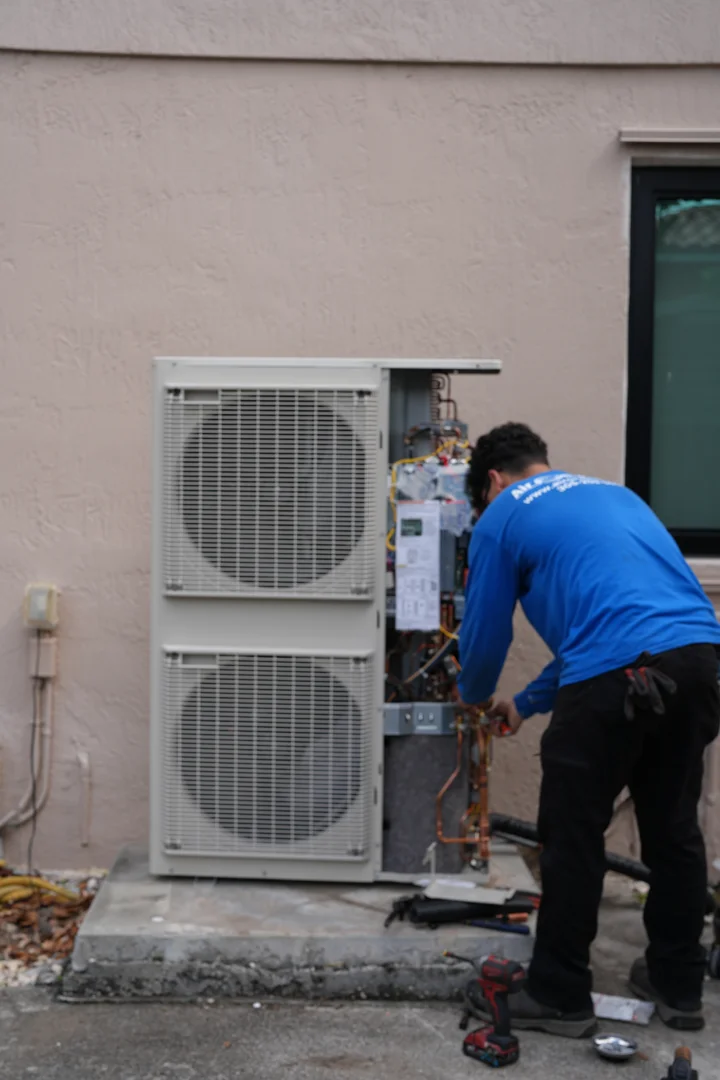
In April 2026, as we prepare for another intense summer, it is vital to understand that a Florida air conditioner is like a marathon runner who never gets to stop. In more temperate states, an HVAC system might run for 1,200 hours a year. Here in Homestead or Pinecrest, that same unit is grinding through 2,500 to 3,000 hours.
This continuous operation means that "standard" maintenance advice often falls short for us. When you follow a dedicated ac tune up guide for south florida homeowners, you aren't just checking boxes; you are protecting the most expensive appliance in your home.
Consider the environment. Our high humidity levels don't just make us sticky; they force the AC to work double-time as a dehumidifier. If the system isn't tuned, it struggles to pull moisture from the air, leaving your home feeling damp even if the temperature is low. Furthermore, for those of us in coastal areas like Cutler Bay or Palmetto Bay, the salt air is a silent predator, causing corrosion on copper coils 15% to 20% faster than inland systems.
Neglecting maintenance is a gamble where the house always loses. Unmaintained systems consume 20% to 30% more energy and are prone to failing 3 to 5 years earlier than they should. In a region where your AC can represent 40% to 60% of your total FPL bill, that inefficiency adds up to thousands of dollars over the life of the unit. For a deeper dive into the local specifics, check out our Miami Air Conditioning Guide: What You Need to Know.
To maintain your system effectively, you need to know the two "lungs" of your AC: the evaporator coil and the condenser coil.
The evaporator coil (located indoors) is responsible for absorbing heat from your home's air. Because it's constantly wet from condensation, it acts like a magnet for dust and pet dander. If this coil gets dirty, it can't absorb heat efficiently, which often leads to the dreaded "frozen coil" where ice literally builds up on your unit in the middle of a 90-degree day.
The condenser coil (located outdoors) releases that absorbed heat into the outside air. In South Florida, these coils get hammered by grass clippings, dirt, and salt spray. A dirty condenser coil can reduce your system's efficiency by 30% or more. This is why we emphasize AC Coil Cleaning Guide Miami, FL as a cornerstone of any maintenance plan.
Then there is the air filter. We cannot stress this enough: Dirty Air Filters and Miami, FL Air Conditioning are the leading cause of service calls. A clean filter can lower energy consumption by 5% to 15%. In our climate, we recommend checking your filter every 30 days. If you have pets or allergies, don't be surprised if it needs a swap every single month.
Efficiency isn't just about the machine; it’s about how you manage it. One of the simplest ways to save money is by mastering your thermostat. The U.S. Department of Energy suggests setting your thermostat to 78°F when you’re home. While that might sound high to some, using ceiling fans can make the room feel 4 degrees cooler, allowing you to stay comfortable without forcing the compressor to run 24/7.
When you're away, consider bumping the setting to 82°F or 85°F. However, be careful not to turn the system off entirely; in South Florida, the AC must run occasionally just to keep indoor humidity below 55% to prevent mold growth. For more tips on finding that "sweet spot," see our guide on Miami Air Conditioning Tip: Thermostat Settings.
While we always recommend a professional eye for the complex stuff, there is plenty you can do to keep your Daikin or other high-efficiency system purring. Think of DIY maintenance as the "oil changes" for your home.
One of the most critical tasks for a South Florida homeowner is managing the condensate drain line. Because our air is so humid, your AC pulls gallons of water out of the air every day. That water travels through a small PVC pipe. Over time, algae and "slime" can grow in that pipe, leading to a backup. If you've ever walked into your hallway and found wet carpet, you know the pain of a clogged drain.
We recommend pouring a cup of white vinegar down the drain line every month. This simple, inexpensive trick kills the algae before it can form a clog. If you're wondering where to find this or how to do it, our article on Do You Have a Clogged Condensate Drain? provides a step-by-step walkthrough.
Monthly DIY Maintenance Checklist:
• Filter Inspection: Check every 30 days; replace if you can't see light through it.
• Outdoor Clearance: Ensure at least 2 feet of "breathing room" around your outdoor unit. Trim back any hibiscus or palm fronds.
• Visual Leak Check: Look for water pooling around your indoor air handler or oil spots near refrigerant lines.
• Vent Cleaning: Dust off your supply and return grilles to ensure maximum airflow.
• Drain Line Flush: Use that cup of vinegar!
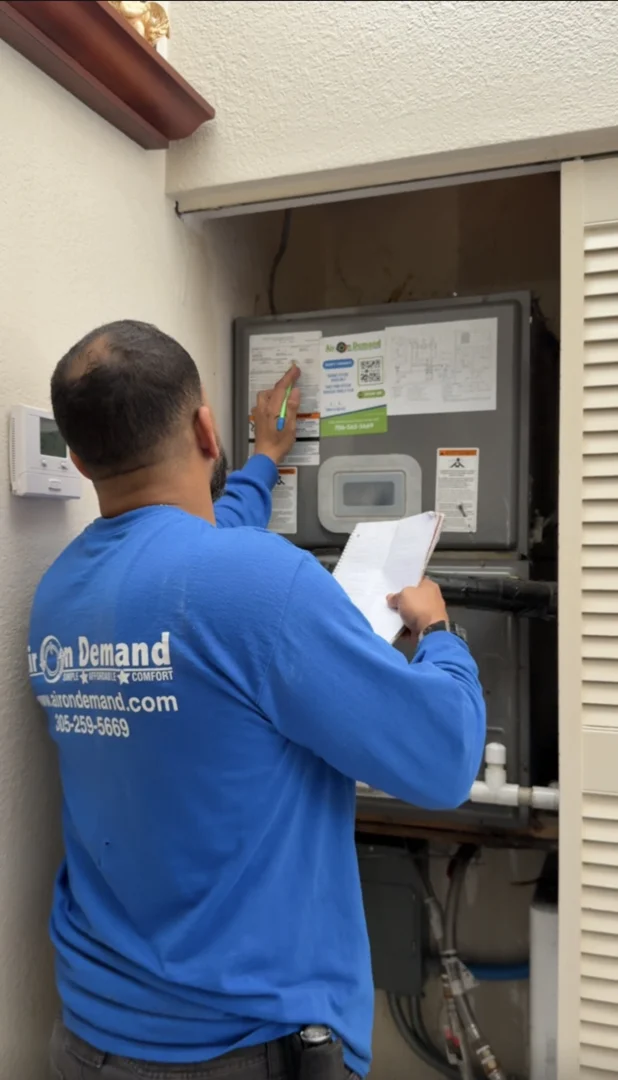
There comes a point where DIY isn't enough. A professional tune-up is a deep-tissue massage for your HVAC system. At Air On Demand, our technicians don't just "look" at the unit; we perform a multi-point surgical inspection.
We check the refrigerant levels using precise gauges. In a perfect world, an AC should never "run out" of refrigerant. If it's low, that means there's a leak, and finding that leak early can save you from a $2,000 compressor failure down the road. We also test the electrical components—specifically the capacitors and contactors. These parts take a beating from South Florida's frequent power surges and heat, and they often show signs of wear long before they actually fail.
To understand the full scope of a pro visit, read What Really Happens During an AC Maintenance Visit. Here is a quick breakdown of the difference:
• Change Air Filters — DIY: Yes — Professional: Included
• Clear Debris from Outdoor Unit — DIY: Yes — Professional: Included
• Flush Drain Line — DIY: Yes — Professional: Deep Cleaned
• Check Refrigerant Levels — DIY: No — Professional: Yes
• Test Electrical Connections — DIY: No — Professional: Yes
• Lubricate Moving Parts — DIY: No — Professional: Yes
• Calibrate Thermostat — DIY: No — Professional: Yes
• Inspect Ductwork for Leaks — DIY: No — Professional: Yes
Even with the best maintenance, parts eventually wear out. The key is catching them before they leave you sweating at 2 AM on a Saturday.
Short Cycling is a major red flag. This is when your AC turns on and off every few minutes without ever really cooling the house. It puts massive strain on the compressor and can skyrocket your electric bill. Similarly, keep an ear out for unusual noises. A squeal usually means a belt or motor issue, while a clanking sound could mean something has come loose in the blower.
If you notice weak airflow, your system is gasping for air. This could be a clogged filter, but it could also be a failing blower motor or leaky ducts. For a list of the most urgent "call us now" symptoms, check out 3 Signs You Need AC Repair ASAP. And if the air coming out of your vents feels like a blow-dryer, see our troubleshooting guide on AC Blowing Hot Air.
Living in the subtropics means we face challenges that homeowners in Seattle or New York never dream of.
The Salt Factor: If you live within five miles of the ocean (looking at you, Palmetto Bay and Cutler Bay), your outdoor unit is under constant attack. Salt air causes "pitting" on the aluminum fins of your condenser. We recommend a gentle freshwater rinse of your outdoor unit every two weeks to wash away salt deposits. Just use a regular garden hose—never a pressure washer, which can flatten the delicate fins and ruin your airflow.
Hurricane Season Protocol: From June to November, your AC needs a protection plan. Ensure your outdoor unit is properly bolted to its concrete pad and that hurricane straps are tight. If a storm is approaching and you expect power flickers, it is often safer to turn the AC off at the thermostat and the breaker. Power surges when the grid fluctuates can fry sensitive circuit boards. For more on rainy day protection, read Protect Your Air Conditioner When It's Rainy.
Humidity and IAQ: In Coconut Grove and Coral Gables, where older homes are common, indoor air quality (IAQ) is a major concern. A poorly maintained AC can actually become a breeding ground for mold. Regular tune-ups ensure that the system is properly draining moisture and that the air you breathe is clean. If you're unsure if your system is up to par, learn Miami, FL Air Conditioning Tip: How to Tell If You Need Service.
While national guides say once a year, South Florida's extreme runtime makes a bi-annual (twice a year) schedule much safer. Ideally, schedule one visit in the spring (March/April) to prep for summer, and one in the fall (October/November) to clean out the summer’s dust and check the heating strips before our few "cold" nights.
Yes! A poorly maintained system can increase energy bills by 20% to 30%. When your coils are clean and your refrigerant is at the perfect level, the system runs for shorter periods to achieve the same temperature. In a climate where AC is the biggest energy drain, those savings are significant.
Clear any projectiles (potted plants, patio furniture) from near the outdoor unit. Check that your surge protector is functioning. If a major storm is imminent, turn the system off to prevent damage from power surges. After the storm, always inspect the outdoor unit for debris or flooding before turning it back on.
Maintaining your air conditioner in South Florida isn't just about comfort; it's about financial wisdom. By following this ac tune up guide for south florida homeowners, you are ensuring that your home remains a sanctuary against the heat while keeping your monthly costs under control.
At Air On Demand, we specialize in the unique needs of our neighbors in Kendall, Palmetto Bay, and Homestead. As Daikin specialists, we offer some of the best protection in the industry, including 12-year parts warranties and the Daikin Comfort Promise. Whether you need a quick spring tune-up or a comprehensive system evaluation, our team provides fast service with real-time updates so you're never left in the dark—or the heat.
Don't wait for the first 95-degree day to find out your system is struggling. Invest in your home’s longevity today by visiting our AC Maintenance page and scheduling your next visit. We’ll help you keep your cool, no matter how high the mercury rises.