
Why Mismatched Condensers and Air Handlers Fail Faster in Miami's High Humidity
September 26, 2026
Your thermostat says it is 72 degrees inside, but you are still sweating, wondering exactly why mismatched condensers and air handlers fail faster in Miami's high humidity. You likely upgraded your outdoor unit recently to improve efficiency, expecting crisp, dry air. Instead, your house feels like a cave—cold, yet uncomfortably wet and sticky. This frustrating scenario almost always happens when you pair a brand-new, high-efficiency outdoor unit with an older, lower-efficiency indoor unit. For example, slapping a modern 15-SEER condenser onto an aging 10-SEER air handler creates a massive mechanical imbalance. The system simply cannot process the heavy moisture load. Understanding why these partial replacements fail at moisture removal is the very first step toward restoring true indoor comfort to your home.
When it is time to evaluate your air conditioning systems, getting professional AC replacement services in Miami ensures every component works perfectly together.
Many homeowners ask, "can I replace just my AC condenser?" when their outdoor unit fails. While a technician can physically connect a new outdoor unit to an old indoor unit, a simple "yes" technically misses the broader performance catastrophe waiting to happen. To understand why this fails, you have to look at how air conditioning actually works. Your system performs two distinct jobs simultaneously: sensible cooling and latent cooling.
Sensible cooling is the process of dropping the actual temperature of the air. This is what registers on your thermostat. Latent cooling is the process of removing moisture from the air. In a humid subtropical climate, latent cooling is arguably more important for human comfort than sensible cooling. High-efficiency outdoor units are incredibly good at sensible cooling. They drop the air temperature rapidly. However, if that powerful outdoor unit is paired with older air handlers, the indoor coil cannot extract moisture effectively before the thermostat tells the system to shut off. The result is a home that reaches the target temperature but feels damp, clammy, and uncomfortable.
Moisture removal relies on a very specific scientific process. As warm, humid indoor air blows across the cold indoor evaporator coil, the moisture in the air reaches its dew point, condenses into water droplets on the coil, and drains away.
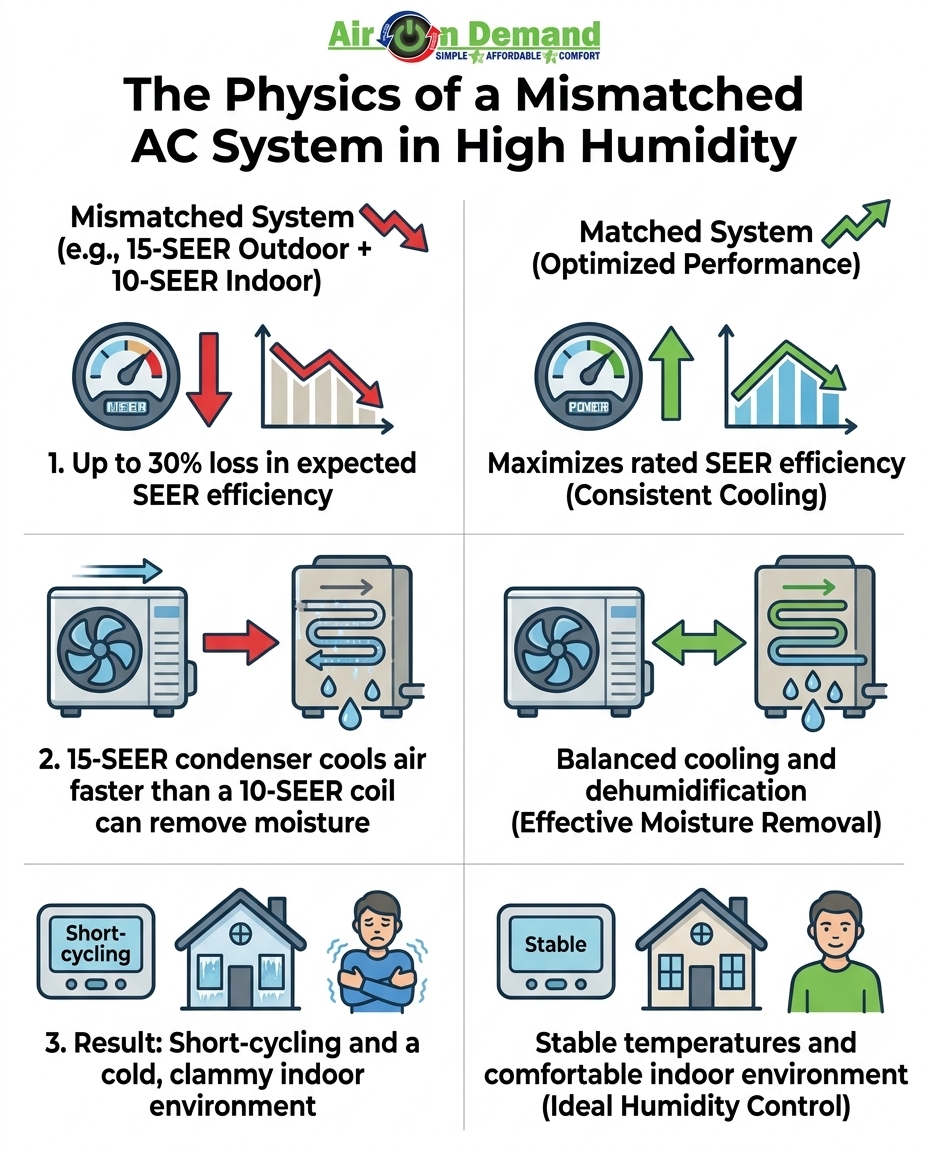
For this to work, the air must pass over the coils at a highly specific, controlled rate. When you have a 15-SEER condenser paired with a 10-SEER air handler, the indoor fan and coil were simply not designed to handle the rapid cooling capacity of the new outdoor unit. The indoor coil gets cold very fast, but the air does not spend enough time moving across the surface to drop its moisture.
• Sensible Cooling — What It Does: Lowers the air temperature — How Mismatches Affect It: Cools too quickly, satisfying the thermostat prematurely.
• Latent Cooling — What It Does: Removes airborne humidity — How Mismatches Affect It: Fails to run long enough to allow condensation to form and drain.
SEER (Seasonal Energy Efficiency Ratio) measures how efficiently a cooling system operates over an entire season. When you look at the specific dynamics of a SEER mismatch, the technical mechanics reveal why partial upgrades waste money. A 15-SEER condenser paired with a 10-SEER air handler is a recipe for severe operational stress. The new outdoor condenser is engineered to pump refrigerant at a specific volume and pressure, assuming it is communicating with an equally advanced indoor coil.
The older 10-SEER indoor coil has less surface area and a weaker blower motor. It physically cannot absorb the heat from your home fast enough to boil the refrigerant back into a gas before it returns to the compressor. This disrupts the entire airflow balance and coil temperature regulation.
The 30% Efficiency Penalty: Industry data shows that mismatched systems can degrade expected SEER efficiency by up to 30%. If you paid for a 15-SEER condenser, pairing it with a 10-SEER air handler means you might only be getting 10.5-SEER performance. This completely negates the financial benefits and utility savings you expected from the new condenser.
The Risk of Frozen Coils: Furthermore, this imbalance creates a severe risk of freezing your indoor coil. Because the old indoor unit cannot move enough warm air over the coil to match the extreme cold provided by the new condenser, the temperature of the indoor coil drops below freezing. The heavy moisture in the air condenses and immediately turns to solid ice. A frozen coil blocks all airflow, forcing the system to run constantly without cooling your home, eventually leading to a complete system breakdown.
The consequences of a mismatched system become incredibly obvious during specific seasonal weather patterns. Consider the September lingering high humidity in South Florida. During this late summer and early fall transition period, the peak blistering heat of July begins to wane, and temperatures might slightly dip into the low 80s or upper 70s. However, the relative humidity remains oppressive, often averaging over 75 percent.
This specific climate profile requires robust latent cooling capabilities. Because the sensible heat load (the temperature) is lower, a mismatched system will cool the house down to your thermostat setting almost instantly. This leads to a destructive mechanical behavior known as short-cycling, where the system turns on and off rapidly.
Here is exactly how short-cycling destroys indoor comfort during the September transition:
1. Rapid Temperature Drop: The oversized 15-SEER condenser blasts the home with cold air, dropping the indoor temperature by a few degrees in just five to ten minutes.
2. Premature Shutoff: The thermostat registers that the target temperature is met and abruptly shuts the entire system down.
3. Moisture Remains: Because the system only ran for ten minutes, the indoor coil never had the long, steady run time necessary to condense and drain the heavy atmospheric moisture.
4. The Clammy Rebound: The air in the home is cold but fully saturated with water. Within minutes, the home feels sticky, prompting the thermostat to trigger the system again, starting the rapid cycle over.
This constant on-and-off cycling prevents the long, steady run times necessary for latent heat removal. It exacerbates the cold but clammy syndrome, making your home feel like a damp basement rather than a comfortable living space.
When homeowners ask, "can you replace just the outside AC unit?" they are usually trying to avoid the labor and equipment costs of replacing the indoor air handler. While we have covered the comfort issues, the mechanical consequences of this choice are far more severe. The compressor, located inside the outdoor unit, is the heart of your cooling system. It is designed to pump refrigerant in a continuous, balanced loop.
When a 15-SEER condenser is paired with a 10-SEER air handler, the new compressor is forced to overwork against a highly restrictive, undersized older indoor coil. This creates a bottleneck in the refrigerant line, leading to dangerously high head pressures at the compressor.
Consider these hidden mechanical tolls when mismatching equipment:
• Refrigerant Incompatibilities: Older 10-SEER air handlers were built for R-22 refrigerant, which operates at much lower pressures. Modern 15-SEER condensers use R-410A (or newer refrigerants), which operate at significantly higher pressures. Even if the old coil is flushed, it is not built to withstand the pressure of modern refrigerants.
• Liquid Slugging: Because the old indoor coil cannot boil the refrigerant back into a gas efficiently, liquid refrigerant can travel backward through the suction line into the compressor. Compressors are built to pump gas, not liquid. Liquid slugging destroys compressor valves instantly.
• Premature Compressor Failure: The constant short-cycling combined with high head pressure causes the compressor motor to overheat, leading to electrical burnout years before its expected lifespan.
• Voided Manufacturer Warranties: Major HVAC manufacturers explicitly state that their equipment must be installed as a matched system. Pairing a new condenser with an obsolete air handler will almost certainly void the warranty on your new equipment.
To avoid these catastrophic failures and protect your investment, installing properly matched new AC units is the only reliable path forward.
In the HVAC industry, performance is not based on guesswork; it is based on rigorous scientific testing. The Air-Conditioning, Heating, and Refrigeration Institute (AHRI) is the globally recognized authority that certifies the performance of heating and cooling equipment. AHRI certification requires matched indoor and outdoor components to guarantee performance ratings.
When a manufacturer builds a 15-SEER condenser, they submit it to AHRI for testing along with a specific, matching indoor air handler. AHRI tests the two units working together as a complete system. If they pass, AHRI issues a certification number proving that this specific combination achieves 15 SEER.
Without a matched system, the advertised efficiency of the new condenser is virtually meaningless. An AHRI certificate cannot be generated for a 15-SEER condenser paired with a 10-SEER air handler because no manufacturer would ever submit that combination for testing. Exact matching ensures proper refrigerant flow, balanced airflow, and synchronized latent and sensible cooling capacities. Furthermore, if you are looking to take advantage of generally applicable energy rebates or federal tax credits, these programs almost universally require an official AHRI certificate proving the system was installed as a matched pair.
The only true solution to a cold, clammy home caused by mismatched equipment is replacing the outdated indoor air handler. However, simply buying a new indoor box is not enough. The key to long-term reliability and superior indoor air quality lies in proper load calculations and exact system matching.
Before any new equipment is installed, a technician must perform a precise heat load calculation (often called a Manual J calculation). This mathematical formula measures your home's specific thermal envelope, taking into account square footage, insulation levels, window orientation, and the intense Miami sun. This calculation ensures the new matched system is sized perfectly for your home. An oversized system will short-cycle just like a mismatched system, failing to dehumidify the air.
Air On Demand emphasizes a strict commitment to proper load calculations and exact system matching. By focusing on specialized knowledge in advanced HVAC installations, we prioritize dehumidification alongside temperature control. When you invest in matching indoor air handlers with new Daikin condensers, you are ensuring that the indoor coil's surface area, the blower motor's speed, and the outdoor compressor's capacity are all communicating flawlessly. This prevents premature component failure and guarantees that your home stays cool, dry, and consistently comfortable, no matter how humid it gets outside.
Technically, a technician can connect a new condenser to an old air handler, but it is highly discouraged. Doing so causes severe dehumidification loss because the new, powerful outdoor unit cools the air too quickly for the old indoor coil to remove moisture. This mismatch also creates massive mechanical strain that leads to premature system failure.
Replacing just the outside unit forces the new compressor to push high-pressure refrigerant into an older, restrictive indoor coil. This bottleneck causes the compressor to overheat and short-cycle constantly. Furthermore, manufacturers require matched indoor and outdoor components, so replacing only the outside unit will typically void your new equipment warranty.
Your AC feels cold but humid because it is failing at latent cooling, which is the process of removing moisture from the air. This usually happens when a high-SEER condenser is paired with a low-SEER air handler, causing the system to satisfy the thermostat's temperature setting before it has time to wring the humidity out of the indoor air.
When the air handler and condenser do not match, the system suffers from imbalanced airflow and improper refrigerant pressures. You can expect up to a 30% loss in energy efficiency, frequent short-cycling, poor indoor air quality, and a high risk of the indoor evaporator coil freezing solid into a block of ice.
Yes, major HVAC manufacturers stipulate that their equipment must be installed as part of a complete, matched system verified by AHRI standards. If a 15-SEER condenser paired with a 10-SEER air handler suffers a compressor failure, the manufacturer will likely deny the warranty claim due to improper installation and mechanical abuse.
A clear, physics-grounded understanding of SEER mismatching proves the absolute necessity of replacing the air handler when upgrading your outdoor unit. Restoring indoor air quality and genuine comfort in high humidity requires components that are engineered to work in perfect harmony. A 15-SEER condenser paired with a 10-SEER air handler will only leave you frustrated, uncomfortable, and facing expensive repairs. To protect your home and your investment, consult with local professionals to evaluate your current system's performance and explore fully matched replacement options today.