Why Your Health Smart Filter Whistles When the Miami Air Handler Turns On
September 30, 2026
Are you trying to figure out why your Health Smart filter whistles when the Miami air handler turns on, especially right after you swapped it out for the new season? You are not alone. At Air On Demand, our technicians field countless calls about this exact issue every September. As homeowners dive into their pre-heating-season IAQ prep, many upgrade their standard fiberglass filters to high-efficiency pleated models. The goal is cleaner indoor air, but the result is often a startling, high-pitched screech every time the thermostat calls for cooling. This jarring sound leaves many residents wondering if they have broken their system simply by trying to improve their air quality.
This unexpected noise represents a critical decision point for your system. The whistling is a direct symptom of air bypass, which occurs when your system struggles to pull enough air through the dense new filter material. Depending on the severity, this could be a simple matter of the filter sitting incorrectly in the return grille, or it could be a major warning sign that your system's blower motor is under dangerous, excessive strain. If you are looking to upgrade your indoor air filtration, understanding the root cause of this noise is essential. Finding the right balance with air conditioner filters in Miami means achieving clean air without sacrificing the health of your HVAC equipment.
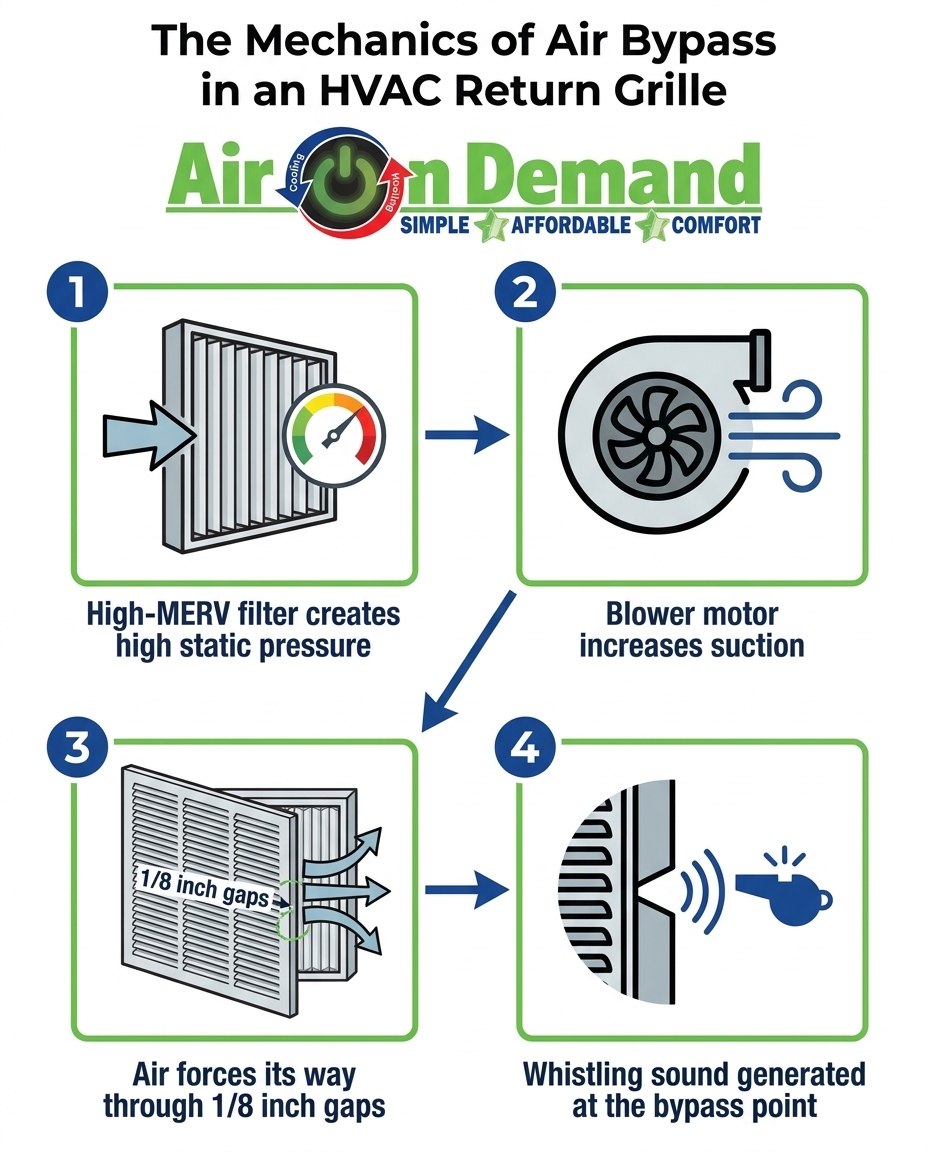
Your Health Smart filter whistles because its high-efficiency material increases static pressure in your air handler. If the filter isn't seated perfectly, the system's powerful suction forces air through tiny gaps around the frame, creating a high-pitched whistling sound known as air bypass.
In any forced-air heating and cooling system, air will always take the path of least resistance. When you place a dense barrier in front of the return duct, the blower motor still demands the same volume of air to circulate through your home. If the filter frame does not form an airtight seal against the return grille housing, the resulting suction will aggressively pull air through any available opening.
Even a gap as small as 1/8 of an inch is enough to cause problems. When the blower motor ramps up to full speed, the velocity of the air being dragged through that tiny crevice creates a vibration. This vibration translates into an audible, high-frequency whistle that echoes through your ductwork and into your living space. More importantly, this means unfiltered air is bypassing the media entirely, pulling dust and debris directly into your equipment and defeating the purpose of your indoor air quality upgrade.
To understand the physics of this phenomenon, think about how you whistle with your own mouth. If you open your mouth wide and exhale, the air moves silently. But if you purse your lips together tightly and force the same amount of air through that tiny opening, you generate a loud, piercing sound. The exact same principle applies to your return grille.
• High Velocity: The blower motor creates negative pressure, pulling air rapidly toward the air handler.
• Constricted Space: A microscopic gap between the cardboard filter frame and the metal grille acts like pursed lips.
• Vibration and Resonance: The fast-moving air vibrates the edges of the filter frame and the metal housing, amplifying the sound through the hollow return duct.
To understand the root of the air bypass issue, we have to look at how high-efficiency filters are constructed. Filters are rated on the MERV (Minimum Efficiency Reporting Value) scale. Standard fiberglass filters, often rated MERV 1 to 4, are highly porous. They stop large debris like pet hair and heavy dust bunnies, but they allow air to flow through with virtually no resistance. High-efficiency options, like a Health Smart filter (often rated MERV 11, 13, or higher), use densely packed, electrically charged microfibers to trap microscopic particles like pollen, mold spores, and fine particulate matter.
While this dense media is excellent for your lungs, it naturally restricts the volume of air that can pass through it. This restriction introduces a concept known as High-MERV static pressure. In residential HVAC systems, static pressure is the resistance to airflow within the ductwork and components. When you install a denser filter, the static pressure in the return duct spikes. You might be wondering, do Health Smart filters restrict airflow enough to cause damage? The short answer is that they force the blower motor to work significantly harder to pull the necessary volume of air through the restrictive media.
This increased workload has a compounding effect. As the motor pulls harder, the suction inside the return duct becomes much stronger than it would be with a cheap fiberglass filter. It is this intense, magnified suction that exposes poorly sealed return grilles, finding every tiny imperfection in the filter's seating and leading directly to the whistling effect.
• Standard Fiberglass (MERV 1-4) — Media Density: Very Low — Static Pressure Impact: Minimal — Airflow Resistance: Low — Risk of Whistling: Very Low
• Basic Pleated (MERV 5-8) — Media Density: Moderate — Static Pressure Impact: Moderate — Airflow Resistance: Medium — Risk of Whistling: Low to Moderate
• High-Efficiency (MERV 11-13+) — Media Density: Very High — Static Pressure Impact: Significant Spike — Airflow Resistance: High — Risk of Whistling: High (if improperly seated)
A whistling filter is far more than just a minor auditory annoyance; it is a blaring alarm that your system's efficiency is compromised. This is especially critical given Miami's extreme heat and high relative humidity. In our years of providing AC installation and repair across South Florida, we've seen firsthand that air conditioning systems do not just cool the air—they must run almost constantly to manage latent heat, which is the heavy moisture suspended in your indoor air.
Optimal airflow is absolutely critical for effective latent cooling and dehumidification. Here is a breakdown of how restricted airflow disrupts this delicate process:
• The Problem: The dense filter restricts the total volume of warm, humid indoor air reaching the air handler.
• The Cause: Because less air is moving over the indoor evaporator coil, the refrigerant inside the coil absorbs less heat than it was designed to.
• The Consequence: The temperature of the evaporator coil drops rapidly. Without enough warm airflow to keep it stabilized, the condensation on the coil can freeze.
• The Solution: Restoring proper airflow prevents the coil from dropping below freezing, allowing the system to extract moisture and drain it away safely.
If the coil freezes solid, your system will blow warm air, or stop blowing air entirely, while the compressor continues to run outside. When the block of ice eventually thaws, it often overwhelms the condensate drain pan, leading to severe water damage in your ceiling or utility closet. Ignoring a whistling sound during the humid transition months can quickly escalate into a catastrophic system failure.
Before assuming your system requires major repairs, there are several safe, actionable steps you can take to verify if the whistling is simply a filter installation error. Many times, a minor adjustment is all it takes to eliminate the noise and stop the air bypass.
Important safety note: Never attempt to open the air handler cabinet, modify the ductwork, or adjust internal blower speeds yourself. These tasks carry serious electrical hazards and require a licensed professional. You should only interact with the return grille and the filter itself.
1. Turn off the power: Always start by turning your thermostat to the "Off" position. Wait for the blower motor to spin down completely. This stops the suction, making it much easier to remove and inspect the filter without tearing it.
2. Verify the actual dimensions: Filters have a "nominal" size printed in large numbers (e.g., 20x20x1) and an "actual" size printed in smaller text (e.g., 19.5 x 19.5 x 0.75). If your return housing requires an exact 20-inch fit and your filter is slightly undersized, that 1/2-inch difference will create a massive air bypass whistle. Look for any gaps larger than 1/8 inch around the perimeter.
3. Check the directional airflow arrows: Every pleated filter has an arrow printed on the edge of the cardboard frame. This arrow must point *toward* the air handler (in the direction the air is flowing). Installing it backward forces the system to pull against the structural wire mesh in the wrong direction, increasing resistance and noise.
4. Inspect for physical damage: Ensure the filter is not bent, crushed, or improperly wedged into the housing. If you had to force or bend the cardboard frame to make it fit, the seal is broken. A compromised frame allows air to rush through the crumpled sections, generating a loud screech.
5. Test the seal: If you find a small gap, some homeowners temporarily apply a thin strip of foam weatherstripping to the inner lip of the metal grille housing to create a tighter seal against the cardboard frame. If the whistle stops after doing this, you have confirmed the issue was air bypass.
If you have gone through the troubleshooting steps, verified the filter size is perfect, ensured it is seated flawlessly, and the whistling *still* persists, you have reached the limit of DIY adjustments. At this stage, the noise is no longer just about a tiny gap in the return grille; it indicates that the system's ductwork or blower motor is fundamentally incompatible with the high static pressure of the new filter.
When a blower motor is forced to pull against an immovable wall of dense filter media, it experiences severe mechanical and electrical strain. You may notice other warning signs accompanying the whistle. The system might emit an unusual, deep humming sound from the air handler closet. You might experience short-cycling, where the AC turns on and off rapidly without actually cooling the house. Most commonly, you will feel a noticeable, drastic drop in the volume of air coming out of your supply vents.
This is where professional intervention is mandatory to protect your equipment. An HVAC technician will use specialized tools, such as a manometer, to measure the exact Total External Static Pressure (TESP) of your system. Our team at Air On Demand brings deep expertise in balancing high-efficiency indoor air quality solutions with the specific, high-volume airflow dynamics required for South Florida homes. We regularly see the damage caused when systems are pushed beyond their limits, which is why a professional must determine if your ductwork needs modification, if the blower speed needs to be safely recalibrated, or if you need to switch to a different style of media cabinet to achieve hospital-grade filtration without destroying your air handler services components.
It can be tempting to just turn up the television to drown out a whistling return vent, especially if the house still feels relatively cool. However, leaving air bypass unaddressed sets off a chain reaction of wear and tear that will drastically shorten the lifespan of your HVAC system.
Here is a checklist of what happens inside your system when unfiltered air bypasses the media:
• Component Coating: The bypassed air carries dust, pet dander, and airborne debris directly into the air handler. This grime coats the sensitive interior components, particularly the wet evaporator coil and the blower wheel blades.
• Loss of Efficiency: As dust acts like an insulating blanket on the evaporator coil, the system loses its ability to absorb heat. The AC must run longer cycles to compensate for the poor airflow and reduced heat transfer.
• Increased Energy Consumption: Longer run cycles and a struggling, overheating blower motor draw significantly more electricity, causing your monthly utility bills to spike unnecessarily.
• Costly Breakdowns: Continuous blower strain leads to premature motor failure. Furthermore, a dirty, freezing evaporator coil can allow liquid refrigerant to flow backward into the outdoor compressor, destroying the most expensive part of your system.
Proactive resolution is the only way to protect your investment. Addressing a whistling filter early prevents minor airflow issues from turning into the need for major AC repair in Miami.
Your new AC filter whistles because its dense, high-efficiency material restricts airflow, causing the blower motor to pull harder. This increased suction forces air through tiny gaps between the filter frame and the metal return grille. The high-velocity air vibrating through these small crevices creates the whistling noise.
High MERV filters are not inherently bad, but they can be damaging if your specific HVAC system was not designed to handle their increased static pressure. If your ductwork is undersized or your blower motor is older, a high MERV filter can severely restrict airflow, leading to overheating, frozen coils, and premature motor failure. Always consult a professional to see what MERV rating your system can safely support.
To fix a whistling return vent, first ensure your air filter is the exact correct size for the housing, as even a 1/8-inch gap can cause noise. Verify that the directional airflow arrows on the filter point toward the system and that the cardboard frame is not crushed or bent. If the filter is perfectly seated and still whistles, you may need a technician to evaluate your system's static pressure.
Yes, a whistling filter is a strong indicator of restricted airflow, which is the primary cause of frozen AC coils. When the dense filter blocks sufficient warm indoor air from reaching the evaporator coil, the refrigerant inside gets too cold and freezes the ambient condensation. This ice buildup will eventually stop your system from cooling entirely.
While a whistling AC is not usually an immediate safety danger to your family, it is a serious mechanical hazard to your HVAC equipment. The noise indicates high static pressure and air bypass, meaning your blower motor is under heavy strain and unfiltered dust is coating your internal components. Ignoring it will likely lead to expensive system breakdowns.
Ultimately, a whistling filter is your system's way of asking for an immediate airflow adjustment. While upgrading your indoor air quality is a smart move for fall preparation, it should never come at the cost of your air handler's mechanical health or your family's peace and quiet. Balancing clean, highly filtered indoor air with the efficient, high-volume cooling required in South Florida is entirely achievable with the right approach.
If you have checked your filter's sizing and seating but the high-pitched noise continues, it is time to stop guessing and get definitive answers. Schedule a professional inspection to evaluate your system's static pressure. We will ensure your IAQ upgrades are actually helping, rather than harming, your equipment, giving you a clear explanation of the mechanics and a permanent solution to the noise.