Can a Punctured Evaporator Coil Be Patched or Must It Be Replaced?
September 23, 2026
Is your indoor unit making a strange, continuous noise, leaving you wondering: can a punctured evaporator coil be patched or must it be replaced? When our technicians at Air On Demand get called out to a hissing, leaking indoor unit during the late-summer peak cooling season here in Miami, it usually indicates a punctured evaporator coil actively venting refrigerant into the air. This is a critical mechanical failure that immediately halts the system's ability to extract heat and humidity from your home. The hissing sound is the physical escape of pressurized gas through a breach in the metal, presenting homeowners with a difficult decision regarding the best path forward.
The short answer is that while patching a punctured coil is theoretically possible in a controlled environment, our team has found that the extreme high pressures of modern refrigerants and the ultra-thin materials used in today's systems make replacement the only mechanically sound, long-term solution. Attempting a quick patch on a compromised coil often leads to immediate failure, secondary leaks, and severe compressor damage. When facing this critical system failure, securing professional AC repair is the first step toward restoring reliable cooling.
Common symptoms our technicians see accompanying a punctured, hissing coil include:
• Rapid loss of cooling power: The air coming from your vents will quickly transition from cold to lukewarm as the refrigerant charge depletes.
• Ice accumulation: As the pressure drops inside the coil, the remaining refrigerant becomes too cold, causing ambient condensation to freeze solid on the metal fins.
• Short-cycling: The system may turn on and off rapidly as low-pressure safety switches trip to protect the compressor.
• Increased humidity: Without a fully functioning indoor coil, the system loses its ability to pull moisture out of the indoor air.
Understanding why a simple patch is insufficient requires looking closely at how modern cooling equipment is engineered and the intense physical stresses these components endure every time the thermostat calls for cooling.
In our years of servicing Miami's cooling systems, we've seen firsthand how HVAC manufacturing has evolved. Decades ago, indoor coils were primarily constructed from thick copper tubing. Copper was highly durable and relatively forgiving when subjected to the intense heat of a brazing torch, making physical repairs somewhat feasible. However, copper was also heavy, expensive, and prone to a specific type of degradation known as formicary corrosion—a chemical reaction caused by volatile organic compounds (VOCs) commonly found in household cleaning products, paints, and building materials.
To combat formicary corrosion and increase energy efficiency, the HVAC industry shifted toward modern aluminum evaporator coils. Aluminum offers exceptional thermal conductivity, meaning it transfers heat out of the indoor air much faster than older materials. However, the physical properties of aluminum make it incredibly unforgiving when it comes to structural repairs.
The engineering behind modern coils relies on maximizing the surface area while minimizing the thickness of the metal. This design choice is intentional and serves several critical functions for system performance:
• Better thermal conductivity: Thinner metal allows the cold refrigerant inside the tubes to absorb heat from the warm indoor air with minimal thermal resistance, resulting in higher energy efficiency ratings.
• Reduced weight and material footprint: Aluminum is significantly lighter than copper, allowing for larger, higher-capacity coils to be installed in tighter indoor spaces without overloading the structural supports of the air handler.
• The trade-off—repair difficulty: The primary drawback to this highly efficient, ultra-thin aluminum is its extreme susceptibility to melting, warping, or distorting when subjected to the high-temperature brazing torches required for metal repair.
Whether a breach in the coil is caused by a physical puncture (such as a tool slipping during maintenance) or microscopic pinhole leaks caused by environmental factors, the resulting structural weakness cannot be easily isolated. The thin walls of the tubing are designed for heat transfer, not for enduring the localized thermal shock of a repair torch.
• Thermal Conductivity — Legacy Copper Coils: Moderate — Modern Aluminum Coils: Exceptionally High
• Material Thickness — Legacy Copper Coils: Thick and rigid — Modern Aluminum Coils: Ultra-thin for efficiency
• Formicary Corrosion Risk — Legacy Copper Coils: High susceptibility to household VOCs — Modern Aluminum Coils: Highly resistant to VOC damage
• Brazing/Repair Viability — Legacy Copper Coils: Possible by skilled technicians — Modern Aluminum Coils: Highly prone to melting and failure
We often explain to our customers that the core issue with patching a modern indoor coil lies in the exact metallurgical challenges of brazing aluminum. Brazing is a metal-joining process where two pieces of metal are heated, and a filler metal is melted into the joint to create a seal. When working with copper, the melting point of the base metal is significantly higher than the filler, giving the technician a wide margin of error.
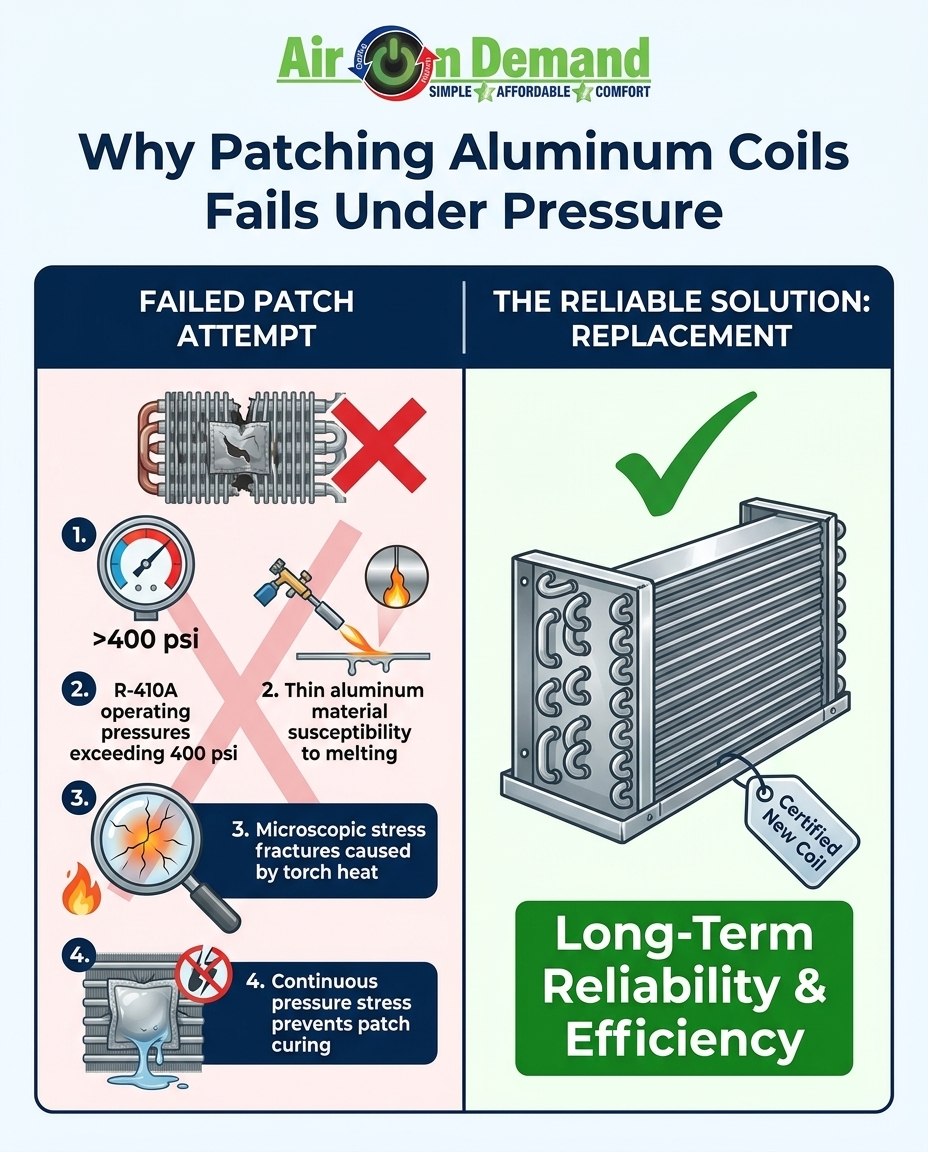
Aluminum, however, has a very narrow temperature window before it reaches its melting point. The filler rods required to patch an aluminum puncture melt at temperatures dangerously close to the melting point of the aluminum coil itself. When a technician applies a torch to patch a hole in the thin aluminum tubing, the surrounding metal absorbs the intense heat almost instantly.
The hidden damage of the Heat-Affected Zone (HAZ):
• Microscopic stress fractures: The rapid heating and cooling of the ultra-thin aluminum creates microscopic stress fractures in the metal immediately surrounding the patch.
• Warping and distortion: The localized heat causes the thin walls of the tubing to warp, altering the internal diameter of the coil and disrupting the precise flow of refrigerant.
• Compromised structural integrity: Even if the filler metal successfully covers the initial puncture, the surrounding aluminum is now brittle and permanently weakened.
It is crucial to understand that this is a technical limitation of the material itself, not a lack of technician skill on our part. The physics of applying high-temperature flames to paper-thin aluminum dictate that the area around the patch will always be weaker than the original factory extrusion. Once the structural integrity of that specific coil section is compromised, it is only a matter of time before the extreme internal forces of the system tear the weakened metal apart.
To fully grasp why a brazed patch on an aluminum coil is destined to fail, we tell our customers to look at the immense internal forces pushing against that patch from the inside. Modern air conditioning systems utilize R-410A high operating pressures to move heat efficiently. Compared to legacy R-22 systems, which operated at relatively moderate pressures, R-410A is a highly volatile, high-pressure compound.
During a standard cooling cycle, the pressure on the high side of an R-410A system can easily exceed 400 psi (pounds per square inch). To put that into perspective, the average car tire is inflated to roughly 35 psi. The refrigerant inside your indoor coil is pushing outward against the thin aluminum walls with more than ten times the force of a fully inflated tire. When a coil has been compromised by a puncture and subsequently weakened by the heat of a brazing torch, that 400 psi of force is constantly pressing against the most fragile, brittle section of the metal.
Here in Miami, our team knows that your air conditioner must run almost continuously, especially during the late-summer back-to-school transition, to properly dehumidify and cool the home. This continuous operation prevents the system from resting, keeping pressure stress on the coil at maximum levels for hours on end. The constant cycling of the compressor also introduces thermal expansion and contraction. As the coil rapidly cools down during operation and warms up when the system eventually shuts off, the metal expands and contracts. This microscopic movement flexes the weakened area around the patch over and over again.
Ultimately, our field experience shows that the combination of continuous high-pressure stress, thermal expansion, and the brittle nature of the heat-affected zone inevitably blows out temporary brazed patches. This is a primary reason why an AC hissing sound requires immediate attention—the forces at play are too extreme for a compromised component to withstand.
When we explain that brazing an aluminum coil is highly unreliable, Miami homeowners often ask us about alternative patching methods, such as exterior epoxies or chemical leak sealants injected directly into the refrigerant lines. While these products are heavily marketed as quick fixes, they present severe mechanical risks to the entire cooling system.
Chemical leak sealants are designed to circulate through the system along with the refrigerant and oil. When the sealant encounters a leak and is exposed to atmospheric moisture or oxygen, it is supposed to crystallize and plug the hole. However, air conditioning systems are incredibly sensitive to foreign contaminants. If there is any existing moisture inside the refrigerant lines—which is highly likely if the system has been leaking and sitting idle—the sealant can prematurely crystallize inside the moving parts of the system.
The dangers of relying on chemical sealants and epoxies:
• Gummed-up components: Sealants frequently clog the thermostatic expansion valve (TXV), a precision component that meters the exact flow of refrigerant into the evaporator coil. A clogged TXV completely halts the cooling process.
• Compressor failure: If the crystallized sealant reaches the outdoor compressor, it can destroy the internal valves and bearings, turning a coil problem into a catastrophic total system failure.
• Inadequate exterior epoxies: Two-part epoxies applied to the outside of a puncture cannot withstand the continuous thermal expansion, contraction, and high operating pressures of R-410A. The epoxy eventually cracks and peels away, reopening the leak.
These methods are unreliable band-aids that often lead to much more severe secondary breakdowns. Relying on a chemical additive to fix a structural failure is a gamble that frequently results in a homeowner needing emergency AC repair when the compressor ultimately locks up.
Given the insurmountable challenges of brazing thin aluminum, the extreme operating pressures of modern refrigerants, and the catastrophic risks of chemical sealants, full replacement is the scientifically and mechanically correct approach to a punctured coil. Installing a new, factory-sealed evaporator coil is the only way to guarantee that the system's original pressure tolerance and structural integrity are fully restored.
A factory-sealed coil is manufactured under strict quality control standards. The aluminum tubing is extruded flawlessly, and the entire assembly is pressure-tested at the factory to ensure it can withstand the rigors of R-410A refrigerant. By opting for a replacement, you eliminate the risk of secondary leaks forming around a weakened, heat-damaged patch area. Furthermore, restoring proper, unimpeded refrigerant flow ensures the system can adequately dehumidify and cool the home without forcing the compressor to overwork.
At Air On Demand, our team's commitment to transparent diagnostics means we will always give you an honest assessment on when a temporary patch is a waste of money versus when a coil replacement is the only safe, long-term solution. Framing the replacement recommendation as an issue of mechanical safety and long-term reliability ensures that homeowners are not throwing good money after bad. A proper Miami AC repair strategy prioritizes the longevity of the entire HVAC system, protecting the expensive outdoor compressor from the strain of operating with a compromised indoor coil.
While physically possible in a controlled environment, our technicians highly discourage repairing a hole in an evaporator coil due to the extreme operating pressures of modern refrigerants. The process of applying intense heat to thin aluminum creates structural weaknesses that almost guarantee the patch will fail once the system is pressurized. For long-term reliability, replacing the damaged coil is the standard mechanical recommendation.
Welding or brazing thin aluminum coils is incredibly difficult and often results in melting the surrounding metal, creating further damage. Because the melting point of the aluminum tubing is so close to the melting point of the filler material, the torch heat frequently warps the coil and causes microscopic stress fractures. These fractures become new leak points as soon as the system resumes operation.
Leaks typically occur due to physical punctures, continuous high-pressure stress, or formicary corrosion from household VOCs. While modern aluminum is highly resistant to the chemical corrosion that plagued older copper coils, it is still susceptible to physical damage from tools, severe vibration, or the continuous stress of high-pressure R-410A refrigerant pushing against a weak point in the factory extrusion.
With proper maintenance and optimal operating conditions, a factory-sealed evaporator coil can last 10 to 15 years. Regular filter changes, maintaining proper airflow, and ensuring the system is operating with the correct refrigerant charge all contribute to the longevity of the coil. However, once a coil suffers a physical puncture, its lifespan is effectively over.
No, continuing to run the system with a refrigerant leak forces the compressor to overwork and can lead to complete system failure. When the system loses refrigerant, the compressor loses its primary source of cooling, causing it to overheat. Running a compromised system turns a localized coil issue into a catastrophic failure of the most vital component in your air conditioner.
Dealing with a punctured indoor coil can be a frustrating experience, especially when the failure occurs during the hottest weeks of the late-summer cooling season. However, understanding the mechanical realities of your HVAC system empowers you to make informed decisions. The intense pressures of R-410A and the delicate nature of modern aluminum make patching a punctured coil an unreliable gamble that places your entire system at risk. Re-pressurizing a weakened, patched coil is simply delaying the inevitable.
Reiterating the facts, a full coil replacement guarantees restored system integrity, proper dehumidification, and consistent cooling performance without the looming threat of a sudden blowout. You deserve the confidence to make the right repair versus replace decision without the stress of repeated breakdowns. If you are dealing with a hissing indoor unit or a sudden loss of cooling, seek a professional, honest diagnostic assessment from our team to determine the best path forward. Protect your home's comfort and your system's lifespan by exploring professional AC replacement services today.