Protecting Your Outdoor AC Unit from September Yard Debris
September 25, 2026
Your lawn looks perfectly manicured after a long weekend of yard work, but your air conditioner is suddenly struggling to keep the house cool. At Air On Demand, our technicians frequently see this scenario as we transition into early fall. Protecting your outdoor AC unit from September yard debris is a common oversight that leads to unexpected breakdowns just as homeowners are starting their pre-heating-season prep. Many homeowners focus on trimming back heavy vegetation and preparing their properties for incoming weather, completely forgetting about the mechanical equipment sitting right in the middle of the landscaping zone.
When you tackle heavy yard work, it is incredibly easy to accidentally kick up wet grass clippings, dirt, and heavy mulch directly into an actively running air conditioner or heat pump. Because the unit is pulling in massive amounts of air to function, it acts like a giant vacuum for airborne landscaping waste. Navigating the September late-summer growth and storm prep season requires a specific strategy for clearing the perimeter without damaging delicate internal components.
Before you fire up the lawnmower or break out the heavy shears this weekend, it is critical to understand how landscaping impacts your cooling system. Maintaining a clean, debris-free zone is a cornerstone of proper AC maintenance, ensuring your equipment operates efficiently as we head into the autumn months.
Most landscaping damage happens in the blink of an eye. A mower discharges a thick clump of wet grass directly at the unit, or a weed whacker gets a fraction of an inch too close to the exterior casing. While the outside of the cabinet might look sturdy, the internal mechanisms rely on precise, unobstructed airflow to function. When that airflow is compromised by a sudden influx of yard waste, the system immediately begins to suffer.
Understanding the relationship between your landscaping habits and your HVAC system's health is the first step in preventing unnecessary wear and tear. By adjusting how you approach perimeter clearing, you can keep your yard looking pristine without sacrificing your indoor comfort or indoor air quality (IAQ).
In our years of providing expert AC repair and AC installation across Miami, the team at Air On Demand has learned that generic fall HVAC advice often focuses on dry, falling autumn leaves and preparing systems for winter hibernation. That advice does not apply in South Florida. Here, systems are still running at near-peak capacity well into the fall. Because the equipment is actively working to cool your home, the threat is not dry leaves—it is heavy, wet Bahia grass, damp soil, and sticky mulch acting like a suffocating blanket on the unit.
To understand why this is so dangerous, you have to look at how the system actually works. The outdoor unit's primary job is to pull in massive volumes of outside air across the outdoor condenser coil fins to shed the heat it absorbed from inside your home. When wet debris plasters itself against these fins, it blocks that critical air intake. The system can no longer release heat effectively, trapping high temperatures inside the equipment.
When airflow is restricted by a layer of wet yard waste, the mechanical strain on the system skyrockets. The compressor, which pumps refrigerant through the lines, is forced to work harder and run significantly hotter to achieve the same cooling output. This continuous strain leads to severe overheating.
The cascading failure process:
• Blocked Intake: Wet grass seals off the narrow gaps between the aluminum fins.
• Trapped Heat: The internal temperature of the condenser casing rises rapidly.
• Component Stress: The compressor draws more electrical current, trying to force the cooling cycle to complete.
• System Shutdown: The extreme heat eventually triggers safety switches, resulting in fan motors shutting down due to thermal overload.
Because Miami AC units run relentlessly in September to combat high humidity and temperatures, suffocating them with landscaping debris is a fast track to a complete system failure.
• Dry Autumn Leaves — Behavior Around HVAC Units: Blows away easily, tends to rest loosely on top of the fan grille. — Impact on System Performance: Minor airflow restriction; usually easy to brush off by hand.
• Wet Grass Clippings — Behavior Around HVAC Units: Clumps together, acts like a wet paste, and gets sucked into narrow gaps. — Impact on System Performance: Severely chokes airflow, plasters against fins, and traps moisture against metal parts.
• Heavy Wood Mulch — Behavior Around HVAC Units: Retains water, heavy enough to dent soft metal if thrown by a mower blade. — Impact on System Performance: Can cause physical impact damage and block lower intake vents completely.
Establishing clear boundaries around your HVAC equipment is the most effective way to prevent accidental landscaping damage. Across countless Miami-area residential properties we service, our technicians see a clear pattern: systems that enjoy a wide, clean perimeter consistently outlast and outperform those choked by encroaching vegetation. Following a strict set of rules during your weekend yard cleanup will keep your system breathing easily.
Essential rules for maintaining a safe HVAC perimeter:
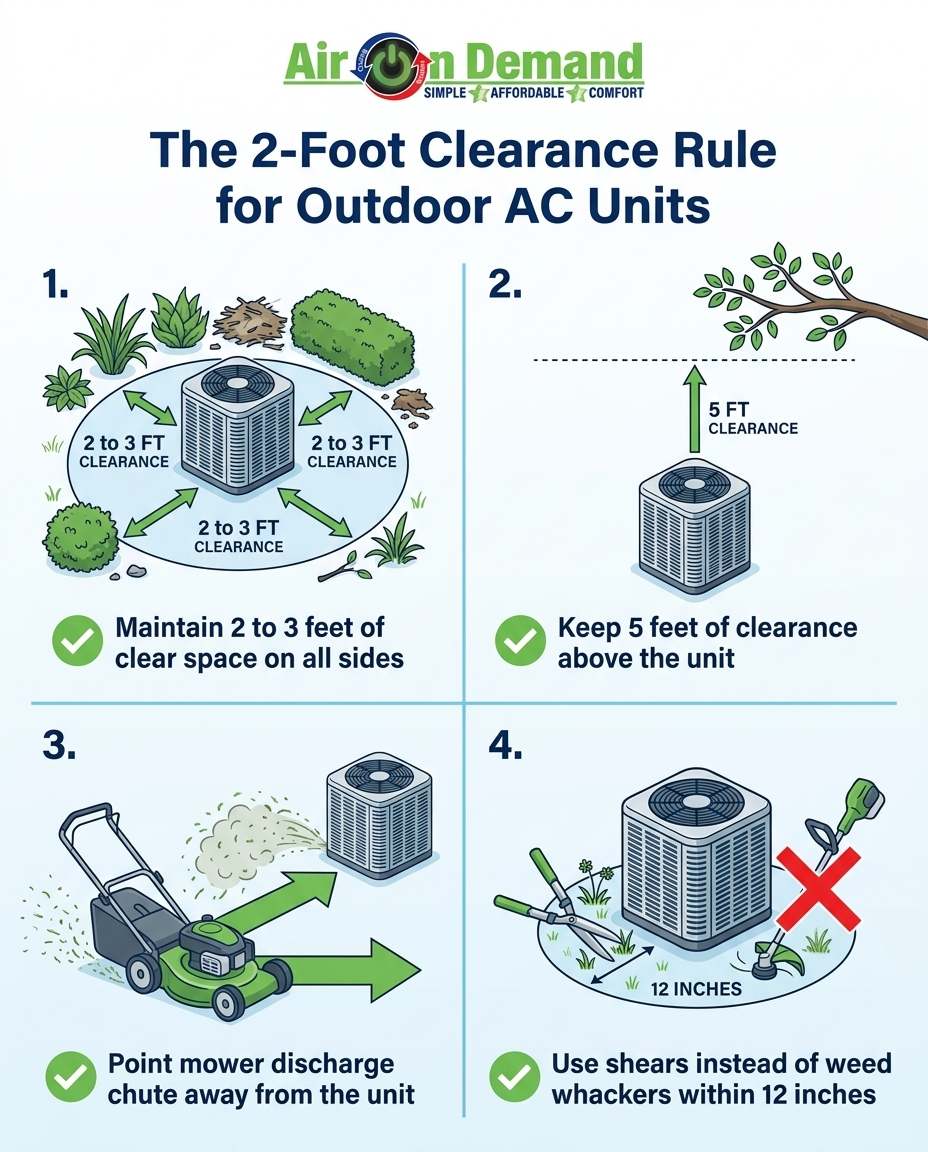
• Enforce the 2-to-3-foot clearance rule: Keep all sides of the outdoor unit completely free of plants, tall grass, and decorative items. This provides the minimum volume of space required for adequate air intake.
• Maintain vertical clearance: Ensure there is at least 5 feet of unobstructed space directly above the unit so the exhaust fan can blow hot air upward without it bouncing back down.
• Control the mower discharge: Always point the lawnmower's discharge chute away from the HVAC unit. Never make a pass where the side-discharge sprays clippings directly at the metal casing.
• Rake and bag heavy debris: Instead of using a high-powered leaf blower near the unit—which forces dirt and dust deep into the mechanical components—rake heavy debris by hand and bag it immediately.
• Trim back encroaching shrubs: Bushes and hedges grow rapidly in late summer. Trim them back regularly so branches do not push through the protective grille.
• Inspect after every landscaping session: Before heading inside, do a quick visual walk-around of the unit to ensure no stray clippings or branches are resting against the exterior.
Vegetation in South Florida grows aggressively, especially after heavy afternoon rains. A perimeter that was perfectly clear in August can easily become overgrown by late September. Making the 2-to-3-foot clearance rule a mandatory part of your weekly lawn care routine ensures the equipment never starves for air.
One of the most frequent landscaping accidents our team repairs involves the improper use of string trimmers (weed whackers) near the condenser casing. While these tools are excellent for edging sidewalks, they are highly destructive when brought too close to HVAC equipment. The exterior of your unit is lined with thousands of tightly packed outdoor condenser coil fins, which are manufactured from extremely thin, fragile aluminum.
These fins are designed to be thin so they can transfer heat efficiently, but that thinness makes them highly susceptible to physical damage. A weed whacker string spinning at high speeds can easily slice through the protective outer cage and flatten dozens of fins in a fraction of a second. When these fins are bent flat, they permanently block airflow to that section of the coil, even if no dirt or debris is present.
To protect these delicate components, you must change your approach when working within the immediate 12-inch radius of the unit. Never use high-speed power tools in this danger zone.
The hand-clearing method:
1. Turn off the power to the AC unit at the thermostat so it does not kick on while you are working nearby.
2. Put on heavy gardening gloves to protect your hands from sharp metal edges.
3. Manually pull weeds, tall grass, and vines that have grown up against the concrete pad or the unit itself.
4. Use manual hand shears to carefully snip away thicker stalks that cannot be pulled by the roots.
If an accident has already happened and a large section of the aluminum fins is heavily bent, flattened, or damaged by flying debris, DIY fixes are not recommended. Attempting to pry the fins back open with a knife or screwdriver usually tears the metal, leading to expensive refrigerant leaks. In these cases, professional AC repair services in Miami are necessary to properly comb the fins back into alignment and restore proper airflow.
September is the statistical peak of the Atlantic hurricane season, bringing a unique set of challenges to early fall yard maintenance. The focus shifts from simple lawn mowing to extensive storm preparation. During this time, the types of debris threatening your HVAC system become much larger and significantly more dangerous. Daily heavy rains accelerate vegetation growth, while high winds threaten to turn loose yard waste into destructive projectiles.
Preparing your property for severe weather during the September late-summer growth and storm prep season requires careful attention to the area surrounding your outdoor unit. Heavy flying debris, such as large palm fronds, coconuts, and broken oak branches, can dent the casing, smash the fan grille, or severely damage the internal fan blades if they strike the unit during a storm.
Taking proactive steps before the wind picks up can save your system from catastrophic physical damage. Follow these structured steps to secure the perimeter:
1. Clear dead branches early: Survey the trees surrounding your property. Prune any dead or dying branches that overhang the HVAC unit, as these are the first to snap during high winds.
2. Secure loose patio items: Patio furniture, children's toys, and lightweight potted plants should be moved indoors or tied down. In strong gusts, these items can smash into the condenser casing.
3. Remove heavy organic waste: Do not leave piles of trimmed palm fronds or heavy brush near the unit waiting for bulk trash pickup. High winds will scatter this debris directly into the equipment.
4. Conduct a post-storm visual inspection: After a severe weather event passes, never turn the AC back on immediately. Walk outside and inspect the unit. Look for heavy debris lodged in the top fan grille or plastered against the side intakes.
5. Clear the fan path: Ensure no branches have fallen through the top grille. If a stick is jamming the fan blade and the system tries to turn on, the fan motor will burn out almost instantly.
As a local Miami business, we know our specific weather patterns demand vigilance. The combination of intense heat, daily deluges, and tropical storm threats means your outdoor equipment is constantly battling the elements. Keeping the area clear is your best defense.
We always tell our customers that there is a distinct line between maintaining the landscaping around your unit and actually cleaning the internal components of the HVAC system. While homeowners play a crucial role in keeping the 2-to-3-foot perimeter clear, extracting debris that has already breached the outer casing requires professional expertise.
If you notice a light accumulation of dust or dry grass on the outside of the unit, it is generally safe to gently rinse the exterior with a standard garden hose set to a low-pressure shower spray. Always spray from the top down to wash debris away from the fins. However, you must never use a pressure washer on your air conditioner. The high-velocity water will instantly flatten the outdoor condenser coil fins, causing severe and permanent airflow restriction.
Once wet grass, sticky mulch, and damp dirt are sucked deeply into the coil fins, surface rinsing is no longer effective. In fact, spraying water on deeply embedded dirt often turns it into thick mud, cementing it further into the narrow gaps. When debris reaches this level of penetration, the unit's outer cage must be carefully dismantled for internal cleaning—a task that requires a licensed professional.
Signs you need professional intervention:
• Visible matting: A thick, visible blanket of dirt or grass is trapped between the protective cage and the aluminum fins.
• Longer cooling cycles: The system runs constantly but struggles to reach the temperature set on the thermostat.
• Unusual heat: The air blowing out of the top of the outdoor unit feels exceptionally hot, or the metal casing is hot to the touch.
• Increased energy bills: A sudden spike in electrical costs indicates the compressor is working overtime to overcome restricted airflow.
Because South Florida's extreme weather impacts equipment so uniquely, local technicians know exactly how to safely extract stubborn, wet tropical debris from delicate coils without causing damage. Scheduling a routine AC inspection ensures that deep-seated debris is handled properly, restoring your system to peak operational efficiency.
Protecting your HVAC equipment from landscaping damage does not require specialized tools, just a bit of mindful planning. By enforcing a strict clearance zone, pointing your mower discharge away from the casing, and keeping weed whackers at a safe distance, you can prevent the vast majority of debris-related breakdowns across Miami-area residential properties.
As you tackle your next round of yard work, remember that a clean perimeter is the best way to keep the system running efficiently. If your unit has already ingested a heavy dose of wet grass or storm debris, do not wait for the compressor to overheat. Take action and schedule a professional AC coil cleaning before late-season storms cause further buildup. Additionally, early fall is the perfect time to consider upgrading aging equipment to a high-efficiency heat pump, which may qualify for generic federal tax credits or local utility incentive programs, ensuring your home stays comfortable year-round.
How do I protect my AC unit from grass clippings?
The most effective method is to always point your lawnmower's discharge chute away from the AC unit when mowing nearby. Additionally, leave a 2-to-3-foot buffer zone around the equipment where you use hand shears instead of power equipment. If clippings do blow toward the unit, gently brush them off the exterior casing immediately after mowing.
How much clearance does an outdoor AC unit need?
HVAC manufacturers strongly recommend maintaining a minimum of 2 to 3 feet of unobstructed clearance on all four sides of the outdoor unit. Furthermore, you should ensure there is at least 5 feet of vertical clearance above the unit. This open space allows the system to pull in sufficient fresh air and exhaust hot air without restriction.
Can you spray water on your outside AC unit to clean it?
Yes, you can use a standard garden hose set to a gentle shower setting to rinse light dust and loose clippings off the exterior. Always spray at a downward angle to avoid driving dirt deeper into the fins. However, you must never use a pressure washer or a high-pressure nozzle, as the force will permanently bend the delicate aluminum fins.
What happens if grass gets in the AC unit?
When wet grass gets sucked into the AC unit, it plasters against the condenser coil fins and blocks the intake of air. This suffocation prevents the system from releasing heat, forcing the compressor to work much harder and run hotter. Over time, this extreme thermal strain can cause the fan motor to overheat and shut the entire system down.
Is it safe to use a weed whacker near my condenser?
No, it is highly dangerous to use a string trimmer within 12 inches of your outdoor AC unit. The high-speed string can easily slice through the outer protective cage and flatten the fragile aluminum fins inside. Instead, manually pull weeds by hand or use manual garden shears to clear vegetation directly against the concrete pad.
How often should I have my outdoor AC coils professionally cleaned?
For most homes, having the outdoor coils professionally cleaned once a year during a routine maintenance visit is sufficient. However, if your unit is exposed to heavy tropical storms, excessive yard debris, or sits near a high-traffic landscaping zone, you may need a professional cleaning twice a year to maintain optimal airflow.