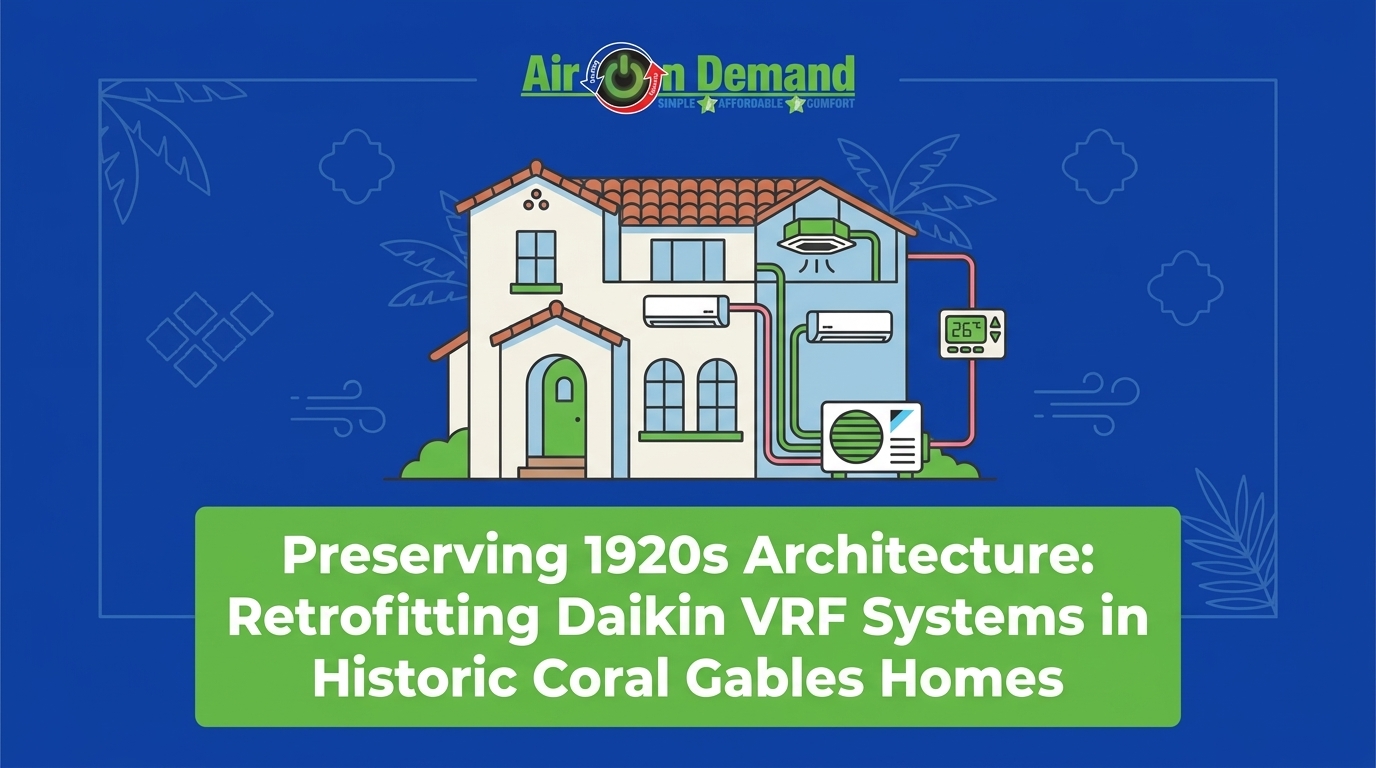
Retrofitting Daikin VRF Systems in Historic Coral Gables Homes
September 27, 2026
Your historic home is a masterpiece of architectural design, but struggling with relentless heat and humidity shouldn't be the price you pay to live in it. Upgrading your climate control often forces a painful choice: suffer through inefficient, noisy cooling, or rip open original walls to install massive metal ductwork. Retrofitting Daikin VRF Systems in Historic Coral Gables Homes solves this exact dilemma, allowing you to bridge the gap between century-old craftsmanship and modern comfort.
If you are exploring advanced cooling solutions that respect your property's heritage, integrating Daikin equipment offers a pathway to exceptional indoor air quality without the devastating demolition associated with traditional central air.
Properties built during the Florida land boom were designed for a different era. The iconic 1920s Coral Gables historic district features stunning Mediterranean Revival architecture, boasting thick masonry walls, arched doorways, and high ceilings intended to promote natural cross-ventilation. These homes were never built to accommodate the bulky trunk lines, return plenums, and extensive ductwork required by standard modern HVAC systems.
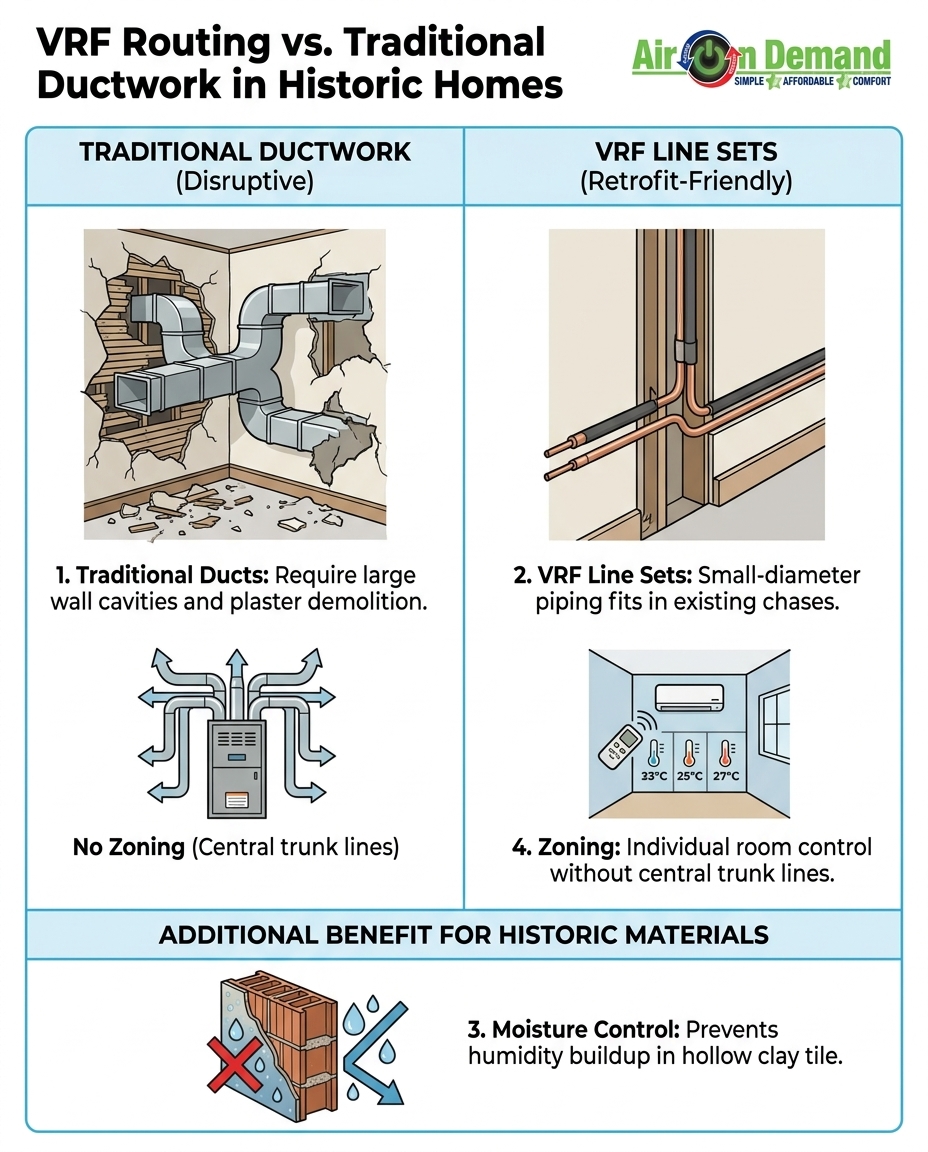
The traditional retrofit problem: When contractors attempt to force a standard central air system into a vintage home, the results often compromise the building's aesthetic integrity. You end up with lowered ceilings, unsightly drywall bulkheads cutting across grand hallways, or original plaster walls torn down to the studs just to create a path for the air to flow.
The modern solution: Homeowners need a system that adapts to the house, rather than forcing the house to adapt to the system. Advanced variable capacity systems route cooling power through narrow, flexible lines rather than massive metal tubes, bypassing the need for major structural alterations.
Understanding the bones of a vintage property is the first step in protecting it. Original construction materials from the 1920s Coral Gables historic district are fundamentally different from modern drywall and concrete block. They possess a unique charm and superior acoustic properties, but they are also incredibly fragile when subjected to modern power tools.
Most historic homes in the area utilize a combination of hollow clay tile for structural support, covered by a lath and plaster finish.
• Hollow clay tile: Used extensively in the 1920s, these terra cotta blocks are strong under compression but highly brittle. A standard rotary hammer drill can easily shatter them.
• Wood lath: Thin strips of wood nailed horizontally across studs.
• Plaster keys: When wet plaster was pushed through the gaps in the wood lath, it formed "keys" on the backside that locked the wall in place as it dried.
The vibration threat: Standard masonry techniques used for modern homes create intense vibrations. When heavy drills hit historic walls, those century-old plaster keys snap off. The result is severe spider-cracking across the wall's surface, or worse, large sections of plaster sagging and detaching entirely from the lath.
Understanding these structural quirks is essential for planning a retrofit that respects the architecture. Contractors must use specialized, low-impact masonry techniques, such as diamond-bit core drilling at low speeds, to create necessary pathways without sending destructive shockwaves through the wall. For many historic property owners, transitioning to ductless mini split systems or advanced variable refrigerant setups is the only way to ensure these delicate frameworks remain intact.
If traditional ductwork is the enemy of historic preservation, what is the alternative? The answer lies in changing how we transport cooling power throughout the home. Daikin VRF (Variable Refrigerant Flow) systems represent a massive leap forward in minimally invasive climate control.
Traditional central air conditions the air in one central location and uses large metal tubes (ducts) to push that air to different rooms. VRF technology flips this concept. Instead of moving air, it moves refrigerant.
The spatial advantage: VRF systems utilize small-diameter copper refrigerant lines—often no thicker than a standard garden hose. These compact line sets can be routed through existing structural cavities, tucked behind baseboards, or run through defunct chimneys, drastically minimizing the need to tear into walls.
Historic homes often feature segmented, closed-off floor plans rather than modern open-concept designs. This makes traditional central air highly inefficient, as it attempts to cool the entire house based on a single thermostat reading.
Precise zoning capabilities allow a VRF system to manage varying heat loads in individual rooms efficiently. You can set the sun-drenched Florida room to one temperature while keeping the shaded master bedroom at another. Options like Daikin Fit systems provide high-efficiency cooling with a significantly reduced physical footprint, making them highly suitable for older properties with tight lot lines and strict aesthetic requirements.
With South Florida's relentless heat and high humidity, the air outside your home is constantly trying to equalize with the conditioned air inside. In a 1920s home, this creates a unique set of challenges regarding moisture management. Historic houses "breathe" differently than modern, tightly sealed construction.
Improperly retrofitted HVAC lines can cause severe condensation issues. If standard copper pipes carrying cold refrigerant are routed through hot, uninsulated vintage wall cavities without meticulous vapor barriers, they will sweat. Over time, this constant dripping leads to plaster rot, mold growth, and the structural degradation of the wood lath.
The psychrometric advantage: Daikin VRF (Variable Refrigerant Flow) systems offer superior moisture control. Because these systems modulate their capacity rather than simply turning on and off, they run longer cycles at lower speeds. This continuous operation pulls significantly more latent heat (humidity) out of the indoor air, preventing humidity buildup inside delicate wall cavities.
Proper insulation of all line sets is mandatory to maintain the integrity of historic plaster over time. Every inch of piping must be encased in high-grade, closed-cell foam insulation to ensure zero condensation occurs within the walls. Advanced climate control ensures that the home's interior environment protects both the occupants and the irreplaceable architecture.
The success of retrofitting a historic home comes down to the planning phase. Finding pathways for refrigerant lines, power cables, and condensate drains without altering the visual appeal of a room requires a deep understanding of vintage construction.
Professionals utilize existing chases, stacked closets, and minimal exterior penetrations to route line sets. A common strategy in the 1920s Coral Gables historic district involves identifying non-primary spaces—like the back corners of utility closets or defunct laundry chutes—to run the vertical piping between floors. From there, lines can be carefully threaded between floor joists to reach individual rooms.
Careful planning ensures that indoor air handlers are placed unobtrusively. Whether utilizing low-wall floor consoles that mimic the look of vintage radiators, or slim-ducted units hidden completely inside drop-ceilings above modern bathroom renovations, the goal is to maintain the room's visual appeal.
Coordination with local preservation guidelines ensures all exterior modifications meet historic board standards. Exterior line sets must often be camouflaged using custom architectural covers painted to match the original stucco, ensuring the home's curb appeal remains untouched.
Expert AC installation in Miami requires a deep understanding of these specific structural routing methods. It is a meticulous process of mapping the home's anatomy before a single tool is ever powered on.
Retrofitting a century-old property is not a rushed weekend project. It is a deliberate, careful process that requires the home to be without primary cooling during the installation phase. Because of this, scheduling complex retrofits requires strategic planning to minimize downtime during peak heat.
The September pre-fall transition offers an ideal window for comprehensive system upgrades. While temperatures in South Florida remain warm, the extreme, oppressive heat of mid-summer begins to taper off. This slight drop in cooling load makes the transition period significantly more comfortable for occupants while the home is temporarily unconditioned.
Proactive planning benefits:
• Reduced emergency pressure: Completing the installation ahead of the dry season ensures the home is optimized for year-round comfort without the stress of an emergency breakdown.
• Better contractor availability: The fall transition often allows for more flexible scheduling, ensuring the installation team has the uninterrupted time needed to execute delicate plaster work.
• System optimization: Upgrading proactively prevents emergency replacements, which can rush the delicate preservation process and lead to regrettable aesthetic compromises.
Retrofitting historic homes is not a standard installation. It requires specialized training, proven protocols, and a deep respect for the materials involved. Not every technician is equipped to handle hollow clay tile or understand the nuances of a Mediterranean Revival floor plan.
Air On Demand brings specialized experience as a local Miami Daikin dealer uniquely equipped to navigate 1920s historic properties. Local experts understand the municipal guidelines, permitting requirements, and preservation standards unique to the area. This ensures your project moves forward smoothly without running afoul of local architectural review boards.
Proper installation by a certified dealer ensures the system operates efficiently and protects the home from moisture damage. Furthermore, working with authorized professionals guarantees access to comprehensive Daikin unit replacement guarantees and long-term support. When dealing with Daikin VRF (Variable Refrigerant Flow) systems, factory-authorized commissioning is vital to ensure the complex electronics and variable-speed compressors communicate flawlessly.
The short answer is to use a ductless or variable refrigerant flow (VRF) system. These systems rely on small-diameter refrigerant lines rather than large metal air ducts to transport cooling power throughout the house. The lines are flexible enough to be routed through existing wall cavities, closets, or exterior chases, completely bypassing the need to tear down ceilings or build drywall bulkheads.
Yes, VRF systems are uniquely suited for old houses with plaster walls. Because the piping is so small, technicians can use specialized, low-vibration core drills to create tiny penetrations without shattering the fragile plaster keys behind the wall. This minimizes the risk of spider-cracking and preserves the 1920s Coral Gables historic district aesthetic.
Variable Refrigerant Flow (VRF) and multi-zone ductless systems are widely considered the gold standard for historic preservation. They offer precise room-by-room temperature control and exceptional humidity management while requiring virtually zero structural demolition. This ensures the home's original millwork, plaster, and floor plans remain entirely intact.
Contractors avoid standard rotary hammer drills, which create violent vibrations that destroy old plaster. Instead, professionals use high-speed, diamond-bit core drills to cut cleanly through the plaster and underlying lath or hollow clay tile. Additionally, lines are often routed through non-structural areas like stacked closets to minimize wall penetrations altogether.
A Daikin VRF system requires surprisingly little space compared to traditional central air. The outdoor units feature a slim, side-discharge profile that fits easily into tight side yards or zero-lot-line spaces common in historic neighborhoods. Inside, the refrigerant lines require only a few inches of clearance, and the indoor air handlers can be mounted on walls, hidden in dropped ceilings of renovated bathrooms, or placed near the floor.
Modern climate control does not require sacrificing the architectural beauty of a historic home. The craftsmanship of the 1920s Coral Gables historic district was built to last, and your cooling system should respect that legacy. With expert planning and advanced VRF technology, delicate plaster walls remain fully protected while delivering whisper-quiet, highly efficient comfort to every room.
Protecting your investment means choosing a solution designed specifically for the unique challenges of vintage architecture. Consult with a local specialist to evaluate your property's specific structural needs, map out non-invasive piping routes, and safeguard your home against humidity. Schedule an assessment today to explore minimally invasive cooling solutions that keep your historic home perfectly comfortable year-round.