Labor vs. Parts: Understanding the Fine Print of Your Daikin Heat Pump Warranty
September 29, 2026
Most homeowners believe that a ten-year factory guarantee means a decade of completely free repairs. However, exploring Labor vs. Parts: Understanding the Fine Print of Your Daikin Heat Pump Warranty quickly shatters that common misconception. A typical pattern we see is a homeowner experiencing a breakdown, assuming their relatively new system is fully protected, and then feeling frustrated when handed a substantial quote to get the unit running again. This confusion stems from a fundamental misunderstanding of how the heating and cooling industry handles equipment guarantees. The manufacturer builds the physical machine, but a local contractor must provide the expertise, time, and consumable materials to diagnose and fix it.
Understanding this division of responsibility is especially important during the September pre-fall transition. As you prepare your home for shifting weather patterns, addressing lingering performance issues becomes a priority. If your system is struggling, you need to know exactly what your factory coverage provides and what out-of-pocket costs you are responsible for before approving a repair. Relying on Daikin equipment gives you access to some of the most robust factory guarantees in the industry, but those guarantees only apply to the physical components themselves. For the actual hands-on work, such as professional AC repair in Miami, you are paying for the specialized local expertise required to implement that factory part safely and correctly.
To navigate a major repair confidently, you must separate the physical manufactured part from the skilled labor required to install it. The factory that assembled your unit operates in a controlled environment, producing thousands of identical components. Their guarantee is a promise that the metal, wiring, and circuitry they built are free from manufacturing defects. If a component fails prematurely, they will provide a replacement piece of hardware at no cost. However, the factory does not dispatch technicians, operate service vehicles, or purchase the consumable materials needed to perform repairs in your specific neighborhood.
The local contractor provides the human expertise necessary to turn a physical part in a cardboard box into a functioning climate control system. This involves diagnosing the exact failure, safely removing the broken component, and integrating the new hardware into your home's existing infrastructure. Comparing a Daikin unit replacement guarantee vs. standard warranties highlights how different tiers of coverage work, but the baseline separation between hardware and service remains consistent across the industry.
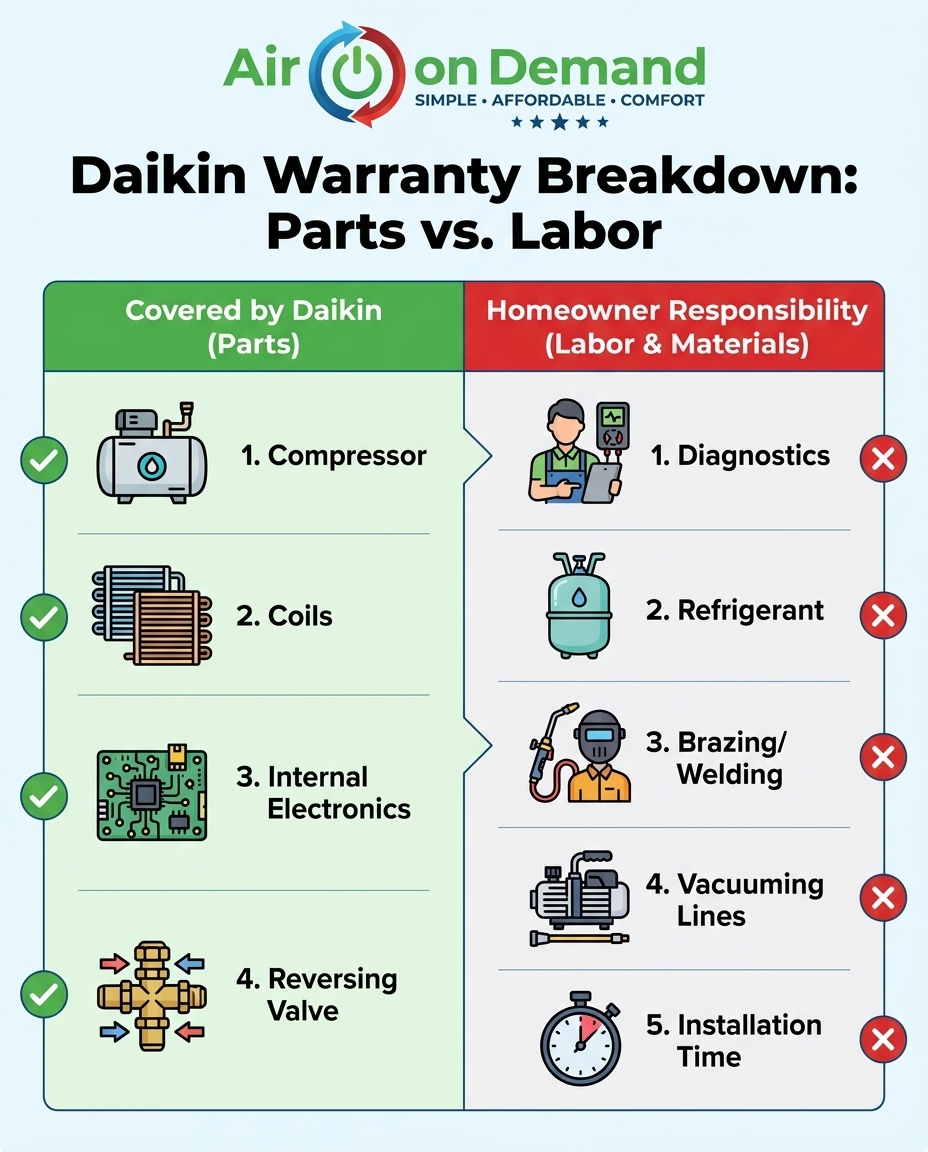
• Manufacturer Parts — What It Includes: The physical hardware (e.g., coils, motors, circuit boards, valves) built by the factory. — Who Pays For It: Covered by the manufacturer (if registered and within the active warranty period).
• Skilled Labor — What It Includes: The technician's time to diagnose, disassemble, install, and test the system. — Who Pays For It: Paid by the homeowner (unless an extended labor agreement was purchased separately).
• Consumable Materials — What It Includes: Refrigerant, brazing rods, nitrogen, wiring connectors, and recovery tanks. — Who Pays For It: Paid by the homeowner as part of the overall repair service.
• Diagnostic Fees — What It Includes: The specialized testing required to identify the root cause of the failure before ordering parts. — Who Pays For It: Paid by the homeowner to the local service provider.
A standard factory agreement protects you against the cost of a defective Daikin heat pump compressor or reversing valve, which are expensive pieces of hardware. It does not protect against the local costs of operating a service business, maintaining specialized tools, and employing licensed professionals to perform the heavy lifting.
When properly registered, Daikin offers some of the most comprehensive parts protection available, often extending up to 10 or 12 years depending on the specific model. This factory guarantee is designed to give you long-term confidence in the hardware itself. If a mechanical or electrical component fails due to a flaw in the manufacturing process, the company will supply a direct replacement part to your local contractor.
The scope of this coverage includes nearly every physical component inside the metal cabinet. Knowing exactly what is included helps you review repair quotes with greater clarity.
• Major mechanical components: This includes high-value items like a Daikin heat pump compressor or reversing valve, which are the heart of your system's ability to heat and cool.
• Airflow mechanisms: Blower motors, condenser fan motors, and the fan blades that move air across the coils.
• Internal electronics: Main control boards, defrost boards, sensors, and built-in capacitors that manage the system's logic and power distribution.
• Heat transfer surfaces: The indoor evaporator coil and the outdoor condenser coil, provided the failure is due to a factory defect rather than external damage.
The registration requirement: To secure this decade-plus coverage, the equipment must be registered with the manufacturer within 60 days of the original installation. If this window is missed, the coverage typically defaults to a standard five-year base period. Registration provides the factory with the exact date of installation and the original owner's details, which is necessary for tracking the lifecycle of the equipment. Always verify that your installation contractor has completed this paperwork on your behalf to lock in your maximum benefits.
Once you understand that the factory only supplies the hardware, the next step is recognizing why the local contractor must charge for the surrounding service. The Miami coastal environment presents unique challenges; the combination of coastal salt air and high humidity accelerates wear on outdoor equipment. This makes accurate diagnostics and proper material handling absolutely critical for long-term reliability. A technician cannot simply swap a part in a few minutes; they must follow strict regulatory and technical procedures.
Refrigerant is a consumable, not a part: The most common surprise for homeowners is learning that refrigerant is excluded from standard parts coverage. Refrigerant is a chemical compound used to transfer heat. If your evaporator coil develops a leak, the manufacturer will provide a new metal coil. However, the factory did not lose the chemical—your system leaked it into the atmosphere. Replacing that highly regulated chemical is considered a consumable material cost, and it falls entirely on the homeowner.
The reality of diagnostic fees: Modern climate control systems are complex networks of high-voltage electricity, pressurized gases, and digital communication boards. When a system stops working, the exact cause is rarely obvious. A technician must spend time using multimeters, micron gauges, and electronic leak detectors to isolate the failure. This diagnostic time requires immense skill and specialized equipment. If you own ductless mini split systems, the diagnostic process can be even more intricate due to the advanced inverter technology and multiple indoor head units.
Environmental regulations and compliance: The handling of refrigerants is strictly governed by EPA Section 608 regulations. A technician cannot legally or safely vent old refrigerant into the air. They must use specialized recovery machines and certified tanks to capture the gas before opening the system to replace a part. These mandatory environmental protection steps add significant time and overhead to any major repair, which is reflected in the labor costs.
To truly understand the value of the labor investment, it helps to look at the most demanding warranty repair possible: replacing a Daikin heat pump compressor or reversing valve. This is not a simple matter of turning a few screws. It is a highly technical, multi-hour surgical procedure on your climate control system. In a high-humidity setting like Miami, every step must be executed flawlessly to prevent moisture from destroying the new hardware.
1. Safe Refrigerant Recovery: Before the old compressor can be removed, the technician must connect a recovery machine to safely extract all existing refrigerant from the system. This process alone can take over an hour, depending on the system's size and ambient temperatures, and requires EPA-certified handling procedures.
2. Cutting and Precision Brazing: The technician must physically cut the copper lines to remove the failed compressor. Once the new heavy component is maneuvered into place, the copper lines must be welded back together through a process called brazing. To prevent oxidation (soot) from forming inside the pipes during welding, the technician must flow nitrogen gas through the lines—a meticulous step that ensures the internal system remains perfectly clean.
3. Deep Vacuuming and Dehydration: This is arguably the most critical and time-intensive step. After the system is sealed, a vacuum pump is attached to pull the internal pressure down to a near-perfect vacuum (typically 500 microns). In Miami's humid climate, this step is vital because the vacuum actually boils off any microscopic moisture trapped inside the copper lines. If even a drop of moisture remains, it will mix with the refrigerant oil, create acid, and destroy the new compressor from the inside out.
4. Recharging and Performance Testing: Once the vacuum holds, the technician introduces fresh refrigerant into the system. They must carefully weigh the charge to exact factory specifications and then run the system through a full cycle, measuring superheat and subcooling temperatures to guarantee optimal performance.
When you review a quote for labor and materials, you are paying for this rigorous, four-step technical execution, ensuring the factory's replacement part actually functions as designed.
Facing a major repair bill for a system that is technically "under warranty" forces a difficult decision. You must evaluate the quoted labor and material costs against the overall age, condition, and efficiency of your existing unit. The September pre-fall transition is an excellent time to make this evaluation, allowing you to address systemic issues before the seasonal demands shift entirely.
When paying for labor makes sense: If your system is only three or four years old and has been well-maintained, investing in the labor to install a covered factory part is almost always the right financial move. The core system still has a long, efficient lifespan ahead of it, and a single component failure (like a faulty fan motor or a defective control board) is usually an isolated event.
Warning signs of cascading failures: The calculation changes as the system approaches the eight-to-ten-year mark. Even if a major component like a compressor is fully covered by the factory, you must consider the condition of the rest of the unit. If the outdoor coil is heavily corroded from coastal salt air, the indoor blower motor is noisy, and the contactors are pitted, replacing one covered part will not stop the other aging components from failing soon. Paying substantial out-of-pocket labor fees to fix one piece of a deteriorating puzzle is often a poor investment.
Making the upgrade decision: If the required labor and materials for a warranty repair approach a significant percentage of the cost of a brand-new system, it is time to weigh your options. A new installation resets your warranty clock entirely, provides vastly improved energy efficiency, and eliminates the risk of cascading failures. Consulting with professionals about AC replacement services can help you determine if absorbing the labor cost of a repair is truly worth it, or if those funds are better directed toward a more reliable, long-term solution.
Standard Daikin factory warranties do not cover labor costs. The manufacturer's guarantee strictly covers the physical replacement of defective parts, while the homeowner is responsible for paying the local contractor for the time, expertise, and diagnostic work required to install those parts. Extended labor agreements can sometimes be purchased separately through your local dealer at the time of installation.
The physical metal coil or copper tubing that leaked is covered if it failed due to a manufacturing defect, but the refrigerant gas itself is not. Refrigerant is classified as a consumable material, meaning you will be responsible for the cost of the new refrigerant needed to recharge the system, as well as the labor to locate and repair the leak.
When properly registered within 60 days of installation, most residential Daikin heat pumps feature a 10-year to 12-year limited parts warranty, depending on the specific model tier. If the equipment is not registered within that initial window, the coverage typically defaults to a standard 5-year base term.
A parts warranty covers major physical components that fail due to factory defects, such as a Daikin heat pump compressor or reversing valve, blower motors, electronic control boards, and internal coils. It guarantees that the manufacturer will supply a replacement piece of hardware to your contractor at no charge.
Failing to perform routine professional maintenance is the most common reason a factory will deny a claim. If a part fails because the system was choked by a filthy air filter or the coils were never cleaned, the manufacturer considers that neglect, not a factory defect. Additionally, having unlicensed individuals perform repairs or using unauthorized third-party parts can void your coverage entirely.
Understanding the exact math behind your equipment coverage empowers you to make smart, confident decisions when a breakdown occurs. By recognizing that the manufacturer supplies the hardware while your local contractor provides the essential labor, diagnostics, and consumable materials, you can evaluate repair quotes without the frustration of unexpected surprises. Protecting your home in the Miami coastal environment requires both high-quality factory parts and rigorous, technically flawless installation standards.
As dedicated Daikin specialists, Air On Demand transparently navigates the fine print and warranty bureaucracy on your behalf. We handle the complex factory claims process to maximize your hardware coverage while providing the elite technical labor required to get your system running perfectly. If you are facing a major repair and need your factory coverage reviewed, reach out for a comprehensive diagnostic and a clear, honest path forward.