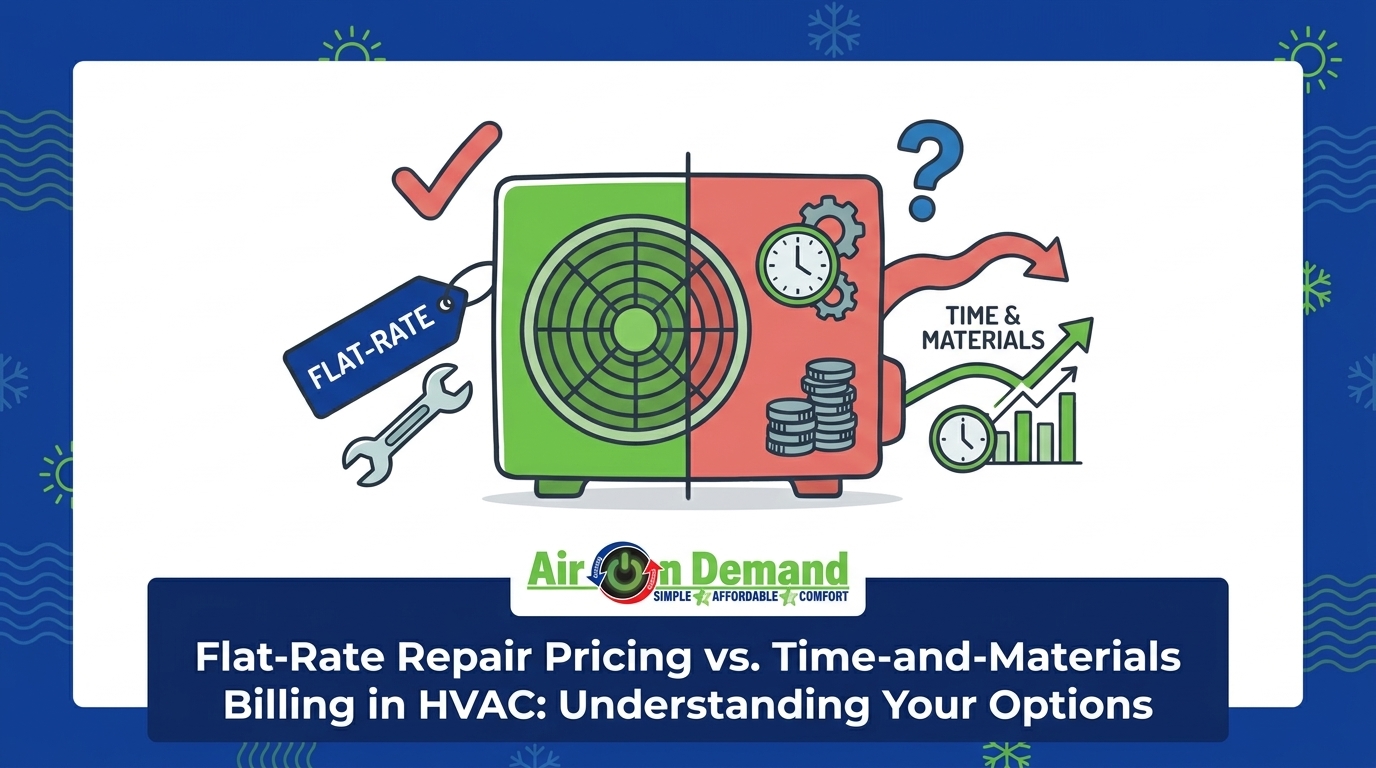
Flat-Rate Repair Pricing vs. Time-and-Materials Billing in HVAC
September 23, 2026
Paying an HVAC technician by the hour doesn't guarantee a fair price—in fact, when you are weighing Flat-Rate Repair Pricing vs. Time-and-Materials Billing in HVAC, the traditional hourly model often penalizes the homeowner. A common misconception in the service industry is that paying strictly for time and parts ensures you only pay for the exact work performed. However, this assumption ignores the unpredictable reality of troubleshooting complex mechanical systems. When a severe malfunction strikes during the late-summer August heat, the last thing you need is the anxiety of an open-ended invoice while a technician searches for the root cause of the problem.
Facing a sudden system breakdown when cooling is absolutely critical creates an incredibly stressful environment. You want your home comfortable again as quickly as possible, but you also need to know what the restoration will cost before committing to the work. Choosing a contractor based on their billing structure is just as important as evaluating their technical expertise. If you are scheduling AC repair services, understanding how your contractor calculates their fees protects you from escalating costs during complex diagnostics. We need to look closely at how these two primary billing models impact your final invoice, your stress levels, and the overall quality of the service you receive.
Time-and-materials billing is a traditional pricing structure where the homeowner pays for the exact time the technician is on-site, plus the cost of any parts required for the repair. On the surface, this sounds entirely logical. However, it introduces a significant vulnerability for the homeowner: the "ticking clock" effect. If a technician is less experienced, lacks the proper diagnostic equipment, or simply struggles to locate a hidden malfunction, the homeowner absorbs the financial cost of that inefficiency. You are essentially paying for the time it takes the technician to figure out the problem, not just the time it takes to fix it.
This vulnerability becomes glaringly obvious when you factor in the extreme working conditions common to Miami and surrounding South Florida areas. During the peak of summer, attic temperatures can easily exceed 100 degrees. Working in this extreme heat physically slows technicians down. They must move carefully, take necessary safety breaks to prevent heat exhaustion, and navigate cramped, sweltering spaces. Under a time-and-materials contract, these environmentally driven delays directly inflate your invoice. You are paying for the extra time it takes to work safely in extreme heat, turning what seems like a simple service call into a massive, unpredictable expense. If you are wondering how much AC services cost, an hourly model makes it impossible to get a straight answer until the job is completely finished.
Finding the root cause takes time: Locating an electrical short hidden behind drywall or pinpointing a micro-leak in a heavily insulated refrigerant line is rarely instantaneous. These diagnostics require methodical, step-by-step testing. Under an hourly model, every minute spent testing adds to your bill.
Lack of efficiency incentives: Hourly models provide no financial incentive for the contractor to invest in faster, more advanced diagnostic tools. If the company gets paid more when the job takes longer, there is little motivation to equip technicians with the latest technology that could cut diagnostic times in half. The homeowner assumes all the financial risk for slow, outdated troubleshooting methods.
Flat-rate pricing offers a completely different approach, providing a predetermined cost for a specific repair based on national or regional industry averages. This fixed price encompasses both the necessary parts and the labor required to complete the job, regardless of how long the technician actually spends at your home. By utilizing standardized completion times for thousands of specific HVAC repairs, contractors can offer a guaranteed upfront cost before any wrenches are turned.
The process of flat-rate billing is designed around transparency and homeowner consent. When dealing with a breakdown in the oppressive late-summer August heat, this structured approach eliminates the anxiety of the unknown. Here is how the flat-rate process typically unfolds when you call for Miami AC repair:
1. Comprehensive Diagnostic: The technician arrives and performs a thorough evaluation of your cooling system to identify the exact cause of the failure.
2. Problem Identification and Solution Building: Once the issue is pinpointed, the technician consults their standardized pricing guide to find the specific repair code associated with your system's problem.
3. Firm Upfront Presentation: The technician presents you with a firm, guaranteed price for the complete repair. This price includes all parts, labor, and necessary materials.
4. Homeowner Approval: You review the proposed cost and authorize the work. No repair work begins until you are completely comfortable with the price.
5. Execution of the Repair: The technician completes the repair. Whether the job takes thirty minutes or three hours, your final bill remains exactly what you agreed to in step three.
The most significant advantage of this model is consistency. You are paying for the solution, not the time it takes to deliver it. This model completely removes the financial penalty of a difficult diagnostic process from the homeowner's shoulders.
Modern HVAC systems are not simple appliances; they are complex networks of sensitive electronic sensors, intricate circuit boards, and highly pressurized refrigerants. When these systems fail, the cause is not always a glaringly obvious broken belt or a completely shattered fan blade. Often, the most frustrating breakdowns involve intermittent failures—a system that only trips a breaker occasionally, or a unit that cools perfectly for an hour before suddenly shutting down. Tracing these erratic behaviors requires extensive, time-consuming troubleshooting.
Environmental factors heavily influence the frequency and severity of these complex failures. In Miami and surrounding South Florida areas, the coastal humidity and salt air accelerate corrosion on outdoor condenser coils, contactors, and electrical connections. This corrosion leads to hard-to-diagnose intermittent failures that take significantly longer to trace. A technician might need to test multiple corroded contact points before finding the exact spot where the voltage is dropping. Under an hourly billing model, this meticulous testing process causes the invoice to skyrocket.
For example, diagnosing high-pressure hissing sounds often involves searching for a microscopic refrigerant leak. Tracing a leak through lines that are hidden inside walls, buried underground, or routed through tight attic spaces can take substantial time. With time-and-materials billing, you are paying for every minute the technician spends waving a leak detector over those hidden lines. With flat-rate pricing, the cost of repairing the leak is set upfront, protecting you from a bloated bill if the leak proves exceptionally difficult to locate.
The tedious testing process: Modern air conditioners rely on an array of safety switches and temperature sensors. When one of these fails, the system locks out to protect itself. Finding which specific sensor failed out of a dozen possibilities requires testing each one individually with a multimeter. This is a tedious, methodical process.
Protection through upfront pricing: Flat-rate pricing protects the homeowner during this lengthy process. The diagnostic fee covers the time it takes to find the problem, and the subsequent repair quote is fixed. You aren't left watching the clock while the technician tests the tenth wire in a complex harness.
When you are evaluating your options during a stressful breakdown in the late-summer August heat, having a clear understanding of how these two billing models stack up against each other is crucial. The differences go far beyond just how the math is calculated; they fundamentally change the relationship between the homeowner and the service provider.
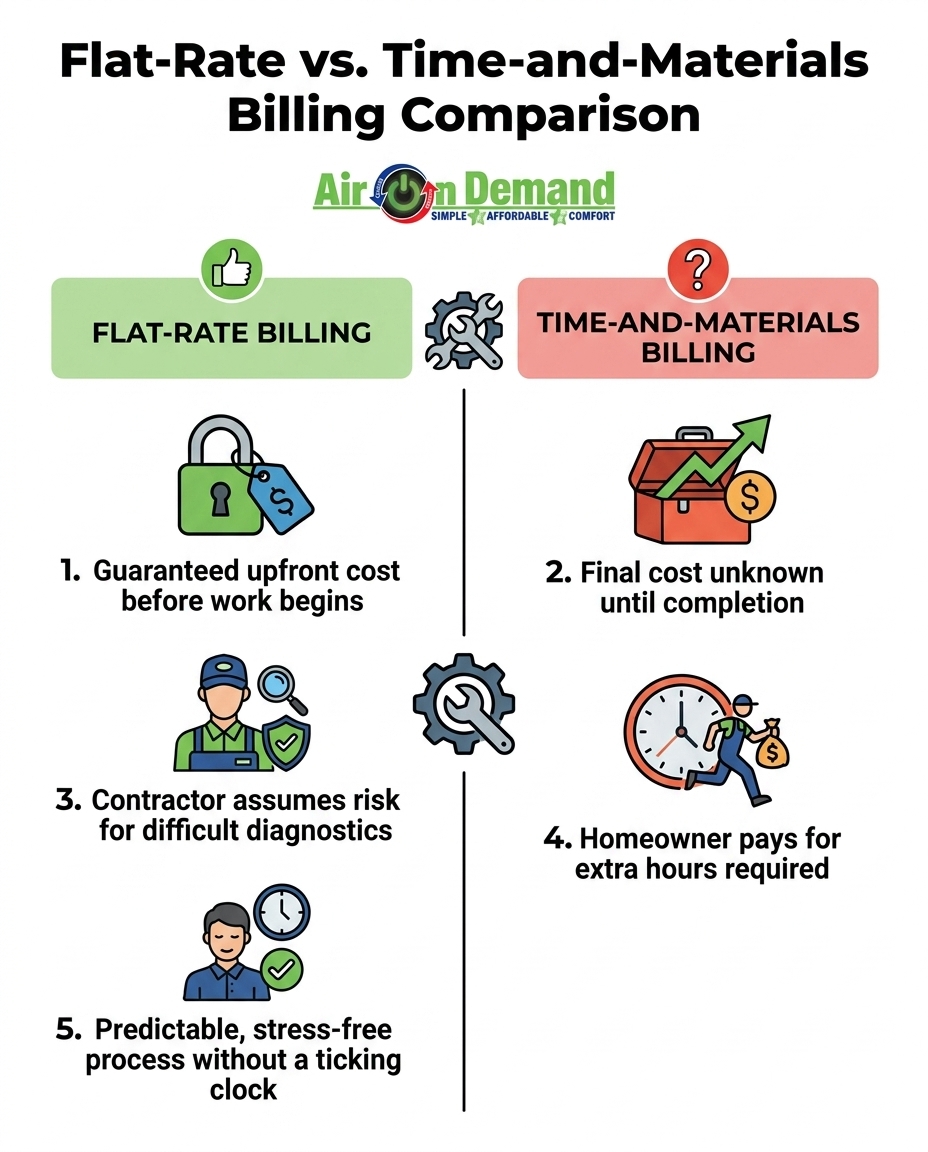
The core differences: The table below highlights the stark contrasts between time-and-materials billing and flat-rate pricing, specifically focusing on cost predictability, risk assumption, and the overall homeowner experience.
• Cost Predictability — Time-and-Materials (Hourly): Completely unknown until the repair is fully completed. — Flat-Rate (Upfront) Pricing: Guaranteed and agreed upon before any repair work begins.
• Risk Assumption — Time-and-Materials (Hourly): Homeowner assumes the financial risk for slow or difficult repairs. — Flat-Rate (Upfront) Pricing: Contractor assumes the financial risk if the repair takes longer than average.
• Efficiency Incentives — Time-and-Materials (Hourly): No financial penalty for slow work; contractor earns more the longer it takes. — Flat-Rate (Upfront) Pricing: Contractor is highly motivated to work efficiently and use advanced diagnostic tools.
• Homeowner Stress Levels — Time-and-Materials (Hourly): High anxiety due to the "ticking clock" and unpredictable final invoice. — Flat-Rate (Upfront) Pricing: Complete peace of mind knowing the exact cost upfront.
One of the most critical, yet often overlooked, aspects of flat-rate pricing is how it functions as a robust consumer protection mechanism. In the service industry, the concept of "risk-shifting" determines who bears the financial burden when things don't go according to plan. Under an hourly model, the homeowner holds all the risk. If a rusted bolt snaps, or if a replacement part requires unexpected modifications to fit an older system, the homeowner pays for the extra hours required to solve the new problem.
A flat-rate agreement completely reverses this dynamic. By providing a guaranteed upfront price, the HVAC company takes on the financial responsibility if a repair proves to be more stubborn or complex than initially anticipated. If a job that typically takes one hour ends up taking four hours due to unforeseen complications, the contractor absorbs the cost of those extra three hours, not you. This is why transparent, upfront flat-rate pricing provides ultimate peace of mind and eliminates hidden fees during highly stressful AC emergencies.
Because the contractor assumes the risk, this model heavily encourages HVAC companies to elevate their internal standards. To remain profitable under a flat-rate model in Miami and surrounding South Florida areas, a company must hire highly trained, competent technicians. They must equip those technicians with the most advanced, efficient diagnostic tools available. They cannot afford to employ slow, inexperienced workers because the company—not the customer—pays for that inefficiency. Ultimately, a company's willingness to offer transparent, flat-rate billing is a strong indicator of their confidence in their team's skills and their commitment to trustworthy business practices.
Sometimes, the diagnostic process reveals a reality that no homeowner wants to face: the system has suffered a catastrophic failure. A technician might spend an hour troubleshooting a system that won't start in the late-summer August heat, only to discover that the compressor has grounded out or the evaporator coil is severely compromised beyond repair. In these moments, the conversation must pivot from a simple fix to a major financial decision regarding system replacement.
The billing model you are operating under drastically affects your ability to make a clear-headed decision in this scenario. If you are trapped in a time-and-materials contract, you have already racked up a significant hourly bill just to find out the system is dead. This creates a "sunk cost" dilemma, where you might feel pressured to throw good money after bad by attempting a risky repair simply because you've already paid so much for the diagnostic time.
Conversely, upfront diagnostic pricing allows you to evaluate your options without the burden of an escalating hourly invoice. You know exactly what the diagnostic visit costs, and you know exactly what the repair would cost. If the repair quote is prohibitively high due to a failed compressor, you can clearly compare that fixed cost against the investment of a new system. Eliminating the sunk cost of a massive, open-ended hourly diagnostic bill makes it much easier to objectively weigh AC repair vs. replacement and allocate your funds toward a long-term upgrade if that is the most sensible path forward.
Flat-rate pricing is a billing method where an HVAC contractor provides a single, guaranteed price for a specific repair before any work begins. This predetermined cost is based on industry-standard completion times and includes both the necessary parts and the labor required. It ensures the homeowner knows the exact final bill upfront, regardless of how long the technician actually takes to complete the job.
For the vast majority of homeowners in Miami and surrounding South Florida areas, flat-rate pricing is significantly better because it eliminates financial surprises. Hourly billing forces the homeowner to pay for a technician's diagnostic struggles or delays caused by extreme attic heat. Flat-rate pricing shifts that risk to the contractor, ensuring you only pay for the solution, not the time it takes to find it.
The primary disadvantage of a time-and-materials contract is the lack of a guaranteed final price, leaving the homeowner vulnerable to an open-ended invoice. If a technician is inexperienced, lacks proper tools, or encounters unexpected complications, the homeowner pays for all the extra time required. This "ticking clock" scenario creates immense stress during emergency breakdowns.
Under a flat-rate model, contractors typically charge a standard diagnostic fee to assess the system, followed by a firm, upfront quote for the necessary repair. Under an hourly model, contractors charge for every minute spent troubleshooting, meaning a complex electrical issue or a hard-to-find refrigerant leak can result in a massive diagnostic bill before any actual repair work even begins.
Yes, a true flat-rate quote encompasses all the costs required to complete the specific repair. This includes the replacement parts, the technician's labor, any necessary minor materials, and the expertise required to safely restore the system. Once you agree to a flat-rate price, you should not face any additional, hidden fees for that specific repair scope.
You should never have to guess what an essential home repair will cost, especially when dealing with a severe system failure in Miami and surrounding South Florida areas. The traditional hourly billing model forces you to bear the financial burden of unpredictable diagnostic times, turning a stressful situation into a complete liability. By choosing a contractor who utilizes flat-rate pricing, you secure clear expectations, eliminate the anxiety of a ticking clock, and guarantee that the service provider remains accountable for their efficiency. When your comfort is on the line, insist on a team that respects your budget through transparent, upfront agreements, ensuring you have the information you need to make the best decision for your home.