The Role of the Contactor in Powering Your Outdoor Fan Motor
September 23, 2026
Your thermostat is set to cool, but the house is growing uncomfortably warm, and when you investigate outside, you realize the AC unit fan is not spinning—which brings us to the role of the contactor in powering your outdoor fan motor. You can hear a low humming sound coming from the condenser cabinet, but without that large blade pulling air through the coils, your home is rapidly losing ground against the heat. This is a classic symptom of a high-voltage electrical interruption. When you reach the September post-summer transition, your cooling equipment has already endured thousands of grueling on-and-off cycles. That cumulative mechanical and electrical stress often targets a single, hidden switch inside your outdoor unit.
If you are dealing with a sudden cooling failure, getting professional AC repair is the safest way to restore your system.
Most homeowners naturally assume that a motionless fan means the motor itself has died. While motors certainly fail, the actual culprit is frequently the electrical gatekeeper that supplies the motor with power. Diagnosing a high-voltage electrical failure is never a do-it-yourself task. It requires an expert eye to trace the voltage, test the components, and safely replace the exact part that has broken the circuit.
To understand why your fan has stopped, you first need to understand the electrical hierarchy of your cooling system. Your outdoor condenser relies on two entirely different types of electrical current to function: a low-voltage control signal and a high-voltage power supply. The AC contactor is the electromechanical switch that bridges these two systems. Without it, your thermostat would have no safe way to turn on the heavy-duty components sitting in your backyard.
When you need reliable AC repair in Miami, technicians almost always check this specific component first because it acts as the primary electrical gateway for the entire outdoor unit.
Your thermostat operates on just 24 volts of electricity. This low voltage is completely safe for the small wires running through your walls, but it is nowhere near powerful enough to spin a heavy fan blade or pump refrigerant. The outdoor fan motor and compressor require 240 volts of electricity. The contactor solves this mismatch through a simple but brilliant mechanical process.
The sequence of operations:
1. The Call for Cooling: The indoor thermostat detects that the room temperature has risen above your set point and sends a 24-volt signal outside.
2. The Magnetic Coil Engages: This low-voltage signal travels into the base of the contactor, energizing a small copper coil.
3. The Electromagnetic Pull: The energized coil creates a strong magnetic field, which physically pulls down a set of metal contacts (often creating a loud "clack" sound).
4. The High-Voltage Connection: When those metal contacts snap shut, they bridge the gap in the 240-volt circuit, allowing high-voltage electricity to flood into the compressor and the outdoor fan motor simultaneously.
• Thermostat — Voltage Level: 24V (Low) — Primary Function: Sends the command to cool the home — Failure Result: System never attempts to turn on
• Contactor Coil — Voltage Level: 24V (Low) — Primary Function: Creates magnetic field to close the switch — Failure Result: Outdoor unit remains completely silent and off
• Contactor Pads — Voltage Level: 240V (High) — Primary Function: Passes heavy current to the motors — Failure Result: Motors hum, struggle, or fail to start
• Fan Motor — Voltage Level: 240V (High) — Primary Function: Pulls air through condenser coils — Failure Result: System overheats and trips safety switches
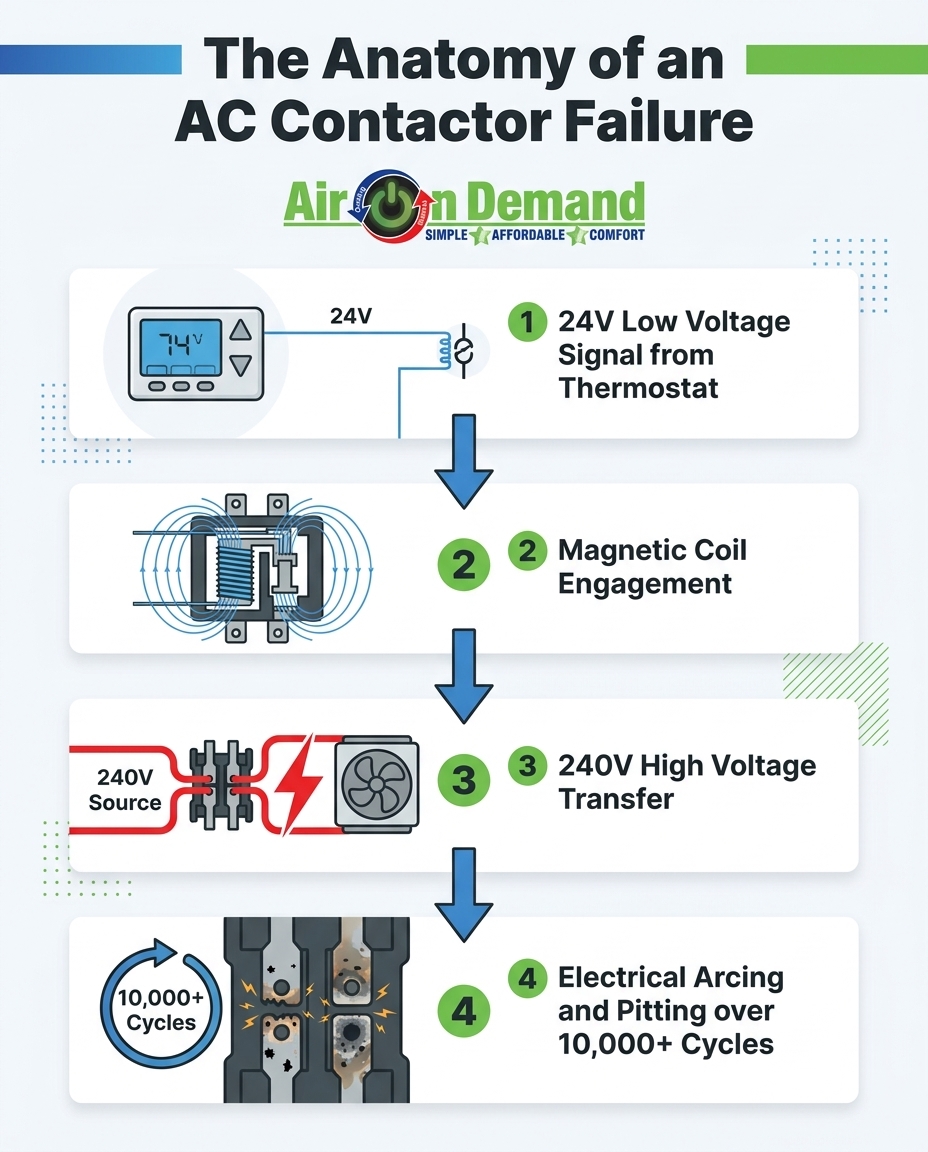
Electricity does not like to wait. When the contactor's magnetic coil pulls the metal plates together, the 240-volt current doesn't wait for them to physically touch. In the microsecond before the metal plates meet, the high voltage jumps across the microscopic air gap. This jump is called an electrical arc, and it is essentially a tiny, controlled lightning bolt.
Every single time your system cycles on, this arc occurs. The arc generates immense heat—thousands of degrees at a microscopic level—which literally vaporizes a tiny amount of the metal on the contact pads. Over the course of the September post-summer transition, after thousands upon thousands of cooling cycles, this constant micro-burning takes a severe toll on the hardware.
The stages of contactor degradation:
• Discoloration: The shiny metal contacts turn black as carbon buildup begins to form from the arcing process.
• Pitting: The smooth surface of the metal becomes cratered and rough, reducing the surface area available to pass electricity.
• High Resistance: The carbon buildup and pitting act as an insulator. The electricity struggles to push through the damaged metal, creating even more heat.
• Total Failure: The contacts become so burnt that the 240-volt current can no longer cross the threshold, leaving the connected motors without power.
This electrical degradation is entirely different from a mechanical failure within the motor itself. If you are diagnosing a seized condenser fan motor, the motor bearings have usually locked up from physical friction. But with a burnt contactor, the motor is perfectly healthy—it is simply being starved of the electricity it needs to spin.
One of the most confusing scenarios for a homeowner in Miami FL is walking outside to find the condenser cabinet vibrating and humming loudly, yet the fan blade at the top is completely stationary. If the contactor controls power to both the compressor and the fan, how can one run while the other does not?
The answer lies in how the contactor is physically constructed and wired. Many residential cooling systems use what is known as a single-pole or double-pole contactor. A double-pole contactor has two separate sets of metal pads that close simultaneously. One side of the high-voltage power flows through the left pad, and the other side flows through the right pad.
Because electrical arcing is slightly unpredictable, one set of contact pads often degrades faster than the other. If the specific contact pad that feeds power to the fan motor becomes severely pitted and carbonized, it will block the electricity to the fan. Meanwhile, the adjacent contact pad feeding the compressor might still be clean enough to make a solid electrical connection. The result is a system where the compressor successfully powers on, but the fan remains completely dead.
The danger of a stationary fan:
Allowing the compressor to run without the fan is highly destructive. The fan's entire job is to pull outside air across the condenser coils to exhaust the heat your system removed from your home. Without that airflow, the heat and pressure inside the compressor will spike rapidly. Within minutes, the compressor will overheat, potentially causing permanent internal damage or triggering an emergency thermal overload switch.
The lifespan of an electrical contactor is directly tied to how often it has to open and close, and how long it has to hold that electrical connection under a heavy load. This is where regional climate plays a massive role in system longevity. The relentless heat and high humidity of Miami FL create an environment that pushes electrical components to their absolute limits.
In a mild climate, an air conditioner might cycle on for fifteen minutes, satisfy the thermostat, and shut down for an hour. In our region, the latent heat load—the amount of moisture in the air that must be removed—forces the equipment to work much harder. To properly cool and dehumidify a home during the peak of summer, the compressor and fan must run in long, heavy cycles.
How the climate multiplies wear and tear:
• Heat saturation: When a contactor is engaged, the magnetic coil generates its own heat. During a 45-minute cooling cycle in 95-degree weather, that heat has nowhere to dissipate, causing the plastic housing and internal springs to weaken over time.
• Cycle frequency: High humidity causes homes to gain heat rapidly the moment the system turns off. This leads to "short cycling" or simply more frequent on/off commands, meaning the metal contacts suffer the destructive electrical arc far more often than the national average.
• Voltage drops: During extreme heat waves, neighborhood power grids often experience slight voltage drops due to high demand. When voltage drops, amperage increases, causing the contactor to run even hotter than normal.
By the time early fall arrives, the contactor has absorbed the brunt of this extreme climate stress, making it one of the most common failure points of the season.
While a contactor can fail suddenly, it usually gives off subtle warning signs before it completely stops transferring power. Catching these symptoms early can save you from an unexpected breakdown during the September post-summer transition. Because this is a high-voltage component, your inspection must be strictly visual and auditory—never touch the equipment or attempt to open the electrical panel.
1. Loud buzzing or chattering noises
A healthy contactor makes a single, solid "clack" when it engages, followed by a very quiet hum. If you hear a loud, aggressive buzzing or a rapid chattering noise (like a machine gun) coming from the electrical panel of the outdoor unit, the magnetic coil is failing. It is struggling to hold the metal contacts tightly closed against the 240-volt current.
2. Intermittent fan operation
If you notice that the outdoor fan struggles to start, spins sluggishly, or only turns on every other cooling cycle, the metal contacts are likely heavily pitted. The electrical current is occasionally finding a clean path through the carbon buildup, but the connection is unreliable.
3. Delayed system shutdown
Sometimes, the extreme heat of the electrical arcing actually welds the metal contacts together. When this happens, the thermostat can send the signal to turn off, but the contactor remains physically stuck in the closed position. Your outdoor fan and compressor will continue to run endlessly until you manually shut off the breaker.
4. A burning plastic odor
As the internal coil overheats or the plastic housing begins to melt from electrical resistance, you may catch a faint, acrid smell of burning plastic near the condenser cabinet. This is a severe warning sign of imminent electrical failure.
The best way to prevent these issues is through routine AC maintenance. During a professional tune-up, a technician uses a multimeter to measure the voltage drop across the contactor. If the resistance is too high, they can replace the pitted switch long before it strands you without cooling.
When the house is hot and the fan isn't moving, the temptation to grab a screwdriver and investigate is strong. However, the condenser cabinet is arguably the most dangerous appliance on your property. The contactor handles 240+ volts of electricity, which is highly dangerous and potentially lethal.
Working with a professional, licensed technician means you are relying on someone who has passed rigorous exams and understands the strict safety protocols required for high-voltage diagnostics. A licensed professional knows exactly how to isolate the power, discharge the stored energy in the system, and test the live circuits safely.
Why this is never a DIY repair:
• Live line voltage: Even when the thermostat is turned off, the line voltage coming from your breaker panel is still live at the bottom of the contactor. One slip of a tool can cause a catastrophic electrical short.
• Capacitor hazards: The contactor is wired directly to the dual run capacitor, which acts as a high-voltage battery. Even with the main breaker turned off, a capacitor can store a lethal electrical charge for hours or days.
• Exact part matching: Contactors are rated for specific coil voltages (24V) and specific amperage loads (e.g., 30 amp or 40 amp). Installing the wrong size contactor can create a severe fire hazard or instantly destroy the fan motor and compressor.
In Miami FL, where the equipment runs constantly, the wiring inside the cabinet can also become brittle from the heat. A professional has the specialized tools to strip, re-terminate, and secure the high-voltage wires so that the new contactor operates safely and reliably for years to come.
This usually happens when the electrical contactor has a burnt or pitted pole on the fan side, while the compressor side still makes a solid connection. The high voltage is successfully crossing the switch to power the compressor, but the carbon buildup is blocking the electricity from reaching the fan motor. You should turn off the system immediately to prevent the compressor from overheating.
Yes, a bad contactor is one of the most common reasons a fan stops spinning. If the metal contacts inside the switch are too pitted or burnt from thousands of electrical arcs, the high voltage simply cannot pass through to power the fan motor. Even if the motor is in perfect condition, it cannot operate without that electrical bridge.
Electrical arcing during thousands of on and off cycles slowly degrades the metal contacts over time. Every time the switch closes, a microscopic electrical arc generates intense heat, vaporizing a tiny amount of metal and leaving behind carbon buildup. In hot climates with heavy cooling demands, this cumulative wear accelerates rapidly.
Symptoms of a failing contactor include a loud buzzing or chattering noise coming from the outdoor unit, an outdoor fan that won't spin, or a system that refuses to turn on or off properly. If the contacts become welded together from the heat, the outdoor unit may continue running even after you turn the thermostat off.
No, this exposes you to live high voltage and risks severe electrical shock, burns, or death. Pushing the contactor in manually with a stick or insulated tool bypasses the system's safety controls and puts you in direct proximity to 240 volts of exposed electricity. Always call a licensed professional to handle high-voltage diagnostics.
A non-spinning outdoor fan is a clear, immediate sign of an electrical interruption. While it is easy to assume the worst about the motor itself, the true culprit is often the hardworking contactor that has simply endured too many cycles over the September post-summer transition. The relentless heat forces this small electromechanical switch to open and close thousands of times, battling electrical arcing and intense heat until the metal contacts finally give out.
Because this failure involves 240 volts of raw electrical power, it is never something you should attempt to diagnose or bypass on your own. Recognizing the symptoms—like a humming cabinet, a stationary fan blade, or a loud buzzing noise—is your cue to step back and call for help. By relying on a licensed professional to safely inspect, test, and replace the degraded components, you can quickly restore your system's functionality and get your home back to a comfortable temperature.