
Will Replacing Just the Condenser Improve My Home's Humidity Control?
September 16, 2026
Are you running your air conditioner around the clock, only to find yourself asking: will replacing just the condenser improve my home's humidity control? The short answer is no. Swapping out only the outdoor unit will not significantly improve your indoor humidity levels. If your living room feels like a swamp while the AC is running, the problem usually lies deeper within your system.
Most homeowners don't realize that their cooling system is a two-part team. The outdoor unit (the condenser) and the indoor unit (the evaporator coil) must work in perfect harmony to keep you comfortable. When you only replace the outside half, you break that harmony. This becomes incredibly obvious during the September early fall transition, when temperatures drop slightly but the heavy, sticky moisture in the air remains.
Your outdoor unit is great at releasing heat, but it doesn't actually pull the moisture out of your indoor air. That heavy lifting happens inside your house. If you want to learn more about how these components work together, reviewing your air conditioning systems is a great place to start.
To understand why a new outdoor unit won't fix your sticky air, we need to look at how air conditioning actually works. Your system performs two completely different jobs at the same time: sensible cooling and latent cooling. If your system only does one of these jobs well, your home will never feel truly comfortable.
Sensible cooling is the process of lowering the actual temperature in the room. This is the number you see on your thermostat. When your outdoor condenser compresses refrigerant and pumps it through the lines, its main job is to expel heat outside. It is highly effective at sensible cooling. However, a lower temperature alone does not equal comfort.
Latent cooling is the process of removing moisture from the air. This is the hidden half of air conditioning. The outdoor condenser does not directly pull moisture from your indoor air. If your system fails at latent cooling, you will end up with indoor relative humidity remaining above 60%. At that level, your home will feel clammy, sticky, and uncomfortable, even if the thermostat says it is 72 degrees.
Here is a quick breakdown of how these two cooling types compare:
• Sensible Cooling — Primary Function: Lowers the air temperature — Component Responsible: Outdoor Condenser (primarily) — What You Notice: The thermostat number dropping
• Latent Cooling — Primary Function: Removes airborne moisture — Component Responsible: Indoor Evaporator Coil — What You Notice: The air feels crisp and dry
When you ignore latent cooling, you are only solving half the problem. For homeowners looking to actively manage their indoor moisture levels, exploring dedicated indoor air quality solutions is often the next logical step. But mechanically, your AC system's ability to handle latent cooling comes down entirely to the indoor equipment.
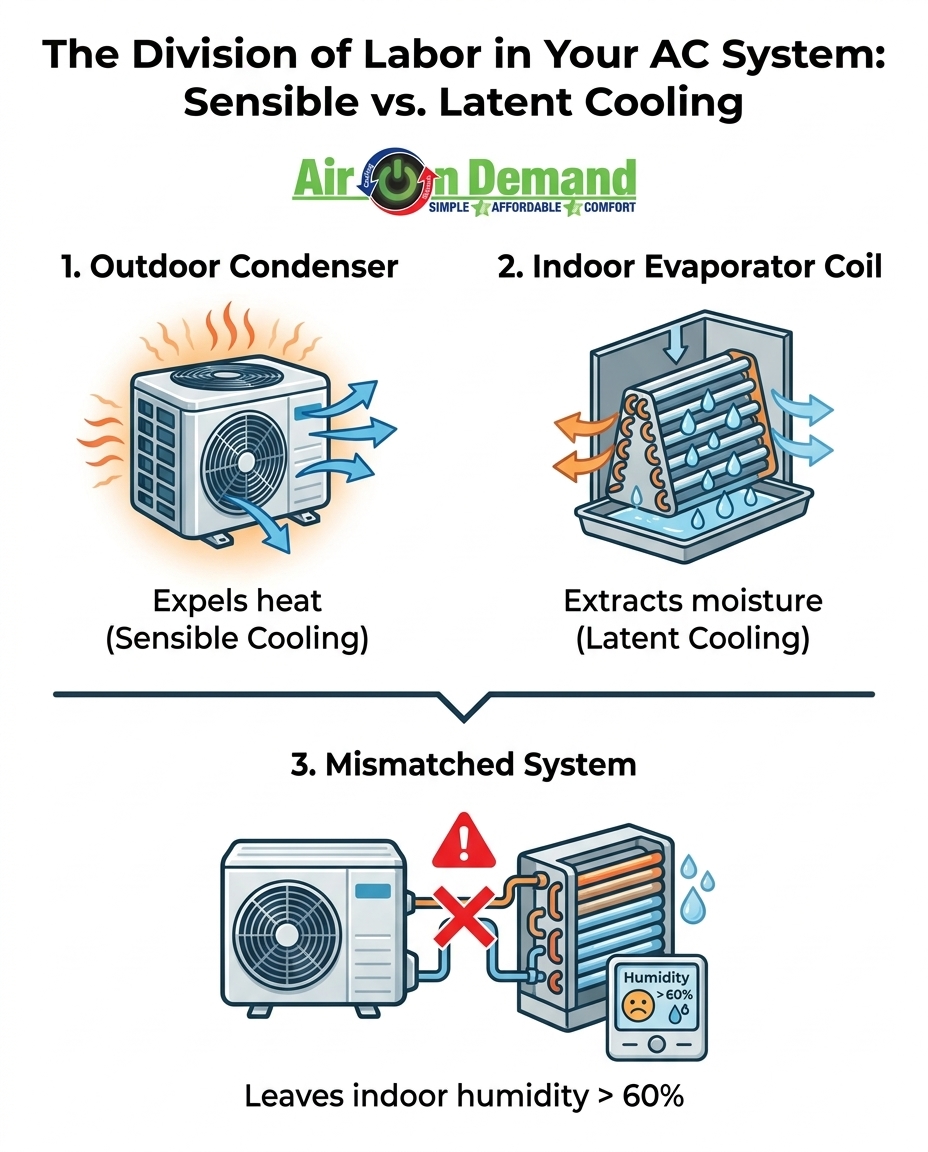
If the outdoor unit isn't pulling the moisture out of the air, what is? The answer sits inside your home, usually in a closet, attic, or garage: the indoor evaporator coil. This component is the true front line for dehumidification.
The Problem: When warm, humid indoor air is pulled into your return vents, it carries a massive amount of invisible water vapor. If that water vapor stays in the air, your home feels muggy.
The Cause: Moisture removal relies on a physical reaction called condensation. Think of a glass of ice water sitting on a patio table on a hot day. Water droplets quickly form on the outside of the glass because the cold surface pulls moisture out of the warm air. Your AC system uses this exact same science.
The Solution: Here is how the indoor coil extracts that moisture step-by-step:
1. Warm, humid air is blown over the freezing cold metal fins of the indoor evaporator coil.
2. Because the coil is so cold, the water vapor in the air rapidly condenses into liquid water on the metal surface.
3. This liquid water drips down into a drain pan.
4. The water safely flows out of your house through a condensate drain line.
5. The freshly dried, cooled air is pushed back into your living spaces.
An aging, dirty, or failing indoor coil simply cannot extract moisture efficiently. The metal fins might be coated in dust, or the internal pressure might be wrong. Regardless of how brand-new and powerful your outdoor condenser is, the indoor coil dictates the moisture extraction. In heavily humid areas like Miami coastal and inland homes, the indoor coil works overtime. It is absolutely critical for your comfort. If the indoor coil is weak, the humidity stays inside.
When you pair a brand-new outdoor condenser with an old indoor evaporator coil, you create what the industry calls a "mismatched system." This is one of the most common mistakes homeowners make when trying to upgrade their cooling equipment on a budget.
A mismatched system means the two major components were not engineered to work together. Modern outdoor condensers operate at much higher efficiencies and different refrigerant pressures than older indoor coils can handle. Here is what happens when you force them to work together:
• Severe short-cycling: The new outdoor unit is so powerful that it cools the house down too quickly. It shuts off before the indoor coil has enough time to extract the moisture.
• Refrigerant bottlenecks: Older coils restrict the flow of modern refrigerants, causing the new compressor outside to overheat and work harder than necessary.
• Reduced equipment lifespan: Forcing a new condenser to push against a restrictive, aging indoor coil adds massive wear and tear, often leading to premature breakdowns.
This mismatch becomes painfully obvious during the September early fall transition. During this time of year, sensible cooling loads drop—meaning it doesn't take much effort to lower the temperature in the house. However, the latent cooling loads (the humidity) stay extremely high. A mismatched system will cool the house in five minutes and shut off, leaving all that heavy moisture trapped inside.
If you are weighing your options, understanding the long-term impact on your comfort is critical when deciding whether to repair vs replace your AC. A mismatched system doesn't just fail at dehumidifying; it actively damages your new investment.
It is completely understandable why homeowners fall into the partial-replacement trap. When the outside unit dies, the upfront cost of only swapping that single box seems appealing. The old indoor coil might still technically function, so why replace it?
Here's the thing: investing in a partial replacement almost always leads to continued poor indoor air quality. Because the old coil cannot handle the new condenser's output, you are left with indoor relative humidity remaining above 60%. When humidity stays that high for prolonged periods, you open the door to secondary issues like musty odors, damp carpets, and even mold growth inside your ductwork.
We believe in providing honest, highly technical advice that puts your long-term comfort first. That means refusing to recommend a partial system "fix" that won't actually solve your underlying muggy air problem. A cooling system is not a collection of independent parts; it is a unified, engineered ecosystem. The indoor and outdoor units must be matched in size, capacity, and efficiency ratings to function correctly.
A properly matched, fully replaced system is the only reliable way to control heavy indoor moisture. When both halves of the system communicate and operate at the same pressure, the AC runs in smooth, steady cycles. This gives the indoor coil the exact amount of time it needs to wring the water out of your air, leaving your home feeling crisp and comfortable.
Understanding the mechanics of your cooling system can be overwhelming, especially when you are dealing with sticky, uncomfortable air. Whether you live in a modern condo or one of the many older Miami coastal and inland homes, the rules of humidity removal remain the same. If you are looking for more ways to stay comfortable, checking out humidity control tips for South Florida can help. Below, we answer the most common questions homeowners ask about AC components and indoor moisture.
Technically, it is possible to only replace the outside unit, but it is highly discouraged by manufacturers and HVAC professionals. Replacing just the condenser leaves you with a mismatched system that suffers from compromised performance, poor efficiency, and a severe inability to remove humidity.
Modern outdoor units use different refrigerants and operate at higher pressures than older indoor coils were designed to handle. When you mix old and new technology, the system constantly fights itself. Furthermore, installing a new outdoor unit without upgrading the indoor coil will almost always void the manufacturer's warranty on the new equipment, leaving you unprotected if the compressor fails.
If you replace the condenser but leave the old indoor coil in place, your system becomes mismatched, leading to poor energy efficiency and frequent breakdowns. The older indoor coil acts as a bottleneck for the new, powerful outdoor unit.
Because the old coil cannot process the refrigerant as fast as the new condenser pushes it, the outdoor compressor has to work twice as hard. This drastically shortens the lifespan of your new investment. More importantly for your comfort, the old coil will severely limit the system's ability to extract moisture, leaving your home feeling damp and muggy even while the AC is running.
The outdoor AC condenser only affects humidity indirectly. Its primary job is to compress refrigerant and expel the heat that was absorbed from inside your home out into the yard. It does not touch the indoor air.
The condenser relies entirely on the indoor evaporator coil to perform the actual dehumidification. The outdoor unit provides the cold refrigerant, but the indoor coil is the physical surface where the moisture condenses and drains away. If the indoor coil is dirty, aging, or mismatched, the best condenser in the world won't make your home feel dry.
A house that stays humid while the AC is running is often suffering from an oversized AC unit that short-cycles. When a system is too powerful for the space, it cools the air too quickly and shuts off before the indoor coil has enough time to extract the moisture.
Other common culprits include a dirty indoor evaporator coil that blocks airflow, a mismatched system where the components don't communicate properly, or leaky ductwork pulling humid air from the attic. In regional climates with heavy moisture, your system needs to run in long, steady cycles to physically wring the water out of the air. If it turns on and off every five minutes, the humidity stays trapped inside.
The most obvious sign that your indoor coil is failing to remove moisture is a clammy, sticky feeling indoors despite having the thermostat set to a low temperature. You might also notice musty odors, condensation forming on your windows, or floors that feel slightly damp to the touch.
A more precise way to check is by using a digital hygrometer. If your hygrometer shows your indoor humidity consistently reading above optimal levels (usually anything over 55% to 60%), your indoor coil is not performing its latent cooling duties. At that point, a professional inspection is necessary to determine if the coil is dirty, failing, or mismatched with the outdoor unit.
Will replacing just the condenser improve my home's humidity control? As we have seen, the answer is a definitive no. True comfort requires a system specifically designed and matched to handle both the temperature and the heavy moisture in your air. When you try to cut corners by leaving an old indoor coil in place, you are almost guaranteeing that you will be stuck with indoor relative humidity remaining above 60%.
Your home should be your sanctuary, not a sticky, muggy environment that forces you to constantly adjust the thermostat. We encourage you to consult with experts who understand the deep science of latent cooling and moisture extraction. Don't guess at partial fixes that will leave you frustrated. Reach out today to schedule an inspection for professional AC replacement services, and let us help you build a unified system that delivers the crisp, dry, and comfortable air you deserve.