
Sizing Health Smart Filters for Older Miami Condos Without Restricting Airflow
September 19, 2026
You want cleaner air in your home, but simply sliding a thick new filter into your AC might actually cause a major breakdown. At Air On Demand, we often see well-meaning homeowners accidentally suffocate their aging systems when sizing Health Smart filters for older Miami condos without restricting airflow. You might think you are doing your family a favor by capturing more dust, pollen, and dander. However, dense filters require a powerful blower motor to pull air through their tight fibers. If your air conditioning system lacks that power, the resulting airflow restriction triggers a dangerous chain reaction that ends with a frozen unit and a massive mess.
If you need help navigating your options, learn more about our professional Air Filtration services, or schedule a dedicated assessment for Air Conditioner Filters In Miami.
Upgrading your indoor air quality is a great goal, but it requires balancing your desire for clean air with the mechanical limits of your specific equipment. Many Miami condos still rely on older air handlers that were engineered long before modern high-efficiency filters hit the market. These systems were built for minimal airflow resistance. When you jam a dense, tightly woven filter into the return grille, the blower motor struggles to breathe. This is the exact decision point many condo owners face: how do you remove microscopic pollutants without pushing your aging HVAC system past its breaking point?
To make the right choice, you have to look beyond the marketing claims on the filter box. A filter that works perfectly in a brand-new house might destroy an older condo unit. Understanding the hidden dangers of airflow restriction is the first step toward safely improving your indoor air quality.
To understand why a simple filter upgrade causes so much trouble, you have to look at how your building was constructed. In our years of providing AC installation and repair across the area, the Air On Demand team has serviced countless 1980s condo buildings designed with strict space limitations. Architects had to squeeze HVAC equipment into tight utility closets or drop ceilings, leaving very little room for large, powerful air handlers. Because of these architectural constraints, the systems installed in these units operate under a completely different set of rules than the AC in a typical single-family home.
The original ductwork in these buildings was engineered for minimal airflow resistance. The blowers were designed to push air through standard, fiberglass filters that captured large debris but let air flow freely. Modern high-efficiency filters simply were not factored into the original engineering of these older blowers. When you introduce a dense filter into a system designed for low resistance, you instantly disrupt the delicate balance of the entire HVAC setup.
Many older condos utilize ceiling-mounted "pancake" air handlers. These space-saving units are incredibly compact, which makes them convenient for tight floor plans but highly sensitive to changes in airflow. The blower motors inside these pancake units are much smaller and less powerful than standard upright air handlers.
The mechanical reality: A smaller blower motor simply cannot overcome the increased resistance of a tightly woven filter. Instead of pulling the required amount of air through the system, the motor works harder, runs hotter, and moves significantly less air.
• Space Constraints — 1980s Condo Pancake Unit: Extremely tight; ceiling or small closet mounted — Modern Single-Family System: Spacious; dedicated attic, basement, or garage space
• Airflow Tolerance — 1980s Condo Pancake Unit: Very low tolerance for added resistance — Modern Single-Family System: High tolerance; variable speed motors adjust to resistance
• Original Filter Design — 1980s Condo Pancake Unit: Thin, low-resistance fiberglass (MERV 1-4) — Modern Single-Family System: Thick, pleated media filters (MERV 8-13+)
• Blower Motor Power — 1980s Condo Pancake Unit: Small, single-speed, low torque — Modern Single-Family System: Large, multi-speed or variable speed, high torque
As the table shows, attempting to treat a compact 1980s condo unit like a modern residential system is a recipe for disaster. The architectural limits of your building dictate exactly what kind of filtration your system can safely handle.
When you install a dense filter, you change the physics of how your air conditioner operates. High-efficiency filters are designed with tightly packed synthetic fibers to trap microscopic particles. While this is great for air quality, it creates a massive barrier for the air trying to pass through. This barrier creates what HVAC professionals call a pressure drop.
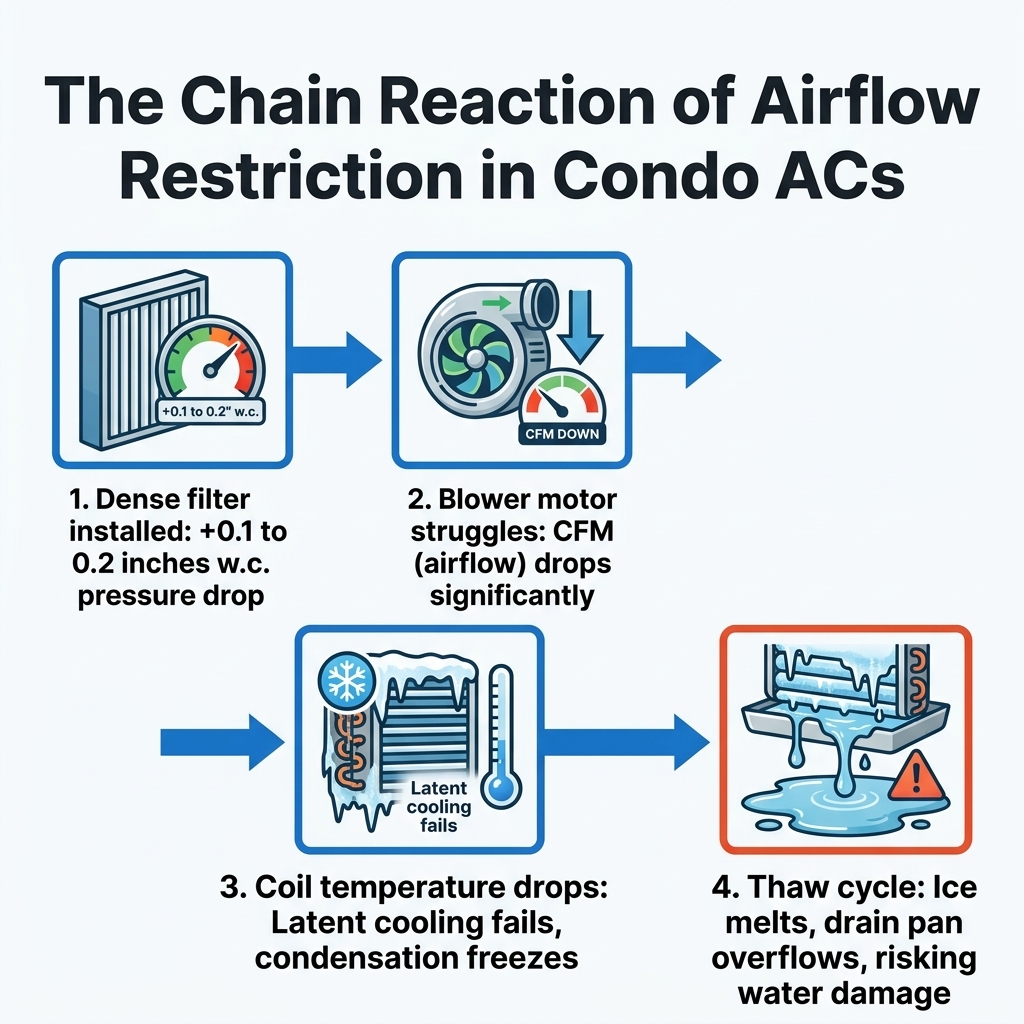
A dense filter can easily increase the pressure drop by 0.1 to 0.2 inches of water column. In an older system, this sudden increase in static pressure directly reduces the Cubic Feet per Minute (CFM) of airflow moving across your indoor equipment. Your air conditioner relies on a precise volume of warm, unconditioned air blowing over the cold evaporator coil to function properly. When that airflow drops, the entire cooling process derails.
The transition from a clean filter to a frozen system happens in a predictable, destructive sequence. Here is exactly what happens inside your air handler:
• Step 1: Resistance increases. The tightly woven fibers of the dense filter block the return air, forcing the blower motor to strain against the negative pressure.
• Step 2: Airflow plummets. Because the motor cannot overcome the resistance, the total CFM of air moving through the ductwork drops significantly.
• Step 3: The coil starves for heat. The evaporator coil contains extremely cold refrigerant. Without enough warm household air blowing over it to absorb that cold energy, the coil's temperature drops rapidly.
• Step 4: Condensation freezes. As the coil temperature plunges below 32 degrees Fahrenheit, the natural moisture pulled from your indoor air freezes directly onto the metal fins instead of dripping into the drain pan.
Once the ice forms, it creates even more airflow restriction, accelerating the freezing process until the unit is completely encased in a block of ice. If you catch this happening, you will likely need professional AC Repair Miami to thaw the system and inspect for permanent damage.
The danger does not end when the system shuts off. When that massive block of ice eventually thaws, the volume of water quickly overwhelms the shallow drain pan. In a stacked condo building, this overflowing water leaks directly through the floor, causing severe water damage to the ceiling and walls of the unit below yours.
The risk of a frozen coil is not limited to the peak of summer. In fact, our technicians often respond to more frozen coil calls as the seasons change. During the early fall transition, Miami maintains high relative humidity—often exceeding 70%—even as the extreme summer heat begins to taper off. This unique climate condition puts incredible stress on an older air conditioning system that is already struggling to breathe.
Your air conditioner performs two distinct jobs: sensible cooling (lowering the temperature) and latent cooling (removing moisture from the air). Latent cooling is absolutely critical in coastal environments. As warm, humid air passes over the cold evaporator coil, the moisture condenses into water droplets and drains away. This dehumidification process requires a steady, unhindered volume of airflow to work properly.
When you restrict the airflow with a dense filter during this humid transition period, you effectively eliminate the system's ability to perform latent cooling. The blower moves air too slowly, allowing the excessive moisture in the September air to condense heavily on the freezing coil. Because the airflow is restricted, the coil gets colder and colder, quickly turning that heavy condensation into a solid sheet of ice.
The seasonal reality: Just because your older AC survived the peak of July does not mean it is safe from freezing in September. The combination of lower outdoor temperatures, high indoor humidity, and restricted airflow from a thick filter is the perfect recipe for a frozen system. For more insights on managing this specific seasonal challenge, you can read about Evaluating Health Smart Filters for South Florida Humidity Management. Proper airflow is your only defense against the heavy moisture loads of early fall.
To truly grasp why older condo units fail when paired with modern filters, you have to understand a concept called static pressure. In simple terms, static pressure is the physical resistance to airflow within your ductwork and HVAC equipment. Think of it like blood pressure for your air conditioner. Just as high blood pressure strains your heart, high static pressure strains your blower motor.
The American Society of Heating, Refrigerating and Air-Conditioning Engineers (ASHRAE) sets strict guidelines regarding residential filtration and pressure drop. Every air handler is engineered to operate within a specific static pressure range. If the resistance goes above that threshold, the system cannot move enough air to function safely.
HVAC professionals measure the overall health of your airflow using Total External Static Pressure (TESP). This measurement combines the resistance from both sides of your system.
1. Return Side Resistance: This includes the return grilles, the return ductwork, and the air filter itself. The filter is almost always the largest single source of resistance on the return side.
2. Supply Side Resistance: This includes the evaporator coil, the supply ductwork, the dampers, and the supply registers blowing air into your rooms.
3. The Calculation: TESP is calculated by adding the return side resistance to the supply side resistance.
Older blowers in condo units have very low maximum TESP thresholds. Because the compact ductwork and original coils already create a baseline level of resistance, there is very little "room" left in the calculation for a restrictive filter. When you add a dense Health Smart filter to the return side, you push the TESP past the motor's absolute limit. The mechanical strain causes the motor to overheat, waste energy, and ultimately fail to deliver the CFM required to keep the coil from freezing.
With all this talk of static pressure and maximum thresholds, you might be tempted to figure out your system's limits on your own. Unfortunately, guessing a filter's impact based purely on its MERV rating is inaccurate and highly dangerous for your equipment. A MERV 11 filter from one brand might have a completely different pressure drop than a MERV 11 filter from another brand. You cannot manage static pressure by reading the back of a cardboard box.
Measuring static pressure requires specialized diagnostic tools. HVAC technicians use a highly sensitive digital manometer to read the exact air pressure inside your ductwork. This process involves drilling precise test ports into the supply and return plenums in specific locations to get an accurate reading without damaging the internal components.
The danger of DIY modifications: Never attempt to drill into your air handler cabinet, modify the ductwork, or bypass safety switches to force a larger filter to fit. Hitting the evaporator coil or a refrigerant line with a drill bit will instantly destroy the system. Furthermore, bypassing safety switches to keep a freezing system running will lead to catastrophic compressor failure.
As the team at Air On Demand, with deep technical expertise in older condo HVAC infrastructure across Miami, we know exactly how these aging systems behave. Only a licensed professional can accurately calculate if a specific filter is safe for your unit's exact static pressure limits. We use precise static pressure diagnostics to ensure that any upgrades to your Miami condos are safe, effective, and mechanically sound.
Just because you live in an older building does not mean you have to settle for poor indoor air quality. You simply have to approach the problem differently. Instead of guessing which filter will work, you need a strategy that prioritizes the mechanical safety of your 1980s air handler while still capturing airborne pollutants.
Here is the safe, professional approach our Air On Demand technicians recommend for improving your indoor air quality without restricting your airflow:
1. Schedule a baseline static pressure test: Before buying any new filters, have a professional technician measure your system's current TESP. This establishes exactly how much resistance your blower motor can handle.
2. Choose low-resistance, high-efficiency filters: If your system has the capacity, your technician can recommend specific filter brands engineered for maximum surface area and minimal pressure drop. These filters often use deep pleats to capture particles without suffocating the motor.
3. Install a dedicated air purifier: If your AC cannot handle a denser filter, the safest solution is a standalone HEPA air purifier. These units clean the air in your living spaces independently, adding zero static pressure to your HVAC system.
4. Consider UV germicidal lights: UV lights installed inside the air handler neutralize mold, bacteria, and viruses without impeding airflow. This is a highly effective way to improve IAQ in older, sensitive systems.
5. Keep up with professional maintenance: A dirty blower wheel or a clogged evaporator coil adds massive static pressure to your system. Regular AC Maintenance Miami ensures your aging blower operates at its maximum potential CFM, giving you the best possible airflow year-round.
By separating the job of heavy filtration from the job of your air conditioner, you can achieve excellent air quality without risking a frozen coil or a flooded condo.
Why does a dense filter freeze my AC coil?
A dense filter restricts the amount of warm air flowing over your evaporator coil. Without enough warm air to absorb the cold refrigerant's energy, the coil's temperature drops below freezing, turning normal condensation into solid ice. This process accelerates quickly, completely encasing the system in ice.
How does static pressure affect older condo AC units?
Static pressure is the resistance your blower motor must overcome to move air through the system. Older condo units were built with smaller, less powerful motors that cannot handle high static pressure. When resistance increases, these aging motors overheat, move less air, and fail prematurely.
Can I safely use a Health Smart filter in an older AC?
You can only use a high-efficiency filter if a professional verifies that your system's static pressure limits can handle the added resistance. Many older units cannot safely pull air through these dense filters. A digital manometer test is required to know for sure.
What MERV rating is best for an older AC?
There is no universal MERV rating for older units, as it depends entirely on the system's current airflow capacity. However, most 1980s air handlers were designed for low-resistance filters, typically in the MERV 4 to MERV 8 range. Going higher without a professional assessment risks severe airflow restriction.
How do I know if my filter is restricting airflow?
Common signs of restricted airflow include weak air coming from your vents, the AC running constantly without cooling the room, and ice forming on the copper refrigerant lines outside. You might also hear the blower motor straining or whistling loudly at the return grille.
Can a frozen AC coil cause water damage in a stacked condo building?
Yes, a frozen coil is a major flood risk. When the massive block of ice melts, the water rapidly overflows the shallow drain pan, leaks through the floor, and destroys the ceiling and drywall of the condo unit directly beneath yours.
Improving the air you breathe should never come at the cost of destroying your air conditioner. The delicate balance between upgrading your indoor air quality and protecting an older condo air handler requires precision, not guesswork. A frozen coil and a flooded floor are entirely avoidable consequences of improper filter sizing.
If you are living in an older building, sizing Health Smart filters for older Miami condos without restricting airflow is a job for experienced professionals. Don't risk your comfort or your property by forcing a dense filter into a sensitive system. Reach out to a licensed HVAC expert for a comprehensive static pressure evaluation, so you can breathe easier knowing your AC is running safely and efficiently.