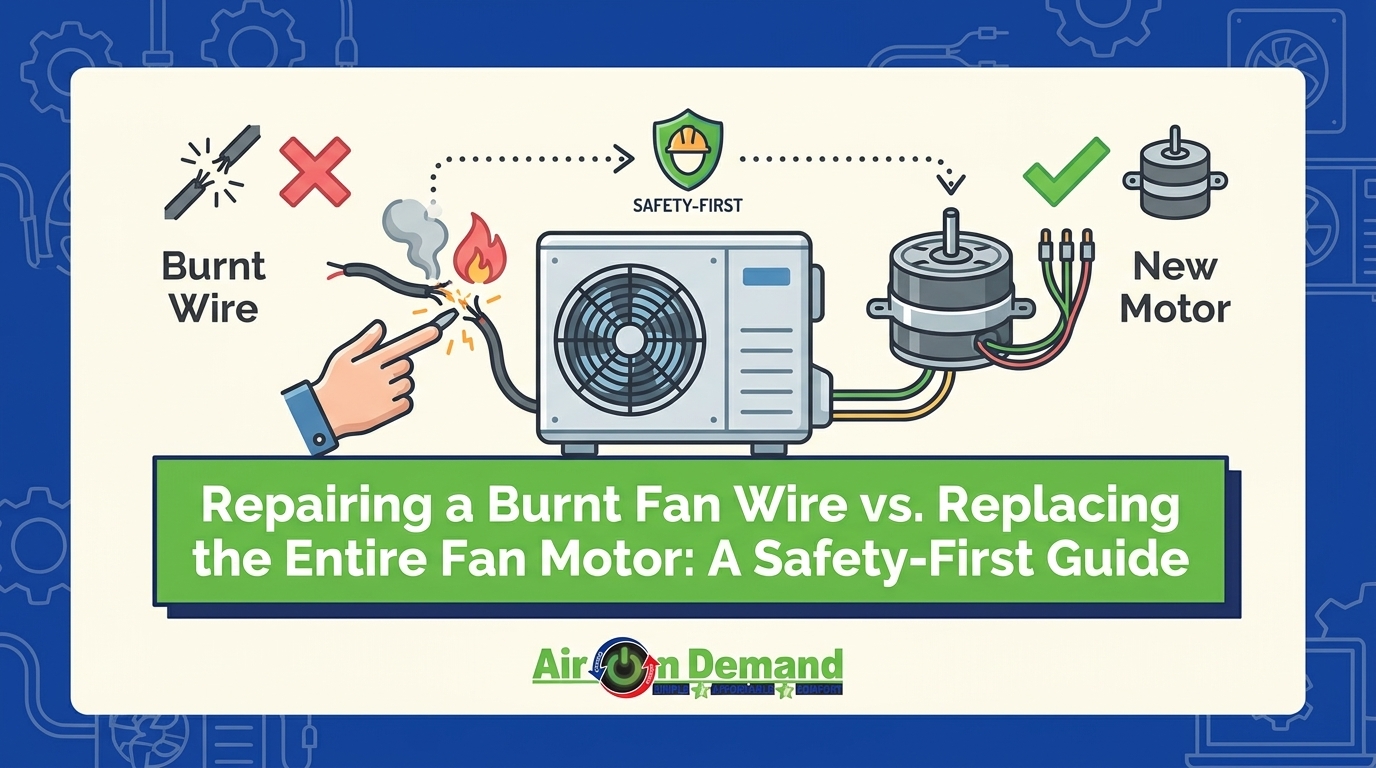
Repairing a Burnt Fan Wire vs. Replacing the Entire Fan Motor
September 17, 2026
Are you staring at a silent outdoor unit, wondering if repairing a burnt fan wire vs. replacing the entire fan motor is the safer route for your home? You rely on your air conditioner to keep your living space comfortable, but after enduring intense heat, systems often reach their breaking point. Right now, as we transition into early fall, our team at Air On Demand frequently responds to calls where a condenser unit has suddenly shut down. When one of our technicians opens the access panel and points to a charred, melted wire lead connected to your fan motor, you face a critical choice. Do you ask for a quick splice to get the cold air flowing again, or is it time to replace the aging motor completely to prevent a larger electrical failure down the road?
For homeowners navigating this exact scenario, understanding the safety implications of an AC repair is the critical first step when weighing an AC repair vs. replacement.
In our years of diagnosing HVAC systems across Miami, we have found that electrical wires inside your equipment do not simply melt for no reason. When you discover a burnt wire at the terminal of your condenser fan motor, it is crucial to understand the mechanical forces that led to the failure. This is rarely just an isolated bad connection. Instead, it is typically a glaring symptom of a much deeper issue within the motor itself.
To understand why wires burn, you have to look at how electric motors age. Over years of operation, the internal bearings inside your fan motor begin to lose their lubrication and wear down. At the same time, the protective coating on the copper windings inside the motor slowly degrades. As friction increases, the motor has to work significantly harder just to spin the fan blades at the required speed.
This extra effort requires more electricity. The motor begins pulling more current through the wires than they were designed to handle, resulting in a high amp draw causing wire overheating. The excess electrical energy converts directly into heat. This intense heat travels along the copper wire lead, eventually baking the rubber insulation until it becomes brittle, melts away, and allows the exposed wire to arc or short out against the metal casing.
One of the most common signs of this specific failure is hearing the deep hum of your compressor running while the fan blades remain completely motionless above it. Many homeowners immediately search for why your AC unit fan is not spinning, hoping for a simple fix like a tripped breaker.
The immediate risk: If your system continues to run in this state, it is actively destroying itself. The fan's primary job is to pull air through the metal fins to dissipate the intense heat generated by the compressor. Without the fan spinning, that heat remains trapped. The compressor will rapidly overheat, potentially leading to a catastrophic and complete system failure. Diagnosing the exact amp draw that caused the stall requires a licensed professional using specialized multimeters. DIY electrical testing on high-voltage HVAC equipment is strictly forbidden due to severe safety risks.
When an Air On Demand technician confirms that a wire has burned up, the most immediate question is whether the connection can simply be repaired. Splicing a damaged wire lead is technically possible, but it is vital to understand the limitations of this approach and view it as a temporary measure rather than a permanent cure.
A proper, code-compliant wire repair is not as simple as twisting two ends together with a standard plastic wire nut. Because of the intense heat and vibration inside a condenser unit, a licensed professional must perform a highly specific repair process:
• Cutting back the damage: The technician must cut the wire back far enough to reach clean, unoxidized copper. Burnt copper cannot conduct electricity safely.
• Using high-heat connectors: Standard electrical tape and basic wire nuts will melt. Professionals use specialized, high-temperature butt connectors.
• Weatherproofing the connection: The splice must be sealed with marine-grade, adhesive-lined heat shrink tubing to prevent moisture from causing a new short.
Improperly spliced HVAC wires create severe fire hazards. If the connection is loose or exposed to the elements, electrical resistance spikes, generating even more heat. This is why DIY repairs are incredibly dangerous and strictly against building codes.
Furthermore, the main limitation of any splice is the underlying motor. If the root problem is a high amp draw causing wire overheating, the new splice is doomed to fail. The failing motor will continue to pull excessive current, and the new connection will eventually overheat and burn up just like the original wire.
There are rare scenarios where a professional splice might be a viable short-term option. If the wire was physically damaged by flying debris during a storm, or if a rodent chewed through the insulation, the motor itself might still be healthy. Scheduling routine AC maintenance is the best way to catch physical wire damage before it shorts out. However, before any splice is finalized, our technicians always perform a professional load test to verify the motor's amp draw. If the motor is pulling too many amps, splicing the wire is just putting a temporary band-aid on a failing system.
For aging systems, opting for a complete motor replacement is almost always the safer, more reliable long-term choice. Rather than repeatedly treating the symptom of melted wires, replacing the motor eliminates the root cause entirely.
When you install a brand-new condenser fan motor, you are removing the worn-out bearings and degraded windings that caused the high amp draw causing wire overheating in the first place. A new motor operates efficiently, pulling exactly the amount of current it was designed to use. This restores the system's efficiency and completely removes the electrical fire hazard associated with overheating wire leads. In some cases, upgrading to a high-efficiency motor may even qualify you for local utility energy rebate programs, making the replacement an even smarter long-term investment.
A major benefit of a full replacement is that it typically includes more than just the motor itself.
• New Run Capacitor: The capacitor acts as the battery that gives the motor the necessary jolt to start and keep running. A new motor requires a new, perfectly matched capacitor.
• Fresh Wiring Harness: New motors come with factory-sealed, pristine wire leads, ensuring there are no hidden weak points or degraded insulation.
• Restored Airflow: A fresh motor spins at its true rated RPM, pulling the maximum amount of air across the condenser coils.
Our professional expertise at Air On Demand prioritizes your long-term safety and system reliability over risky, temporary wire-splicing fixes. A reliable fan motor is the only thing protecting the heart of your system—the compressor—from overheating and dying. Replacing a struggling fan motor today is significantly less invasive and far more reliable than dealing with a completely fried compressor later this season. Positioning this choice as an investment in long-term peace of mind is the smartest move for the safety of your home.
The environment your outdoor unit lives in plays a massive role in how its electrical components age. Our team knows firsthand that the specific climate challenges in Miami create a perfect storm for accelerated electrical wear and tear, making these types of motor and wire failures incredibly common.
Months of relentless summer heat put immense thermal stress on outdoor condenser units. The ambient air temperature combined with the heat rejected by the compressor creates an oven-like environment inside the metal cabinet. By the time we transition into early fall and begin performing pre-heating-season tune-ups, the motor and its wiring have endured thousands of hours of extreme temperatures. This constant baking causes the rubber insulation on wire leads to dry out, become brittle, and eventually crack, leaving the copper inside vulnerable.
Beyond the heat, Miami's high-humidity and salt-air environment acts as a catalyst for electrical failure.
Galvanic corrosion: When salt and moisture settle on the metal terminals where wires connect to the motor or the capacitor, they accelerate galvanic corrosion. The salt eats away at the conductive metals, creating a layer of resistance. Electricity struggles to pass through this corroded layer, which generates even more heat at the connection point.
This combination of extreme heat, heavy usage, and rapid corrosion makes late-season electrical shorts highly predictable. Environmental wear-and-tear of this magnitude cannot be reversed with a simple wire splice. Once the salt air has compromised the internal workings of the motor and the integrity of the wire leads, replacement is the only way to restore true safety and reliability.
To help you make an informed decision about your system, here is a clear breakdown of the differences between attempting a professional wire repair and opting for a complete motor replacement. If your entire condenser unit has suffered severe corrosion and the compressor is also failing, you may need to discuss options for new AC units, but for isolated fan motor issues, these are your primary paths.
• Safety Risk — Professional Wire Splice: Carries a high risk of repeated shorts if the underlying motor is failing and pulling excessive current. — Complete Motor Replacement: Eliminates the electrical hazard completely by removing the high amp draw causing wire overheating.
• System Longevity — Professional Wire Splice: Acts as a temporary band-aid that buys a little time until the motor finally seizes. — Complete Motor Replacement: Resets the lifespan of the condenser's cooling mechanism, providing years of reliable operation.
• Overall Reliability — Professional Wire Splice: Leaves the aging, degraded motor in place to continue struggling through hot weather. — Complete Motor Replacement: Ensures the compressor receives consistent, powerful cooling to prevent system breakdowns.
• Best Application — Professional Wire Splice: Only viable for isolated physical wire damage (e.g., debris impact) on an otherwise healthy motor. — Complete Motor Replacement: The strongly recommended path for aging motors that have endured heavy seasonal usage.
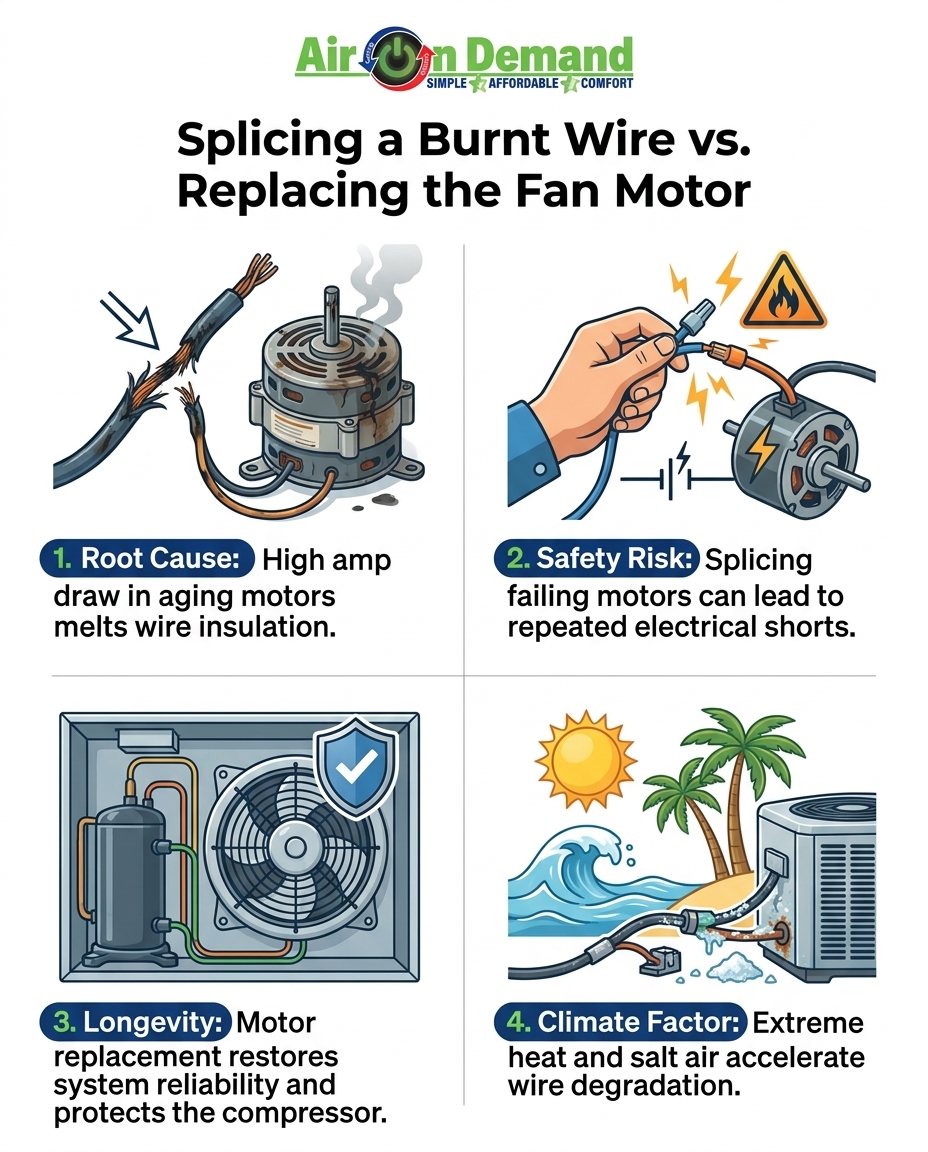
A burnt wire is usually the result of excessive electrical current generating intense heat. As fan motors age, their internal bearings wear out, forcing the motor to work harder and pull more electricity. This high amp draw causing wire overheating eventually melts the insulation, leading to a short circuit at the terminal.
Yes, a licensed professional can safely splice a wire using high-temperature connectors and weatherproofing materials. However, DIY splicing is incredibly dangerous and against building codes. Furthermore, if the motor itself is failing, a splice is only a temporary band-aid that will likely burn up again.
Common signs of a bad fan motor include a buzzing or humming sound from the outdoor unit without the blades spinning, blades that spin very slowly, or a motor casing that is excessively hot to the touch. One of our professional technicians will use a multimeter to measure the amp draw and confirm if the internal windings have failed.
Yes, replacing an aging fan motor is highly recommended to protect the rest of your system. The fan cools the compressor; if the fan fails, the compressor will overheat and suffer catastrophic damage. Replacing the motor is a smart investment in the long-term reliability of your entire AC unit.
If you hear the compressor running but the fan is dead, the electrical connection to the fan has likely been severed. This is frequently caused by a burnt wire lead, a failed run capacitor, or a completely seized motor. You should turn the system off immediately to prevent the compressor from overheating.
Not necessarily. A burnt wire isolated to the condenser fan usually means you need a new fan motor and a new run capacitor. However, if the system was left running without the fan and the compressor suffered severe damage, a full system replacement might be required.
Discovering a burnt wire inside your outdoor unit is a critical warning sign that your system needs professional attention. Especially as we transition into the early fall season, the immense thermal stress your AC has endured often reveals underlying motor issues. A melted wire is rarely just a bad connection; it is a clear indicator that your system is struggling to operate safely.
You do not have to guess whether a repair or a replacement is the right path. The experienced team at Air On Demand can perform a proper diagnostic to determine the true amp draw of your motor and identify any hidden electrical hazards. Prioritize your long-term safety and the reliability of your home's cooling system. Schedule a professional inspection with us today to weigh your options and ensure your system is prepared to keep you comfortable without the risk of sudden electrical failure.