Identifying Leaky Schrader Valves on Your Outdoor Condenser
September 23, 2026
Your air conditioner is running nonstop, but the house still feels uncomfortably warm, and you know something is wrong before the system completely freezes up. Identifying leaky Schrader valves on your outdoor condenser is often the missing piece of the puzzle when you experience a slow, frustrating loss of cooling power. At Air On Demand, a pattern we see often is homeowners immediately assuming the worst—a punctured evaporator coil or a failed compressor—when they feel their vents blowing lukewarm air. However, in our experience, the culprit is frequently much smaller and far easier to address if caught early.
If you are noticing these symptoms, scheduling prompt AC repair is the best way to protect your equipment, and our Air On Demand team provides expert Miami AC repair services to get your system back on track.
By the time we reach September, marking the transition into early fall, your cooling system has endured immense operational strain. Our technicians frequently notice that months of continuous cycling take a heavy toll on the smallest components of your outdoor unit. When refrigerant levels drop slowly over several weeks, the system has to work twice as hard to remove heat and humidity from your indoor air. This extended runtime drives up your energy bills and puts dangerous stress on the compressor motor.
A gradual cooling loss is one of the most deceptive problems a homeowner can face. Because the temperature shift happens slowly, you might not notice the decline until the hottest part of the afternoon when the system simply cannot keep up. Recognizing the physical signs of a leaky Schrader valve—specifically faint hissing or visible oil residue on the service valve—is a crucial first step in restoring your home's efficiency before a minor leak turns into a complete system breakdown.
To understand why a small leak causes such significant cooling issues, it helps to know exactly what this component does. A Schrader valve on an air conditioning condenser looks and functions almost exactly like the air valve on a car or bicycle tire. It is a small, threaded brass service port sticking out of the refrigerant lines near your outdoor unit. These ports serve as the primary access points for technicians to interact with the sealed refrigeration cycle.
Inside the brass housing of the service port sits the valve core. This core features a tiny depressor pin and a delicate rubber O-ring seal. When a professional connects their gauge manifold hoses to these ports, the hose depresses the pin, opening the valve and allowing the technician to check internal pressures, recover old refrigerant, or add new refrigerant. As soon as the hose is removed, the pin pops back up, and the rubber O-ring creates an airtight seal to keep the refrigerant securely inside the system.
While the design is simple, the operating conditions are extreme. Modern residential cooling systems utilize R-410A refrigerant, which operates at incredibly high pressures often exceeding 400 PSI on the high side of the system. This immense pressure puts constant, relentless strain on those tiny rubber seals. Furthermore, the Miami coastal environment accelerates wear on outdoor unit components. In our years of providing HVAC services across Miami, we've found that the combination of extreme internal pressure and harsh external conditions means these small valves carry a heavy burden in keeping your home comfortable.
The Problem: You start noticing a gradual decline in your air conditioner's ability to pull humidity out of the air, and the indoor temperature creeps up despite the thermostat setting. The system is low on refrigerant, but there is no obvious damage to the large copper lines or the aluminum fins.
The Cause: Schrader valve O-rings fail primarily due to a combination of severe thermal stress and environmental degradation. As your air conditioner cycles on and off throughout the summer, the refrigerant lines experience rapid temperature swings. This constant thermal expansion and contraction forces the rubber O-rings inside the valves to expand and shrink repeatedly. Over months of relentless operation, the rubber eventually loses its elasticity, turning hard and brittle. By the time September arrives at the end of peak summer stress, these weakened seals are highly susceptible to cracking and failing.
Our Air On Demand installation and repair crews know exactly how massive a role the local environment plays in the lifespan of your outdoor HVAC components. Miami's intense year-round heat, high humidity, and coastal salt air create a highly corrosive environment that prematurely ages both metal and rubber parts. Salt-laden air constantly blows across the outdoor condenser, accelerating the oxidation of the brass valve housings and drying out the internal rubber seals much faster than in inland climates. We consistently see that this coastal weathering means O-rings which might last a decade in other regions can degrade in just a few years here.
The Solution: The best defense against degraded O-rings is early detection and professional replacement. Because the rubber degrades naturally over time due to heat, pressure, and salt air, routine inspections are critical. Catching a brittle O-ring before it completely blows out prevents a total loss of refrigerant, saving the system from catastrophic compressor damage and keeping the repair simple and straightforward.
We always tell our customers that you do not need specialized gauges or technical training to spot a failing service port. In fact, visual and auditory clues are often the most reliable early warning signs. If you suspect your system is losing refrigerant, you can safely inspect the exterior of the outdoor cabinet without touching any of the electrical or pressurized components. Knowing what to look and listen for can help you understand why an AC hissing sound requires immediate attention.
• The role of refrigerant oil: Refrigerant does not travel through your system alone; it carries a specialized lubricating oil to keep the compressor motor running smoothly.
• The oily footprint: When refrigerant gas escapes through a compromised Schrader valve, it brings microscopic droplets of this oil with it.
• What to look for: Inspect the area around the brass service ports. Look for a dark, greasy spot, a wet appearance, or visible oil residue accumulating directly on or around the valve threads.
• Dust accumulation: Because the leaking oil is sticky, it quickly attracts dirt and debris. A service port that is unusually dirty or caked in grime compared to the rest of the unit is a strong indicator of a slow leak.
• The sound of escaping pressure: A compromised O-ring cannot hold back the 400+ PSI of pressure inside the lines. This creates a distinct auditory signal.
• The pitch and consistency: Listen closely to the area near the valves. A leaky Schrader valve produces a continuous, faint hissing or bubbling sound.
• Checking when off: The most reliable way to confirm this sound is to listen when the condenser fan and compressor are completely powered down. A genuine leak will continue to hiss even when the unit is not actively cycling.
These two physical signs—faint hissing or visible oil residue on the service valve—are the most definitive ways a homeowner can diagnose a potential valve failure before calling in a professional for verification.
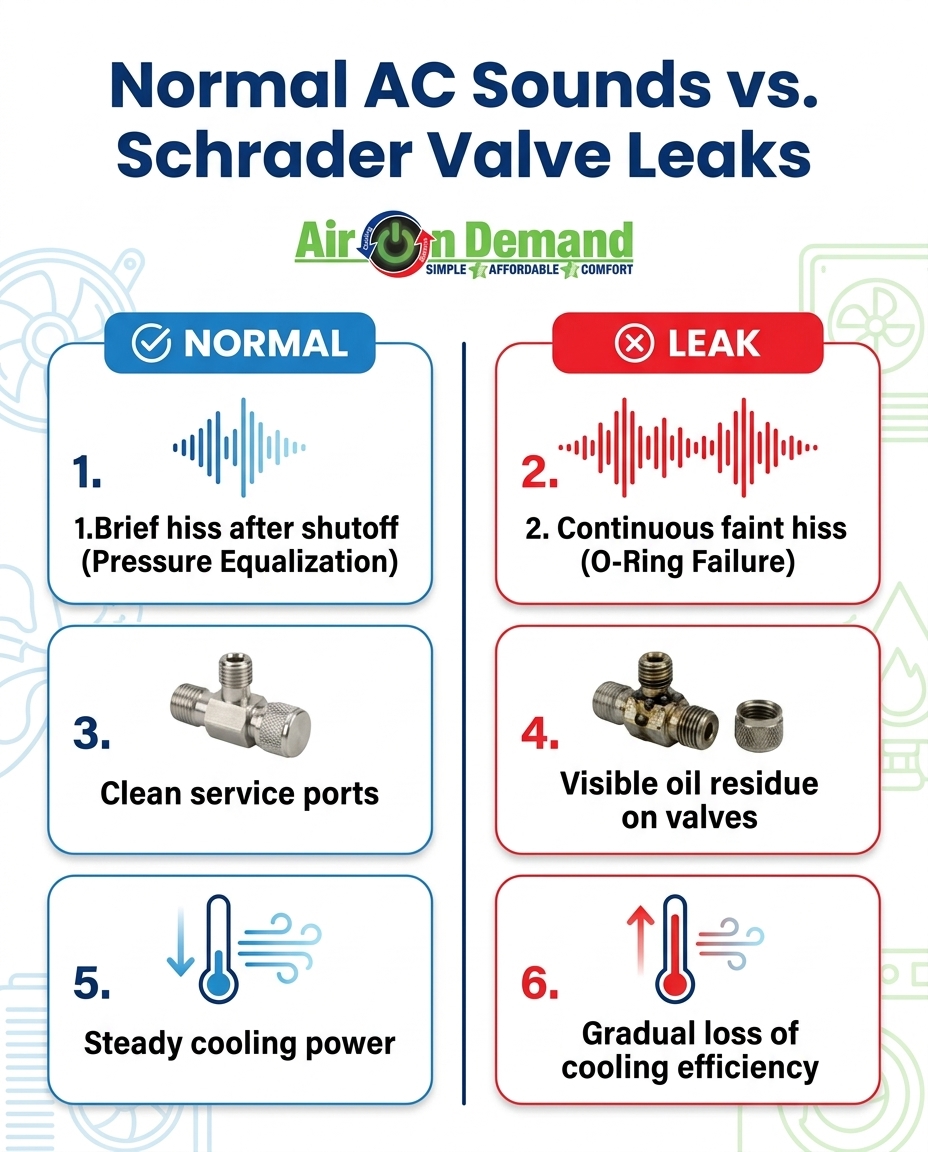
It is important to differentiate between normal operational noises and actual leaks to prevent unnecessary panic. Outdoor air conditioning units are inherently noisy machines, and they make a variety of sounds as they manage high-pressure gases. Not every hiss indicates a failing component.
• Sound Duration — Normal Pressure Equalization: Brief hiss lasting 30 to 60 seconds. — Continuous Valve Leak: Continuous, uninterrupted hissing that never stops.
• Timing of Sound — Normal Pressure Equalization: Occurs immediately after the compressor shuts off. — Continuous Valve Leak: Persists at all times, even hours after the unit is off.
• Visual Appearance — Normal Pressure Equalization: Service ports remain completely dry and clean. — Continuous Valve Leak: Visible oil residue or greasy dirt buildup on the valve.
• Cooling Performance — Normal Pressure Equalization: System maintains steady, reliable cooling power. — Continuous Valve Leak: Gradual, noticeable loss of cooling efficiency indoors.
• Cause of Sound — Normal Pressure Equalization: High and low pressures balancing inside the system. — Continuous Valve Leak: Failing rubber O-ring allowing refrigerant to escape.
Normal pressure equalization is simply the system relaxing. When the compressor turns off, the high-pressure liquid and low-pressure gas need to balance out, which pushes refrigerant through the metering device, occasionally creating a brief hissing noise. A Schrader valve leak, on the other hand, is a mechanical failure that requires intervention.
When we arrive at a home, we sometimes hear that the immediate temptation was to grab a wrench and try to tighten the port to stop the hiss. However, handling air conditioning refrigerant is absolutely not a do-it-yourself task. The extreme pressures involved and the toxicity of the chemicals make tampering with service ports incredibly dangerous for untrained individuals.
If you attempt to tighten a brittle, degraded Schrader valve with standard hand tools, you run a high risk of snapping the brass core entirely. What started as a slow, manageable leak can instantly turn into a catastrophic blowout, rapidly venting the entire refrigerant charge directly into your face and the atmosphere. This not only poses a severe freeze-burn risk to your skin and eyes but also guarantees a much more expensive repair bill.
Beyond the physical dangers, there are strict legal realities. The Environmental Protection Agency (EPA) Section 608 regulations strictly prohibit the intentional venting of refrigerants into the atmosphere due to their ozone-depleting and greenhouse gas properties. It is a legal requirement that only certified technicians recover, handle, and recharge refrigerant. Licensed professionals use specialized electronic leak detection equipment to accurately pinpoint valve leaks and safely handle refrigerant according to EPA regulations. This ensures the job is done safely and legally, which is why having a professional perform routine AC maintenance is so vital in the Miami coastal environment, where salt air accelerates wear on outdoor unit components.
Understanding the professional repair process helps demystify the situation and provides peace of mind that a leaky valve is a routine, manageable fix when caught early. You do not need to replace the entire condenser just because a tiny O-ring failed in September at the end of peak summer stress. When you call Air On Demand for AC service in Miami, our technicians follow a precise, safety-first protocol.
1. Verification and Pinpointing: The technician begins by verifying the exact source of the leak. They utilize highly sensitive electronic leak detectors (often called "sniffers") that beep when they detect refrigerant gas in the air. To confirm the exact microscopic failure point, they apply a specialized micro-bubble soap solution over the valve. If the valve is leaking, the escaping gas will blow highly visible bubbles.
2. Safe Core Removal: Once confirmed, the technician does not need to empty the entire system. They attach a specialized tool called a valve core removal tool. This device locks onto the service port and creates an airtight vacuum chamber. The technician can unscrew the broken valve core inside this chamber and extract it without losing the system's remaining refrigerant charge.
3. Installing the New Core: A brand-new valve core, complete with a fresh, pliable rubber O-ring, is inserted through the tool and threaded securely into the brass housing. The tool is then removed, and the new seal is tested with bubbles to ensure it is completely airtight.
4. Recharging and Balancing: Finally, the technician connects their digital gauges to check the system's total refrigerant charge. They will carefully weigh in the exact amount of new refrigerant needed to replace what was lost, ensuring optimal pressure levels are restored. Fixing this small component promptly prevents the compressor from overheating or the indoor evaporator coil from freezing into a block of ice.
A slow loss of cooling power can make your home miserable, but the solution is often simpler than you think. A small oily spot or a faint hissing or visible oil residue on the service valve is a clear indicator of a failing Schrader valve. While the Miami climate is tough on these small components, addressing the issue promptly means a quick, routine professional fix rather than a catastrophic system failure.
If your system is struggling to keep up and you suspect a leak, do not wait for the unit to freeze over completely. Reach out to our local experts to verify the leak, replace the degraded core, and restore your system's cooling efficiency. For prompt, professional assistance, trust the experienced team at Air On Demand and our Miami AC repair services to keep your home comfortable year-round.
How do you know if your AC Schrader valve is leaking?
The most reliable indicators are visual and auditory clues at the outdoor unit. You will typically notice a faint, continuous hissing sound coming from the brass service ports, even when the unit is off. Additionally, a leaking valve will often leave a dark, greasy spot or visible oil residue on the threads, which quickly attracts dirt and grime.
Is a hissing AC unit always a leak?
No, not every hissing sound indicates a refrigerant leak. It is completely normal to hear a brief hissing sound for 30 to 60 seconds immediately after the air conditioner shuts off, which is just the internal pressures equalizing. However, if the hiss is continuous and never stops, or if it is accompanied by a loss of cooling power, it is highly likely to be a leak.
Why do AC Schrader valves fail?
These valves fail primarily due to the degradation of the tiny rubber O-ring inside the core. Constant thermal expansion and contraction from daily use, combined with the extreme internal pressure of modern refrigerants, cause the rubber to turn brittle over time. In our daily service calls across Miami, we see harsh salt air and high heat further accelerate this wear and tear.
Can a Schrader valve cause a freon leak?
Yes, a compromised Schrader valve is one of the most common causes of slow refrigerant leaks. Because the valve's rubber O-ring is the only barrier keeping the high-pressure gas inside the system, a cracked or hardened seal will allow refrigerant to slowly seep out into the atmosphere, eventually causing the system to lose its cooling capacity.
Why is my outdoor AC unit hissing?
If your outdoor unit is hissing constantly, it usually means high-pressure refrigerant gas is escaping through a tiny opening. This is most commonly found at the Schrader valve service ports, but it can also occur if there is a pinhole leak in the copper refrigerant lines or the condenser coil itself. Any continuous hiss requires professional diagnosis.
How does coastal salt air affect outdoor AC components?
Coastal salt air creates a highly corrosive environment that rapidly accelerates the oxidation and degradation of outdoor HVAC equipment. The salt-laden moisture attacks aluminum fins, rusts steel cabinets, corrodes brass valve housings, and dries out rubber seals much faster than in non-coastal regions, making routine maintenance and early leak detection essential.