Does the Daikin Extended Warranty Cover Refrigerant Recharges?
September 23, 2026
Are you dealing with an unexpected breakdown and wondering, does the Daikin extended warranty cover refrigerant recharges? The short answer is no, the Daikin extended warranty typically does not cover refrigerant recharges. While the manufacturer's warranty is incredibly valuable for replacing defective mechanical parts, the R-410A refrigerant gas itself is classified as a consumable material and is explicitly excluded from coverage.
Discovering a refrigerant leak can be incredibly frustrating, especially during the intense heat of late summer/early fall (September) in Miami. When your system starts blowing warm air, you rely on your warranty to protect you from major out-of-pocket expenses. Finding out that you still have to pay for the refrigerant can feel like a blindside if you do not know how warranty terms are structured.
Understanding this distinction is the key to navigating your repair smoothly. By knowing exactly what your warranty includes and excludes, you can confidently approve necessary repairs and get your home cooled down faster. Whether you have a central air system or specialized Daikin equipment, the rules regarding parts versus consumables remain consistent across the board. The warranty is designed to cover the root cause of the failure, ensuring the heavy lifting of the mechanical repair is handled.
To understand why refrigerant is excluded from your warranty claim, it helps to understand how Daikin systems utilizing R-410A refrigerant operate. An air conditioner is a closed-loop system. Under normal operating conditions, refrigerant does not break, evaporate, or get "used up" like gas in a car. If your system is low on R-410A, it means there is a mechanical failure—a leak—somewhere in the copper lines or the coils allowing the gas to escape.
In the eyes of HVAC manufacturers, a "consumable" is any material required for the operation of the system that is subject to environmental loss, regular replacement, or replenishment. Just like the air filters that keep dust out of your blower motor, or the oil used in certain mechanical compressors, refrigerant is considered a working fluid rather than a structural part.
Furthermore, the current EPA AIM Act is actively phasing down the production and importation of R-410A refrigerant. This federal regulation impacts the availability of the gas and dictates strict industry handling practices for recovery and charging. Because the cost and availability of this consumable fluctuate based on environmental regulations and market supply, manufacturers universally exclude it from long-term fixed warranty contracts.
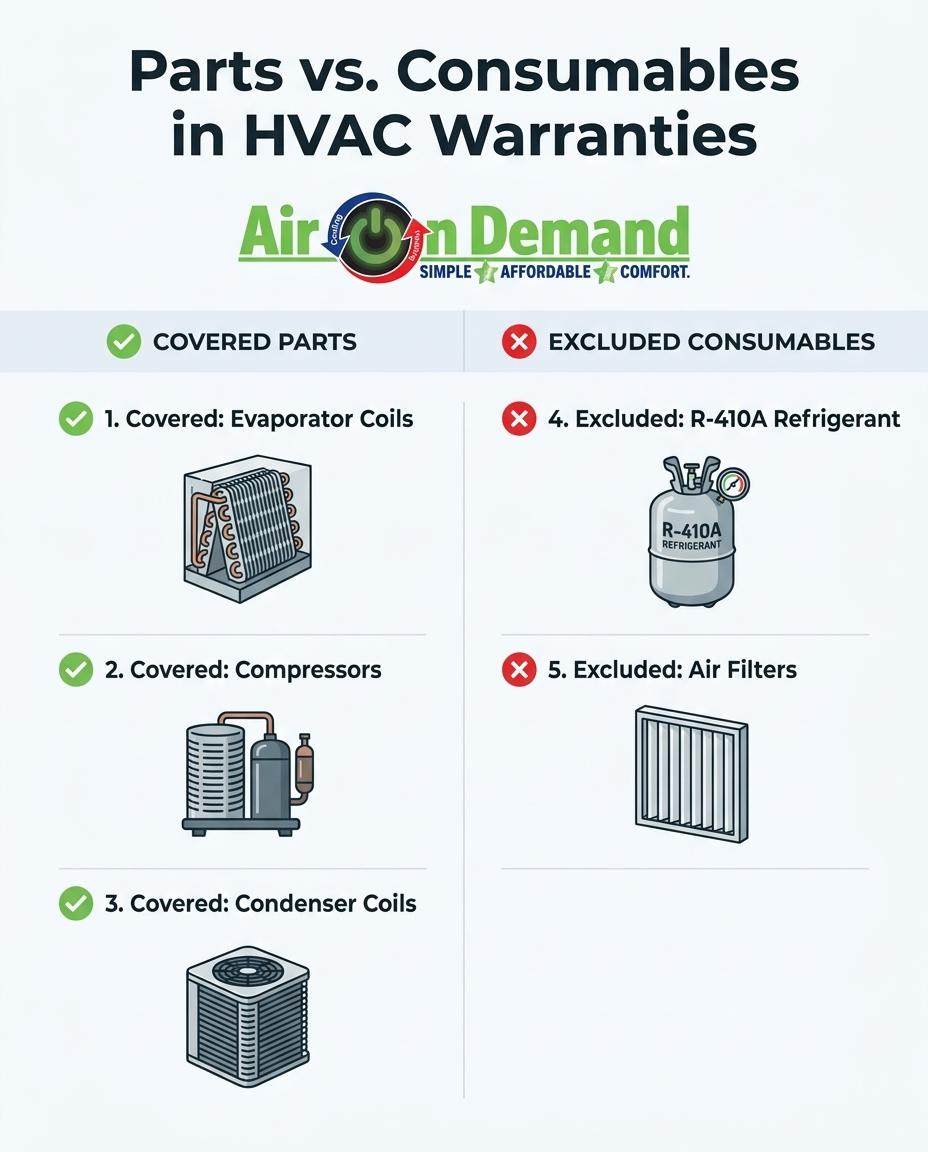
Mechanical parts have physical structures that can fail due to a manufacturer defect. If a weld breaks or a valve sticks, that is a structural failure covered by the warranty. Consumables are the materials that flow through or protect those parts.
• Mechanical Part — Examples: Evaporator Coil, Compressor, Blower Motor — Warranty Status: Covered (if registered/eligible) — Reason for Classification: Subject to manufacturing defects or structural failure.
• Consumable Material — Examples: R-410A Refrigerant, Air Filters, Lubricants — Warranty Status: Excluded (Out-of-pocket) — Reason for Classification: Working fluids or maintenance items required for operation.
Even though the R-410A gas is excluded, your Daikin warranty still provides massive value during a leak scenario. Refrigerant leaks rarely happen in easily patchable areas; they typically occur inside the intricate aluminum or copper tubing of the major coils. When this happens on eligible Daikin systems utilizing R-410A refrigerant, the warranty steps in to cover the most substantial part of the repair.
If your system is properly registered and within its warranty term, Daikin will typically provide a brand-new replacement coil at no cost for the part itself. This is true for standard split systems as well as the specific terms of a Daikin mini split warranty, which covers functional internal components like the indoor unit's coil and circuit boards.
It is important to differentiate between parts coverage and labor coverage. A standard extended parts warranty covers the physical hardware. Unless you purchased a specific extended labor plan through your dealer, the labor required for a professional to remove the broken coil, install the new one, vacuum the system, and recharge the refrigerant will be an out-of-pocket expense. However, having the expensive mechanical failure covered makes professional AC repair in Miami significantly more manageable.
Evaporator coils are a primary source of leaks in modern HVAC systems due to the constant condensation they manage. Replacing an evaporator coil is a major, labor-intensive repair. By providing the replacement coil under warranty, the manufacturer is upholding their guarantee on the structural integrity of the equipment, ensuring your system can be restored to full functionality.
You might wonder why a relatively new coil would develop a leak in the first place. The answer often lies in the local environment. South Florida's coastal, high-humidity environment accelerates the wear and tear on metal HVAC components. Airborne salts, high moisture levels, and volatile organic compounds (VOCs) inside the home interact with the condensation on your evaporator coil, creating a highly corrosive environment.
The Problem: Over time, this process—known as formicary or pitting corrosion—eats away at the metal, creating microscopic holes in the coil walls. These holes are often smaller than a pinprick, but they are large enough to allow the highly pressurized R-410A refrigerant to slowly escape into the atmosphere.
The Cause: The intense late summer/early fall (September) in Miami means your air conditioner is running almost constantly to combat the heat and humidity. This continuous operation increases the volume of condensation the coil must handle, accelerating the chemical reactions that cause corrosion.
The Solution: When a leak occurs during this peak season, immediate repair is critical to restore your indoor comfort and protect the compressor from burning out due to low refrigerant levels. While environmental wear is inevitable, scheduling routine AC maintenance helps technicians clean the coils, remove corrosive buildup, and spot early signs of oil spotting that indicate a microscopic leak is forming.
When a technician informs you that your system is low on refrigerant, the next steps are crucial. Air On Demand believes in a transparent approach to clarifying confusing warranty terms upfront, ensuring you understand exactly what you are paying for and why. Here is how to navigate a leak diagnosis on Daikin systems utilizing R-410A refrigerant:
1. Demand a Proper Leak Search: Refrigerant does not just vanish. Before approving any repair, ensure the technician performs a thorough leak search using electronic sniffers or UV dye to pinpoint the exact location of the failure.
2. Verify Warranty Coverage: Once the leaking component (usually a coil) is identified, have your contractor verify your warranty status with Daikin to confirm the replacement part is covered.
3. Fix the Root Cause: Never settle for a temporary "top off" of R-410A without a plan to fix the leak. Adding refrigerant to a leaking system is a waste of resources and harms the environment. The covered coil must be replaced to permanently solve the problem.
4. Evaluate the Repair Quote: Review the estimate knowing that the heavy lifting (the replacement coil) is covered by Daikin. The quote should clearly outline the out-of-pocket costs for the required labor, the recovery of old refrigerant, and the new R-410A consumable required to recharge the system.
5. Consider the System's Age: If your system is nearing the end of its warranty period and has multiple failing components, it might be time to discuss AC replacement services rather than investing heavily in labor and consumables for an aging unit.
To ensure your warranty remains valid for future claims, it is essential to follow the manufacturer's guidelines. Daikin, like all major HVAC manufacturers, requires that the equipment be registered shortly after installation—typically within 60 days—to activate the full extended warranty term. Failing to register the equipment often reverts the coverage to a shorter base term.
Furthermore, all repairs, leak searches, and refrigerant recharges must be performed by licensed, qualified HVAC professionals. Attempting DIY repairs or hiring unlicensed handymen to handle R-410A is not only dangerous and illegal under EPA regulations, but it will instantly void your manufacturer warranty.
Finally, standard upkeep is a condition of your warranty. Manufacturers expect the equipment to be kept clean and operational. Neglecting basic care, such as running the system with severely clogged filters or completely ignoring annual tune-ups, can lead to claim denials. In fact, skipping annual maintenance can void your Daikin warranty if the manufacturer determines that the part failed due to neglect rather than a factory defect.
Generally, no. Most manufacturer extended warranties cover the mechanical parts that failed, but explicitly exclude the refrigerant gas. Because refrigerant is a working fluid that escapes due to a leak rather than a structural part that breaks, it is classified as a consumable and remains an out-of-pocket expense.
It typically covers functional internal parts like the compressor, circuit boards, and indoor coils for a specified term, provided the system was registered and properly maintained. It does not cover the external copper line sets connecting the indoor and outdoor units, the labor to replace the parts, or the R-410A refrigerant needed to recharge the system after a repair.
No, R-410A is classified as a consumable material required for operation, not a mechanical part subject to manufacturing defects. Daikin systems utilizing R-410A refrigerant require this gas to transfer heat, but the gas itself is excluded from warranty replacement, even if it was lost due to a covered part failing.
The 12-year limited parts warranty generally covers all functional mechanical parts, including the compressor, evaporator coil, and condenser fan motor, when the system is registered within the required timeframe. It guarantees that if these physical components fail due to a factory defect, the manufacturer will provide a replacement part.
Third-party home warranties vary wildly; some may cover a limited amount of refrigerant per claim, while others exclude it entirely. This is entirely separate from a Daikin manufacturer warranty. You must read your specific home warranty contract to see if they cap the coverage for consumables like R-410A.
Depending on the specific model and whether it was registered on time, Daikin compressor warranties can range from 10 to 12 years. Some premium, high-efficiency units even offer a lifetime limited warranty on the compressor for the original registered homeowner. However, replacing a covered compressor will still require an out-of-pocket recharge of the excluded refrigerant.
Dealing with an air conditioning breakdown during late summer/early fall (September) in Miami is stressful enough without getting caught off guard by confusing warranty terms. Understanding the difference between covered mechanical parts and excluded consumables like R-410A brings peace of mind, allowing you to move forward with the necessary repairs without hesitation.
When you suspect a leak, it is vital to rely on a trusted local expert who can properly diagnose the issue, locate the exact source of the escaping gas, and navigate the warranty claim process on your behalf. Don't settle for temporary top-offs that ignore the root cause of the problem. Schedule a comprehensive diagnostic inspection today to identify the leak, claim your covered replacement parts, and restore your home's comfort efficiently and correctly.